Following is a Ukrainian Orthodox icon of the Transfiguration by Ivan Rutkovych (c. 1650 – c. 1708) (for the Church of Christ’s Nativity in Zhovkva, Ukraine, today in the Lviv National Museum).
Orthodox Icons are not drawings or creations of imagination. They are in fact writings of things not of this world. Icons can represent our Lord Jesus Christ, the Virgin Mary, and the Saints. They can also represent the Holy Trinity, Angels, the Heavenly hosts, and even events. Orthodox icons, unlike Western pictures, change the perspective and form of the image so that it is not naturalistic. This is done so that we can look beyond appearances of the world, and instead look to the spiritual truth of the holy person or event. (Source )
Retrotraducciones en español (haga clic o pulse aquí)
Seis días después Jesús llamó a que vinieran Pedro, Jacobo y Juan. Jesús subió y los tres discípulos fueron con él a un lugar en las montañas donde no había gente.
Los discípulos vieron con sus propios ojos que la cara y la ropa de Jesús se cambiaron a un blanco brilloso, no blanco como ropa lavada, sino diferente, un blanco muy brilloso que brillaba sobre ellos.
Vieron Elías y Moisés hablando con Jesús. Los tres discípulos se asustaron y se volvieron miedosos.
Pedro quería decir algo pero no sabía cómo. Dijo: “Maestro, está bien, suficiente, nosotros tres tiremos ramas de los árboles y hagamos tres tiendas para uds, ¿qué te parece?”
Vieron una nube bajando y la voz de Dios (dijo): “Este es mi hijo amado, pongan atención a él, Jesús.” Y la nube desapareció.
Los discípulos vieron sólo a Jesús parado. Después Jesús bajó caminando y los tres discípulos bajaron también.
Jesús les advirtió: “Lo que vieron ahorita no lo cuenten a otras personas, guarden silencio, es un secreto.
Cuando vean al Hijo de Hombre resucitado del muerto, pueden contarlo, ahorita todavía no lo cuenten.”
Six days later Jesus called Peter, James and John to come and he walked up and the three disciples went with him to a place in the mountains where there were no people.
The disciples saw with their own eyes that the face and the clothes of Jesus changed to a shining white, not white like clothes that have been washed, but different, a very shining white that shone on them.
They saw Elijah and Moses talking with Jesus. The three disciples were shocked and became afraid.
Peter wanted to say something but did not know how. He said: “Teacher, it is well, sufficient, let us three break branches from the trees and make three tents for you, what do you think?”
They saw a cloud coming down and the voice of God (said): “This is my beloved son, pay attention to him, Jesus.” And the cloud disappeared.
The disciples saw only Jesus standing there. Then Jesus walked down and the three disciples went down as well.
Jesus warned them: “That which you just saw, don’t tell it to other people, keep silent, it is a secret.
“When you see the Son of Man risen from the dead you can tell, but right now don’t tell it yet.”
The three disciples agreed to keep it secret and Jesus walked on down, and the disciples also went down. They said to each other: “What would resurrection mean?” “I don’t understand.” “Me neither.”
As they were walking they thought of something and said: “Jesus, we ask you, why do the teachers of the Law tell us that Elijah will come first and then the Christ?”
Jesus (answered): “This is true, first comes Elijah to prepare things and make them ready for Christ to come.”
“But Elijah has already come and the people were against him and Elijah suffered exactly as is written in the scroll.
“In the same way the Son of Man will suffer and be rejected by the people.”
Six days had passed. Jesus took three disciples with Him – Peter, James, John — and they went up a high mountain. There on the mountain, no one was there, just the four of them. And then Jesus’ appearance began to change. His clothes became shiny. His clothes became white as snow. There is no such white color on earth. And no one can wash clothes like that. Then Moses and Elijah appeared. Both of them talked with Jesus.
The disciples were amazed. Peter turned to Jesus:
— Teacher! It is so good here! Let’s make three tents: one for you, Jesus, one for Moses and one for Elijah.
Suddenly a cloud came down from the sky. It covered them. God’s voice came out of the cloud, “Jesus is my beloved son! Listen to him!”
The disciples were amazed. They began to look and suddenly saw Jesus standing alone. Moses and Elijah had disappeared.
Original Russian back-translation (click or tap here):
Прошли шесть дней. Иисус взял с собой троих учеников — Петра, Иаков, Иоанна — и они взошли на высокую гору. Там на горе, никого не было, только они вчетвером. И тут облик Иисуса начал изменяться. Его одежды заблестели. Его одежда стала белой как снег. На земле такого белого цвета нет. И никто не может так выстирать одежды. После этого явился Моисей и Илия. Оба они беседовали с Иисусом.
Ученики были поражены. Петр обратился к Иисусу:
— Учитель! Здесь так хорошо! Давай сделаем три шалаша: один — для тебя, Иисус, один — для Моисея и один — для Илии.
Вдруг с неба спустилось облако. Оно покрыло их. Из облака раздался голос Бога: «Иисус — он мой любимый сын! Слушайте его!»
Ученики были поражены. Они стали смотреть и вдруг увидели, что Иисус стоит один. Моисей и Илия исчезли.
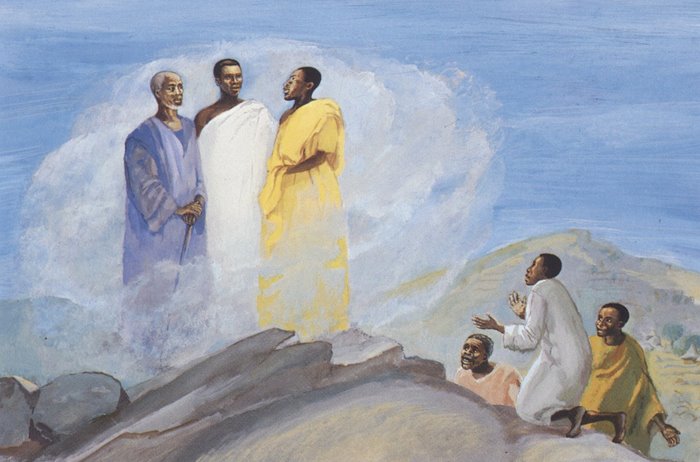
Following is a 1973 painting of the JESUS MAFA project, a response to New Testament readings from the Lectionary by a Christian community in Cameroon, Africa. Each of the readings was selected and adapted to dramatic interpretation by the community members. Photographs of their interpretations were made, and these were then transcribed to paintings:
In this theatrical representation of Jesus’ transfiguration, Jesus is robed in a dazzling white garment, as the story in the gospels describes. He appears to be greeting Moses and Elijah like old friends as they are surrounded by a cloud that makes the whole scene feel ethereal. Peter, James, and John look on with flabbergasted and fearful expressions, bewildered at what they should do. This painting invites the viewer to imagine what it would be like to have seen such amazing things. Undoubtedly, it would inspire one to follow and obey Jesus, just as God commands in the story: “This is my son, the beloved. Listen to him!”
From Art in the Christian Tradition, a project of the Vanderbilt Divinity Library, Nashville, TN. Image retrieved March 23, 2026. Original source: librairie-emmanuel.fr.
Following are a number of back-translations of Mark 9:8:
Uma: “All of a sudden, they looked around, there were no longer any other people with them, just Yesus alone.” (Source: Uma Back Translation)
Yakan: “So-then, when they looked around, suddenly they didn’t see anything else, except Isa.” (Source: Yakan Back Translation)
Western Bukidnon Manobo: “Then the disciples looked around, but they could no longer see any other person, for Jesus again was their only companion.” (Source: Western Bukidnon Manobo Back Translation)
Kankanaey: “They immediately-looked-up, but there was no other whom they saw except Jesus alone.” (Source: Kankanaey Back Translation)
Tagbanwa: “Suddenly/unexpectedly again, when those disciples looked around, they saw nobody else with them, only Jesus.” (Source: Tagbanwa Back Translation)
The Greek Iēsous is “only” a proper name but one with great importance. The following quote by John Ellington (in The Bible Translator1993, p. 401ff. ) illustrates this:
“In Matthew’s account of the birth of Jesus Christ, Joseph is told that when Mary gives birth to a son ‘you will name him Jesus, because he will save his people from their sins’ (1:21). This name is a Greek transliteration of the Hebrew name [Yeshua (יֵשׁוּעַ) which is a short form of a name meaning] ‘the Lord [Yahweh] saves.’ The name is very significant and is in itself especially dear to Christians around the world. (…) Unquestionably great importance is attached to the name of Jesus by Christians of all persuasions and backgrounds.”
While Iēsous (pronounced: /i.ɛː.suːs/) is transliterated as “Jesus” (pronounced /ˈdʒiːzəs/) in English (but was translated as “Hælend” [the “healing one”] in Old English — see Swain 2019) it is transliterated and pronounced in a large variety of other ways as well, following the different rules of different languages’ orthographies, writing systems and rules of pronunciation. The following is a (partial) list of forms of Jesus in Latin characters: aYeso, Azezi, Boiyesuq, Cecoc, Chesús, Chi̍i̍sū, Chisɔsi, Ciisahs, Ciise, Ciisusu, Djesu, Ɛisa, Ƹisa, Eyesu, Gesù, Gesû, Gesü, Ġesù, Ghjesù, Giêsu, ꞌGiê‑ꞌsu, Giê-xu, Gyisɛse, Hesu, Hesús, Hisus, Hisuw, Ià-sŭ, Iesen, Ié:sos, Iesu, Iesui, Iesusɨn, Iesusiva, Ié:sos, Ihu, Īhu, Iisus, Iisussa, Ijeesu, iJisọsị, Iji̍sɔ̄ɔsi, Iosa, Íosa, Ìosa, İsa, I’sa, Isiso, Isõs, Ísu, Isus, Isusa, Iisussa, Isuthi, Itota, Îtu, Isuva, Izesu, Izesuq, Jasus, Jeeju, Jeesus, Jeesuse, Jeezas, Jehu, Jeisu, Jeju, Jejus, Jesesi, Jeshu, Jeso, Jesoe, Jesosa, Jesoshi, Jesosi, Jesosy, Jesu, Jesû, Jesua, Jesuh, Jesuhs, Jesuo, Jesús, Jésus, Jesúsu, Jethu, Jetsóó, Jezed, Jezi, Jézi, Ježiš, Jezu, Jezus, Jézus, Jėzus, Jēzus, Jezusi, Jėzus, Jezuz, Jiijajju, Jíísas, Jiisusi, Jiizas, Jíìzọ̀s, Jisas, Jisase, Jisasi, Jisasɨ, Jisaso, Jisesi, Jisɛ̀, Jisos, Jisọs, Jisɔs, Jisu, Jiszs, Jizọs, Jizɔs, Jizọsi, Jizọsu, Jòso, Jusu, Jweesus, Ketsutsi, Njises, ọYẹsọ, Sesi, Sisa, Sísa, Sisas, Sises, Sīsū, Sizi, Txesusu, uJesu, Ujísɔ̄si, ŵaYesu, Xesosi, ´Xesús, Xesús, Yasu, Ya:su, yasuɛ, Yasuuⓐ, Ɣaysa, Yecu, Yeeb Sub, Yeeh Suh, Yeesey, Yeeso, Yeesso, Yēēsu, Yehsu, Yëësu, Yeiqsul, Yeisu, Yeisuw, Yeshu, Yē shú, Yeso, Yéso, Yesò, Yëso, Yɛso, ye-su, Yésu, Yêsu, Yẹ́sụ̃, Yěsù, Yésʉs, Yeswa, Yet Sut, Yetut, Yexus, Yezo, Yezu, Yiesu, Yiisa, Yiisu, Yiitju, Yis, Yisɔs, Yisufa, Yitati, Yusu, ‑Yusu, :Yusu’, Zeezi, Zezi, Zezì, Zezuz, Zezwii, Ziizɛ, Zisas, Zîsɛ, Zjezus, Zozi, Zozii, and this (much more incomplete) list with other writings systems: ᔩᓱᓯ, ᒋᓴᔅ, Հիսուս, ᏥᏌ, ኢየሱስ, ያሱስ, ܝܫܘܥ, Ісус, Їисъ, 耶稣, იესო, ईसा, イエス, イイスス, イエスス, 예수, येशू, येशो, ਈਸਾ, ພຣະເຢຊູ, ජේසුස්, যীশু, ଯୀଶୁ, ཡེ་ཤུ་, ‘ঈছা, இயேசு, ಯೇಸು, ພຣະເຢຊູ, ယေရှု, ઇસુ, जेजू, येसु, เยซู, យេស៊ូ, ᱡᱤᱥᱩ, ယေသှု, యేసు, ᤕᤧᤛᤢ᤺ᤴ, އީސާގެފާނު, ਯਿਸੂ, ꕉꖷ ꔤꕢ ꕞ, ⵏ⵿ⵗⵢⵙⴰ, ଜୀସୁ, يَسُوعَ,ㄧㄝㄙㄨ, YE-SU, ꓬꓰ꓿ꓢꓴ, 𖽃𖽡𖾐𖼺𖽹𖾏𖼽𖽔𖾏, ꑳꌠ, ᠶᠡᠰᠦᠰ (note that some of these might not display correctly if your device does not have the correct fonts installed).
Click or tap here to read more.
In some languages the different confessions have selected different transliterations, such as in Belarusian with Isus (Ісус) by the Orthodox and Protestant churches and Yezus (Езус) by the Catholic church, Bulgarian with Iisus (Иисус) by the Orthodox and Isus (Исус) by the Protestant church, Japanese with Iesu (イエス) (Protestant and Catholic) and Iisusu (イイスス) (Orthodox), or Lingala with Yesu (Protestant) or Yezu (Catholic). These differences have come to the forefront especially during the work on interconfessional translations such as one in Lingala where “many hours were spent on a single letter difference” (source: Ellington, p. 401).
In Literary and Mandarin Chinese where transliterations of proper names between the Catholic and Protestant versions typically differ vastly, the Chinese name of Jesus (Yēsū 耶稣) remarkably was never brought into question between and by those two confessions, likely due to its ingenious choice. (Click or tap here to see more).
The proper name of God in the Old Testament, Yahweh (YHWH), is rendered in most Chinese Bible translations as Yēhéhuá 耶和華 — Jehovah. According to Chinese naming conventions, Yēhéhuá could be interpreted as Yē Héhuá, in which Yē would be the family name and Héhuá — “harmonic and radiant” — the given name. In the same manner, Yē 耶 would be the family name of Jesus and Sū 稣 would be his given name. Because in China the children inherit the family name from the father, the sonship of Jesus to God the Father, Jehovah, would be illustrated through this. Though this line of argumentation sounds theologically unsound, it is indeed used effectively in the Chinese church (see Wright 1953, p. 298).
Moreover, the “given name” of Sū 稣 carries the meaning ‘to revive, to rise again’ and seems to point to the resurrected Jesus. (Source: J. Zetzsche in Malek 2002, p. 141ff., see also tetragrammaton (YHWH))
There are different ways that Bible translators have chosen historically and today in how to translate the name of Jesus in predominantly Muslim areas: with a form of the Arabic Isa (عيسى) (which is used for “Jesus” in the Qur’an), the Greek Iēsous, or, like major 20th century Bible translations into Standard Arabic, the Aramaic Yēšūaʿ: Yasua (يَسُوعَ). (Click or tap here to see more.)
Following are languages and language groups that use a form of Isa include the following (note that this list is not complete):
In Indonesian, while most Bible translations had already used Yesus Kristus rather than Isa al Masih, three public holidays used to be described using the term Isa Al Masih. From 2024 on the government is using Yesus Kristus in those holiday names instead (see this article in Christianity Today ).
Some languages have additional “TAZI” editions (TAZI stands for “Tawrat, Anbiya, Zabur, and Injil” the “Torah, Prophets, Psalms and Gospel”) of the New Testament that are geared towards Muslim readers where there is also a translation in the same language for non-Muslims. In those editions, Isa is typically used as well (for example, the Khmer TAZI edition uses Isa (អ៊ីសា) rather than the commonly used Yesaou (យេស៊ូ), the Thai edition uses Isa (อีซา) rather than Yesu (เยซู), the Chinese edition uses Ěrsā (尔撒) vs. Yēsū (耶稣), and the English edition also has Isa rather than Jesus.)
In German the name Jesus (pronounced: /ˈjeːzʊs/) is distinguished by its grammatical forms. Into the 20th century the grammatical rules prescribed a unique Greek-Latin declination: Jesus (nominative), Jesu (genitive, dative, vocative), Jesum (accusative), from which today only the genitive case “Jesu” is still in active use. Likewise, in Seediq (Taroko), the morphological treatment of “Jesus” also occupies a special category by not falling under the normal rule of experiencing a vowel reduction when the object-specific suffix an is added “since it was felt that the readers might resent that the name has been changed that drastically.” (Compare Msian for “Moses” (Mosi) as an object, but Yisuan for “Jesus” (Yisu).) (Source: Covell 1998. p. 249)
In Lamba the name ŵaYesu consists of a transliteration Yesu and the prefix ŵa, a plural form for “proper names when addressing and referring to persons in any position of seniority or honor.” While this was avoided in early translations to avoid possible misunderstandings of more than one Jesus, once the church was established it was felt that it was both “safe” and respectful to use the honorific (pl.) prefix. (Source C. M. Doke in The Bible Translator 1958, p. 57ff. )
In virtually all sign languages, “Jesus” is signed with the middle finger of each hand pointing to the palm (or wrist) of the other in succession (signing the nails of the cross). In the context of Bible translation this has been pointed out as theologically problematic since the “semantic connections of the original name Jesus do point towards ‘salvation,’ they do not naturally lead to crucifixion.” (Source: Phil King in Journal of Translation 1 (2020), p. 33ff.)
Following is the oldest remaining Ethiopian Orthodox icon of Jesus from the 14th or possibly 13th century (found in the Church of the Saviour of the World in Gurji, Ethiopia). As in many Orthodox icons, Jesus’ right hand forms the Greek letters I-C-X-C for IHCOYCXPICTOC or “Jesus Christ.” Another interpretation of the right hand is that it shows three fingers pointing to the Trinity, while the two other fingers point to Jesus’ two natures.
Orthodox icons are not drawings or creations of imagination. They are in fact writings of things not of this world. Icons can represent our Lord Jesus Christ, the Virgin Mary, and the Saints. They can also represent the Holy Trinity, Angels, the Heavenly hosts, and even events. Orthodox icons, unlike Western pictures, change the perspective and form of the image so that it is not naturalistic. This is done so that we can look beyond appearances of the world, and instead look to the spiritual truth of the holy person or event. (Source )
The following is the so-called “Wales Window for Alabama.” It is a stained-glass window by the artist John Petts from Carmarthenshire, Wales, created in response to the 16th Street Baptist Church bombing which took place in 1963:
Stained glass is not just highly decorative, it’s a medium which has been used to express important religious messages for centuries. Literacy was not widespread in the medieval and Renaissance periods and the Church used stained glass and other artworks to teach the central beliefs of Christianity. In Gothic churches, the windows were filled with extensive narrative scenes in stained glass — like huge and colorful picture storybooks — in which worshipers could ‘read’ the stories of Christ and the saints and learn what was required for their religious salvation. (Source: Victoria and Albert Museum )
The style of the following drawing of Jesus by Annie Vallotton is described by the artist as this: “By using few lines the readers fill in the outlines with their imagination and freedom. That is when the drawings begin to communicate.” (see here ; see also We All are One in Christ)
Illustration by Annie Vallotton, copyright by Donald and Patricia Griggs of Griggs Educational Service.
Instead of ei mē ‘except’ of Westcott and Hort, Souter, Nestle, Lagrange, and Taylor, alla ‘but’ is read by Textus Receptus, Tischendorf, Soden, Vogels, Kilpatrick, and Merk.
Instead of ei mē (or alla) ton Iēsoun monon meth’ heautōn ‘except (or, but) Jesus alone with them’ of Nestle, Souter, Textus Receptus, Tischendorf, Soden, Vogels, and Merk, the order of words is changed to meth’ heautōn ei mē ton Iēsoun monon ‘with them except Jesus alone’ in Westcott and Hort, Lagrange, Taylor (cf. Kilpatrick).
Exegesis:
exapina (only here in the N.T.) ‘suddenly,’ ‘unexpectedly,’ ‘abruptly.’
periblepsamenoi (cf. 3.5) ‘looking around.’
monon ‘only,’ ‘alone’: an adjective, modifying Iēsoun ‘Jesus,’ not an adverb modifying eidon ‘they saw.’
Translation:
They must be translated to refer to the disciples.
In some languages, the dependent participial construction suddenly looking around must be made into an independent or at least coordinate phrase, for it is obviously a more important aspect of the process than the negative statement which follows. Accordingly, one may translate ‘they suddenly looked around and could no longer see any one….’
But Jesus only may be translated as ‘no one except Jesus; there was no one else.’
Quoted with permission from Bratcher, Robert G. and Nida, Eugene A. A Handbook on the Gospel of Mark. (UBS Handbook Series). New York: UBS, 1961. For this and other handbooks for translators see here .
Suddenly: There are two interpretations as to which verb the word Suddenly is connected:
(1) The word Suddenly is connected with the verb saw. They looked around, then they suddenly saw that Elijah and Moses were already gone. (This interpretation is made clear in Matthew. The disciples were at first afraid to look up. When Jesus touched them and they looked around, they suddenly noticed that Elijah and Moses were no longer there.)
For example, the New Jerusalem Bible says:
Then suddenly, when they looked around, they saw no one
(Berean Standard Bible, New International Version, New Jerusalem Bible, New Revised Standard Version, NET Bible, King James Version, God’s Word, English Standard Version)
(2) The word Suddenly is connected with the verb looked around. As soon as the disciples heard the voice, they suddenly looked around. For example, the New Century Version says:
Suddenly Peter, James, and John looked around
(Good News Bible, Revised Standard Version, New American Standard Bible, Contemporary English Version, New Century Version, Phillips’ New Testament in Modern English)
It is recommended that you follow interpretation (1).
they: The pronoun they refers to the three disciples. For example, the New Century Version says:
Peter, James, and John
looked around: The verb looked around means “looked in several different directions.” Although the disciples expected to see Moses and Elijah, they only saw Jesus. Use a natural expression for that meaning.
9:8b
they saw no one with them except Jesus: The words saw no one…except Jesus indicates that Elijah and Moses were gone and the disciples saw only Jesus.
Here are some other ways to translate this:
Moses and Elijah were gone, and they saw only Jesus with them (New Living Translation) -or-
they saw only Jesus (Contemporary English Version) -or-
but they saw only Jesus there alone with them (New Century Version)
Made available under the terms of a Creative Commons Attribution-ShareAlike 4.0 License (CC BY-SA) creativecommons.org/licenses/by-sa/4.0
All Scripture quotations in this publication, unless otherwise indicated, are from The Holy Bible, Berean Standard Bible.
BSB is produced in cooperation with Bible Hub, Discovery Bible, OpenBible.com, and the Berean Bible Translation Committee.




Leave a Reply
You must be logged in to post a comment.