
The Greek that is translated as “a man whose name was Joseph” in English is translated in Nkumbi as “Joseph.” Riikka Halme-Berneking (in The Bible Translator 2014, p. 353ff. ) explains: “Recently, two Nkumbi translators realized they could not use the word omulume ‘man’ in Luke 1:27 where Mary is engaged to ‘a man called Joseph’ because it would imply that Joseph already was a married man and he would marry yet another woman, Mary. Another word, omumati ‘boy,’ would have to be used instead. However, without any specific information about Joseph’s age and marital status, it was decided that it was best not to take a stance on one or the other, and thus the word ‘man’ was left untranslated.”
betrothed, engaged
The Greek that is translated as “engaged” or “betrothed” in English is translated in Pampanga as “having-been-given-approval” and Tagalog as “having-been-brought-before-the authorities” (both implying a couple which has already applied to the local civil registrar or priest for a license to marry). Tboli uses “braceleted” (a figurative expression for the giving of property for the dowry, an act that finalizes the marriage contract) and Uab Meto has “publicly pledged to marry (lit. “reciprocally-bound”)” (a term indicating that an interchange of gifts as a pledge for marriage has taken place).
Annunciation to Mary (icon)
Following is a Serbian Orthodox icon of the Annunciation to Mary from the 14th century (found in the Church of Theotokos the Perivleptos, Ohrid, today in the National Museum of Serbia).


Orthodox Icons are not drawings or creations of imagination. They are in fact writings of things not of this world. Icons can represent our Lord Jesus Christ, the Virgin Mary, and the Saints. They can also represent the Holy Trinity, Angels, the Heavenly hosts, and even events. Orthodox icons, unlike Western pictures, change the perspective and form of the image so that it is not naturalistic. This is done so that we can look beyond appearances of the world, and instead look to the spiritual truth of the holy person or event. (Source )
Tibbs (2025, p. 51ff.) writes about the annunciation icon: “The archangel is seen entering from the left, moving toward the right, which is the typical direction of narrative action in icons. One reason for this is that the icon is read similarly to the Greek text in the New Testament, from left to right.
“The are no walls in the icon to suggest that Gabriel had entered an indoor space, as would have been presser in naturalistic art. The absence of enclosing walls in iconography is also intentional since the icon has no dimension or physical boundaries. There is no light source, and therefore, there are no shadows. The absence of both walls and light sources serves to convey that the event itself expands beyond its natural earthbound limits. Evdokimov writes that the icon is ‘never a window on nature,’ not even on a specific place, ‘but rather an opening onto the beyond.’
“It is the red drape that sets the scriptural event within its actual indoor historical setting, with the color red representing the earthly setting of this event. The red drape affirms that this event took place at a specific moment in history, in a specific indoor space in Nazareth, between a specific angel, Gabriel, and a specific young woman, Mary, in the ‘sixth month’ after Elizabeth conceived (Luke 1:26-27, 36). Yet the icon goes beyond the historical setting to encompass the cosmic significance of this event: the eternal God enters human history.”
Joseph (of Nazareth)
The name that is transliterated as “Joseph” in English is translated in Finnish Sign Language with the sign signifying “woodworker” (referring to Mark 6:3). (Source: Tarja Sandholm)
“Joseph” in Finnish Sign Language (source )
In French Sign Language it is translated with a sign that combines the letter J and adoption (of Jesus):
“Joseph” in French Sign Language (source: La Bible en langue des signes française )
For more information on translations of proper names with sign language see Sign Language Bible Translations Have Something to Say to Hearing Christians .
Learn more on Bible Odyssey: Joseph, Husband of Mary .
complete verse (Luke 1:27)
Following are a number of back-translations of Luke 1:27:
- Noongar: “He brought God’s words for a young girl. Her people had given her to become Joseph’s wife. This man was a descendant of King David. The girl’s name was ‘Mary’.” (Source: Warda-Kwabba Luke-Ang)
- Uma: “to meet a young woman named Maria. That young woman was engaged to a young man named Yusuf, a descendant of King Daud long ago.” (Source: Uma Back Translation)
- Yakan: “He was told to go to a certain virgin called Mariyam. This Mariyam was betrothed to a man called Yusup, a descendant of King Da’ud ley.” (Source: Yakan Back Translation)
- Western Bukidnon Manobo: “The one he was sent to was a virgin named Mary. And as for this Mary, she was promised to a young man named Joseph. And as for this Joseph, he was a descendent of the king long ago David.” (Source: Western Bukidnon Manobo Back Translation)
- Kankanaey: “Because he had something to say to a young-lady who was a virgin (lit. whom no one had touched) who was engaged to be married to Jose a descendant of the former King David. The name of that young-lady was Maria.” (Source: Kankanaey Back Translation)
- Tagbanwa: “He was caused to go to a still single girl/woman whose name was Maria, whose marriage to Jose had been agreed upon but wasn’t finalized yet, still being in-the-works. As for that Jose, he was indeed a descendant of past King David.” (Source: Tagbanwa Back Translation)
Mary (mother of Jesus)
The name that is transliterated as “Mary” in English means “bitterness,” “rebellious,” obstinate.” (Source: Cornwall / Smith 1997 )
It is translated in Spanish Sign Language with arms folded over chest which is the typical pose of Mary in statues and artwork. (Source: John Elwode in The Bible Translator 2008, p. 78ff. )
“Mary” in Spanish Sign Language, source: Sociedad Bíblica de España
In American Sign Language it is translated with a sign for the letter M and the sign for “virgin,” which could also be interpreted as “head covering,” referring to the way that Mary is usually portrayed in art works. (Source: Ruth Anna Spooner, Ron Lawer)
“Mary” in American Sign Language, source: Deaf Harbor
In Hungarian Sign Language the sign is based on historical images, referring to the veil covering her head: the earliest depictions of Mary (dating back to the 2nd century) already portray her wearing a headscarf or a veil. Its sign in sign language refers to the veil because, within Christian culture, this is her most recognizable visual attribute, distinguishing her from other biblical figures. (Source: Jenjelvi Biblia and HSL Bible Translation Group)
“Mary” in Hungarian Sign Language (source )
For more information on translations of proper names with sign language see Sign Language Bible Translations Have Something to Say to Hearing Christians .
In the Burmese Common Language Version (publ. 2005), Mary is described as a king’s mother by using the royal noun suffix taw / တော် with the word “mother” in Matthew 1:16 and Luke 2:33. This is done to highlight the status of Jesus as a king or the divine Son. Othjer passages where taht is used include Matthew 2:11, 13, 14, 20, and 21. (Source: Gam Seng Shae in The Bible Translator 2002, p. 202ff. ) See also Jesus’ human vs. divine nature in modern Burmese translation.
In some Semitic languages, the transliteration for “Mary” is identical to the one for the prophetess “Miriam,” testifying to the fact that these names are identical (Arabic and the many translations that are reliant on Arabic: مَرْيَم, Hebrew: מִרְיָם, Ge’ez / Amharic and related languages: ማርያም).
Learn more on Bible Odyssey: Mary in Latin America and the Caribbean and Mary, the Mother of Jesus .
Annunciation

Image taken from the Wiedmann Bible. For more information about the images and ways to adopt them, see here . For other images of Willy Wiedmann paintings in TIPs, see here.
Following is a contemporary tempera / gouache on leather painting by an unknown Ethiopian artist:

Source: Sacred Art Pilgrim website .
Following is a painting (“Annunciation”) by He Qi:
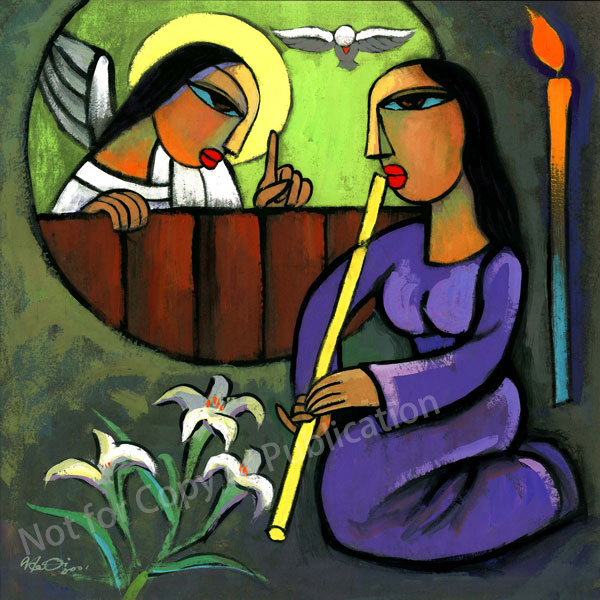
He Qi © 2021 All Rights Reserved.
Image taken from He Qi Art . For purchasing prints of this and other artworks by He Qi go to heqiart.com . For other images of He Qi art works in TIPs, see here.
Following is an artwork by Sister Marie Claire , SMMI (1937–2018) from Bengaluru, India:

(Note that supernatural beings are always portrayed with this type of upraised scarf and white circle.)
For more information about images by Sister Marie Claire and ways to purchase them as lithographs, see here . For other images of Sister Marie Claire paintings in TIPs, see here.
The following is a contemporary stained glass window from Our Lady of Pity in Swaffham, United Kingdom:

Source: Art in the Christian Tradition , a project of the Vanderbilt University Divinity Library, Nashville, TN. Original source: Wikimedia

Stained glass is not just highly decorative, it’s a medium which has been used to express important religious messages for centuries. Literacy was not widespread in the medieval and Renaissance periods and the Church used stained glass and other artworks to teach the central beliefs of Christianity. In Gothic churches, the windows were filled with extensive narrative scenes in stained glass — like huge and colorful picture storybooks — in which worshipers could ‘read’ the stories of Christ and the saints and learn what was required for their religious salvation. (Source: Victoria and Albert Museum )
virgin
The Hebrew and Greek that is mostly translated as “virgin” in English can be translated as “woman that is untouched” in Batak Toba or “a woman with a whole (i.e. unopened) body” in Uab Meto.
“Similar words for ‘girl,’unmarried young woman,’ suggesting virginity without explicitly stating it, are found in Marathi, Apache, or Kituba. Cultural features naturally influence connotations of possible renderings, for instance, the child marriage customs in some Tboli areas, where the boy and girl are made to sleep together at the initial marriage, but after that do not live together and may not see each other again for years. Hence, the closest attainable equivalent, ‘female adolescent,’ does not imply that a young girl is not living with her husband, and that she never had a child, but leaves uncertain whether she has ever slept with a male person or not. Accordingly, in Luke one has to depend on Luke 1:34 to make clear that Mary and Joseph had not had sexual intercourse. A different problem is encountered in Pampanga, where birhen (an adaptation of Spanish virgen — ‘virgin’), when standing alone, is a name of the ‘Virgin Mary.’ To exclude this meaning the version uses “marriageable birhen,” thus at the same time indicating that Mary was relatively young.” (Source: Reiling / Swellengrebel, see here)
In Navajo (Dinė), the term that is used is “no husband yet” (Source: Wallis, p. 106) and in Gola the expression “trouser girl.” “In the distant past young women who were virgins wore trousers. Those who were not virgins wore dresses. That doesn’t hold true anymore, but the expression is still there in the language.” (Source: Don Slager)
The term in Djimini Senoufo is katogo jo — “village-dance-woman” (women who have been promised but who are still allowed to go to dances with unmarried women). (Source: Übersetzung heute 3/1995)
In Igbo translations, typically a newly-created, multi-word phrase is used that very explicitly states that there has not been any sexual relations and that translates as “a woman (or: maiden) who does not know a man.” This is in spite of the fact that there is a term (agb͕ọghọ) that means “young woman” and has the connotation of her not having had sexual relations (this is for instance used by the Standard Igbo Bible of the Bible Society of Nigeria for Isaiah 7:14). Incidentally, the euphemistic expression “know” (ma in Igbo) for “having sex” has become a well-known euphemism outside of Bible translation. (Source: Uchenna Oyali in Sociolinguistic Studies Vol. 17 No. 1-3 (2023): Special Issue: Gender and sexuality in African discourses )
In Chichewa, it is translated as namwali which is used to refer to a girl who has reached puberty stage and is ready to get married. Apart from the physical aspect, the word also has social implications in the sense that it is used to recognize the fact that the girl has become responsible enough to make informed decisions and take care of herself and others. (Source: Mawu a Mulungu mu Chichewa Chalero Back Translation)
See also virgins (Revelation 14:4) and complete verse (Matthew 1:23).
Leave a Reply
You must be logged in to post a comment.