The Greek in Luke 1:28 that is traditionally translated in English as “favored one” is translated in Kafa as “God has looked at you with good eyes” (source: Loren Bliese) and in Mairasi as “Above-One (=God) constantly goes with you” (source: Enggavoter 2004).
Annunciation

Image taken from the Wiedmann Bible. For more information about the images and ways to adopt them, see here . For other images of Willy Wiedmann paintings in TIPs, see here.
Following is a contemporary tempera / gouache on leather painting by an unknown Ethiopian artist:

Source: Sacred Art Pilgrim website .
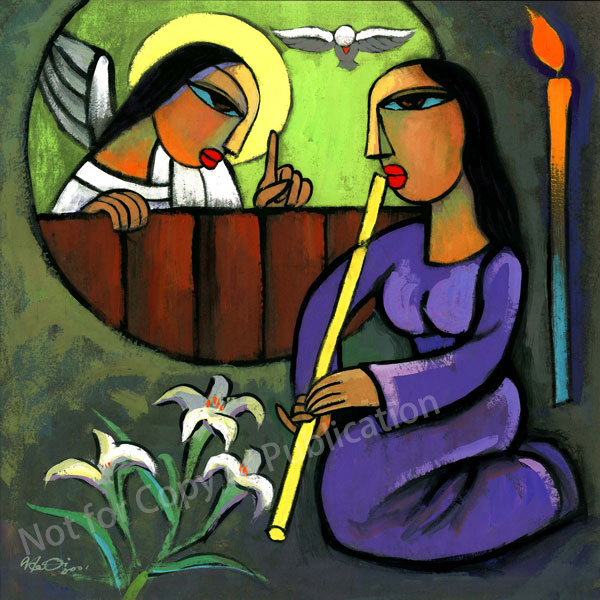
Following is a painting (“Annunciation”) by He Qi:

Image taken from He Qi Art . For purchasing prints of this and other artworks by He Qi go to heqiart.com . For other images of He Qi art works in TIPs, see here.
Following is an artwork by Sister Marie Claire , SMMI (1937–2018) from Bengaluru, India:

(Note that supernatural beings are always portrayed with this type of upraised scarf and white circle.)
For more information about images by Sister Marie Claire and ways to purchase them as lithographs, see here . For other images of Sister Marie Claire paintings in TIPs, see here.
Greetings favored one! The Lord is with you.
The Greek in Luke 1:28 that is translated as “Greetings, favored one! The Lord is with you” or similar in English is translated in the interconfessional Italian Common Language Version (Traduzione Interconfessionale in Lingua Corrente, publ. 2014) as Ti saluto, Maria! Il Signore è con te: egli ti ha colmata di grazia or “Hail, Mary! The Lord is with you; he has filled you with grace.”
Carlo Buzzetti (in The Bible Translator 1982, p. 243 ) explains: “The most famous Latin translation, of St. Jerome, reads: Ave gratia plena, Dominus tecum (‘Hail, woman full of grace, the Lord is with you’), and a great many later translations have been influenced by it. So nearly all the Italian Roman Catholic editions of the Gospel say: Ti saluto, piena di grazia. il Signore e con te. However the Italian protestant versions have avoided the formula piena di grazia (‘full of grace’). This expression does not seem to be the best translation of the Greek, and it implies an interpretation which can easily be confessional: the words piena di grazia could be understood as a description of Mary almost independent from God, whereas the Greek word kecharitomene is a passive form. For this reason we read Ben ti sia, o favorita; il Signore sia leco (old Diodati version) or Ti saluto, o favorita dalla grazia, il Signore e teco (Riveduta version), in which favorita (‘favored one’) is preferred as the equivalent of kecharitomene.
“Unfortunately, the word favorita doesn’t belong at all to the common language Italian of today; and the reader who knows it probably gets the wrong shade of meaning and wrong connotations from it. The same thing is true of other participles and adjectives: graziata, gratificata, graziosa … so the Italian translators of [the Common Language Version] decided to bring in the subject (God) which is hidden in the passive Greek form: and they produced the formula Dio ti ha colmata di grazia (‘God has filled you with grace’). There was no confessional difficulty with this expression; on the contrary, the agreement was general.”
Annunciation to Mary (icon)
Following is a Serbian Orthodox icon of the Annunciation to Mary from the 14th century (found in the Church of Theotokos the Perivleptos, Ohrid, today in the National Museum of Serbia).
![]()
Orthodox Icons are not drawings or creations of imagination. They are in fact writings of things not of this world. Icons can represent our Lord Jesus Christ, the Virgin Mary, and the Saints. They can also represent the Holy Trinity, Angels, the Heavenly hosts, and even events. Orthodox icons, unlike Western pictures, change the perspective and form of the image so that it is not naturalistic. This is done so that we can look beyond appearances of the world, and instead look to the spiritual truth of the holy person or event. (Source )
Tibbs (2025, p. 51ff.) writes about the annunciation icon: “The archangel is seen entering from the left, moving toward the right, which is the typical direction of narrative action in icons. One reason for this is that the icon is read similarly to the Greek text in the New Testament, from left to right.
“The are no walls in the icon to suggest that Gabriel had entered an indoor space, as would have been presser in naturalistic art. The absence of enclosing walls in iconography is also intentional since the icon has no dimension or physical boundaries. There is no light source, and therefore, there are no shadows. The absence of both walls and light sources serves to convey that the event itself expands beyond its natural earthbound limits. Evdokimov writes that the icon is ‘never a window on nature,’ not even on a specific place, ‘but rather an opening onto the beyond.’
“It is the red drape that sets the scriptural event within its actual indoor historical setting, with the color red representing the earthly setting of this event. The red drape affirms that this event took place at a specific moment in history, in a specific indoor space in Nazareth, between a specific angel, Gabriel, and a specific young woman, Mary, in the ‘sixth month’ after Elizabeth conceived (Luke 1:26-27, 36). Yet the icon goes beyond the historical setting to encompass the cosmic significance of this event: the eternal God enters human history.”
angel
The Greek, Hebrew, Ge’ez, and Aramaic that is translated as “angel” in English versions is translated in many ways:
- Pintupi-Luritja: ngaṉka ngurrara: “one who belongs in the sky” (source: Ken Hansen quoted in Steven 1984a, p. 116.)
- Tetela, Kpelle, Balinese, and Mandarin Chinese: “heavenly messenger”
- Shilluk / Igede: “spirit messenger”
- Mashco Piro: “messenger of God”
- Batak Toba: “envoy, messenger”
- Navajo (Dinė): “holy servant” (source for this and above: Bratcher / Nida 1961; Igede: Andy Warren-Rothlin)
- Central Mazahua: “God’s worker” (source: Ronald D. Olson in Notes on Translation January, 1968, p. 15ff.)
- Saramaccan: basia u Masa Gaangadu köndë or “messenger from God’s country” (source: Jabini 2015, p. 86)
- Mairasi: atatnyev nyaa or “sent-one” (source: Enggavoter 2004)
- Shipibo-Conibo: “word bringer” (source: James Lauriault in The Bible Translator 1951, p. 32ff. )
- Apali: “God’s one with talk from the head” (“basically God’s messenger since head refers to any leader’s talk”) (source: Martha Wade)
- Michoacán Nahuatl: “clean helper of God” (source: B. Moore / G. Turner in Notes on Translation 1967, p. 1ff.)
- Noongar: Hdjin-djin-kwabba or “spirit good” (source: Warda-Kwabba Luke-Ang)
- Wè Northern (Wɛɛ): Kea ‘a “sooa or “the Lord’s soldier” (also: “God’s soldier” or “his soldier”) (source: Drew Maust)
- Iwaidja: “a man sent with a message” (Sam Freney explains the genesis of this term [in this article ): “For example, in Darwin last year, as we were working on a new translation of Luke 2:6–12 in Iwaidja, a Northern Territory language, the translators had written ‘angel’ as ‘a man with eagle wings’. Even before getting to the question of whether this was an accurate term (or one that imported some other information in), the word for ‘eagle’ started getting discussed. One of the translators had her teenage granddaughter with her, and this word didn’t mean anything to her at all. She’d never heard of it, as it was an archaic term that younger people didn’t use anymore. They ended up changing the translation of ‘angel’ to something like ‘a man sent with a message’, which is both more accurate and clear.”)
Like a number of other East Asian languages, Japanese uses a complex system of honorifics, i.e. a system where a number of different levels of politeness are expressed in language via words, word forms or grammatical constructs. These can range from addressing someone or referring to someone with contempt (very informal) to expressing the highest level of reference (as used in addressing or referring to God) or any number of levels in-between. One way to do this is through the usage (or a lack) of an honorific prefix as shown here in the widely-used Japanese Shinkaiyaku (新改訳) Bible of 2017. When the referent is God, the “divine” honorific prefix mi- (御 or み) is used as in mi-tsukai (御使い) or “messenger (of God).” (Source: S. E. Doi, see also S. E. Doi in Journal of Translation, 18/2022, p. 37ff. )
See also angel (Acts 12:15) and this devotion on YouVersion .
complete verse (Luke 1:28)
Following are a number of back-translations of Luke 1:28:
- Noongar: “The angel came to Mary and said, ‘Peace to you! God is with you and he greatly blesses you!'” (Source: Warda-Kwabba Luke-Ang)
- Uma: “When the angel arrived there, he said to Maria: ‘Many greetings! The Lord bless you (sing.) and be with you (sing.)!'” (Source: Uma Back Translation)
- Yakan: “When the angel arrived at the place where Mariyam was, he said to the woman, ‘Assalamu alaikum. (polite religious greeting) You are chosen by God, Mariyam. God is with you.'” (Source: Yakan Back Translation)
- Western Bukidnon Manobo: “And the angel arrived there to Mary, and he said, ‘Woman, God has pitied you and he is taking care of you!'” (Source: Western Bukidnon Manobo Back Translation)
- Kankanaey: “The angel went to her and said, ‘How are you (sing.). God is companioning you (sing.) and great is his mercy/favor to you (sing.).'” (Source: Kankanaey Back Translation)
- Tagbanwa: “The angel came to Maria and paid (lit. gave) respect. He spoke, saying, ‘You can be very happy for you are really being shown grace/favor by God. He is really taking care of you.'” (Source: Tagbanwa Back Translation)
Sung version of Luke 1
Translation commentary on Luke 1:28
Exegesis:
eiselthōn pros autēn eipen ‘having gone in to her said.’
eiserchomai followed by pros with a personal object ‘to go to somebody,’ often with the connotation of going into somebody’s house, cf. Mk. 15.43; Acts 10.3; 11.3; Rev. 3.20.
chaire, kecharitōmenē ‘hail, O favoured one,’ play on sounds.
chaire imperative (this form †) of chairō, ‘to be glad’ (cf. on 1.14), used as a very common formula of greeting, its meaning ranging from ‘hail to you’ to ‘hello.’ Some translators take chaire in the literal meaning and translate ‘rejoice’ with reference to Old Testament verses announcing the coming of the Messiah (Zeph. 3.14-17; Zech. 9.9). The former interpretation is preferable.
kecharitōmenē perfect participle of charitoō here ‘to bestow favour upon,’ ‘to bless.’ The precise meaning of the verb here (which to Mary is not quite clear as v. 29 shows) is explained by the angel in v. 30 ‘you have found favour with God,’ charis being the key to both expressions, cf. on v. 30.
ho kurios meta sou ‘the Lord be with you’; either with estin ‘is’ or estō ‘be’ understood. When understood with estin the clause is a statement, continuing and explaining the preceding vocative kecharitōmenē (cf. Judg. 6.12); when estō is understood the clause contains a wish (cf. Ruth 2.4). The former is preferable.
meta sou ‘with you,’ meta with genitive here in the figurative sense of ‘standing by’ somebody.
According to Jewish custom it was considered unusual to greet a woman (cf. Strack-Billerbeck II, 99); this explains Mary’s bewilderment expressed in v. 29.
Translation:
The verse continues the narration of events after the enumeration of additional details given in v. 27. The pronoun he often has to be specified, e.g. by using, ‘the angel,’ or ‘Gabriel.’
He came to her. It may be preferable, or even obligatory, to say ‘come to where she was’ (Sinhala), ‘enter her vicinity/presence’ (Dravidian languages), ‘enter her house’ (Javanese, Batak Toba, Tae,’ Sranan Tongo), ‘ascend to her house’ (Tae’ 1933, because the only type of house known at the time was one built on poles). In some languages the expression requires careful handling here, because ‘entered her house,’ ‘came to her,’ would suggest sexual intercourse; hence ‘he came and arrived where Mary was’ (Kituba), ‘he came gently to her’ (Uab Meto).
Several versions can render hail by a word or formula commonly used in the language when greeting a person. Its basic meaning may be, (1) a term of well-wishing, e.g. ‘peace to you’ (Arabic, borrowed also in some Indonesian languages), ‘you in peace’ (Bambara), ‘goodness’ (Kituba), ‘hither your soul’ (Toraja-Sa’dan), ‘good morning’ (An American Translation), ‘live’ (Tamil), ‘be/stay well’ (Balinese, Ekari, where the use of the formula is rather recent); (2) a phrase for asking permission to enter or to depart (Batak Toba); or (3) a question like English ‘how are you’ (Cuyono), cf. also Sranan Tongo odi, a distant relative of ‘how do you do.’ Other versions use a form of the verb ‘to greet,’ e.g. ‘be greeted’ (Nieuwe Vertaling, Zürcher Bibel), ‘I greet you’ (Bible en français courant). In some cases existing formulas of greeting cannot be used, as e.g. in Marathi, where the common Muslim greeting (salaam, lit. peace) is suspect to the Hindus in the area, whereas the Hindu formulas are objectionable to Christians, because they imply worship of the divine spirit within the person greeted; the translators solved their problem by using a neutral word for well-wishing. Elsewhere the custom of greeting and corresponding formulas do not exist (as e.g. in Tboli, where the translator employs an interjection used to attract the attention of a person to whom one wants to speak), or terms for greeting do not refer to words but to gestures, e.g. ‘to meet snapping fingers,’ which may lead to a rendering of “hail” by ‘I meet you snapping fingers.’ If the translator is of the opinion that the literal meaning of the Greek verb should prevail (see Exegesis), he should try at the same time to bring out its functional meaning, e.g. by using some such translation as, ‘and greeted her with the words, “Be glad” ,’ or ‘and grasped fingers with her saying, “Rejoice” .’ This is necessary because in v. 29 Mary expressly refers to her having been greeted.
O favoured one. In rendering the Greek construction (a passive participle used as a noun in the vocative) various shifts and/or additions may be necessary. (1) The form of address may become more natural by adding the name ‘Mary,’ or the pronoun second person. (2) The agent, ‘God,’ may have to be added. (3) One may have to shift from exclamation to statement, ‘for you are made to rejoice’ (Uab Meto), or (4) from passive to active voice, ‘you whom God favours,’ or ‘you who receive favour/grace’ (Sranan Tongo, Bahasa Indonesia), or (5) to a combination of (3) and (4), ‘God favours you.’ The verb has been rendered, ‘to help well’ (Huanuco Quechua), ‘to dispense fullness of satisfaction’ (Ekari), ‘to value-highly’ (Navajo), ‘the breath to be with,’ i.e. to think of, or, to love (Tboli); cf. also the references on v. 30.
The Lord is with you, or, ‘accompanies you,’ ‘is near to you’ (Toraja-Sa’dan), ‘stands by/takes-care-of-you’ (Tae’ 1933). In some languages the durative aspect is made explicit, ‘continually is with you’ (Tboli).
Quoted with permission from Reiling, J. and Swellengrebel, J.L. A Handbook on the Gospel of Luke. (UBS Handbook Series). New York: UBS, 1971. For this and other handbooks for translators see here . Make sure to also consult the Handbook on the Gospel of Mark for parallel or similar verses.

Leave a Reply
You must be logged in to post a comment.