14but those who drink of the water that I will give them will never be thirsty. The water that I will give will become in them a spring of water gushing up to eternal life.”
Lloyd Peckham explains the Mairasi translation: “In secret stories, not knowable to women nor children, there was a magical fruit of life. If referred to vaguely, without specifying the specific ‘fruit,’ it can be an expression for eternity.”
The Hebrew and Greek that is translated as “thirst” or “thirsty” in English is translated in Kituba as “hungry for water” (source: Donald Deer in The Bible Translator 1973, p. 207ff. ) and in Mairasi as “water pain” (source: Enggavoter 2004).
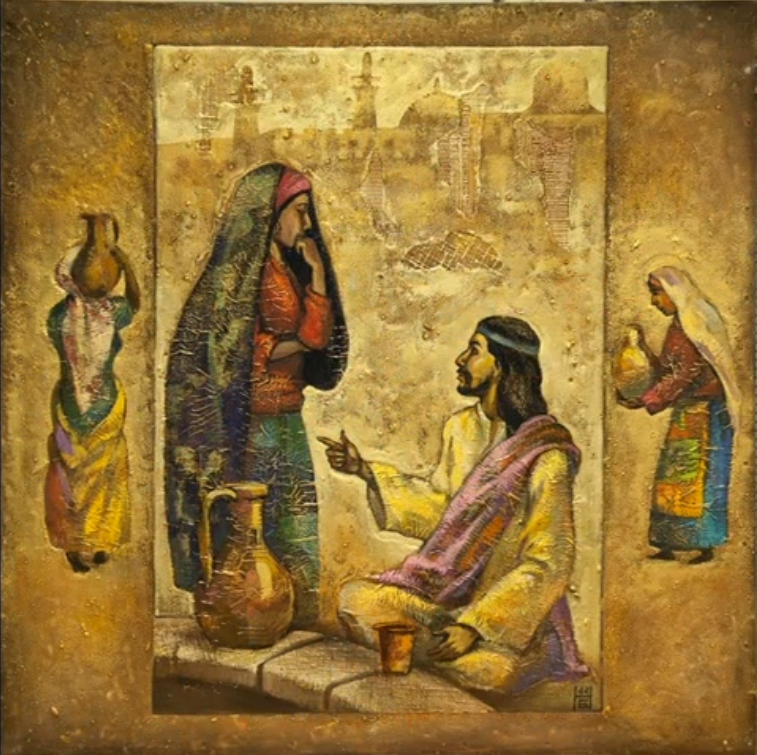
“Jesus is dressed in a different style of clothing than the style of the woman who is shown as a Lanna Thai northerner. It is unusual for him to talk to a person from a different region, especially a woman. The clothes, the roof of the house in the background, and the dipper for water all indicate that this is in northern Thailand.”
Ketut Lasia is one of the last traditional Balinese painters in the Ubud style. As an adult, Lasia converted from Hinduism to Christianity, and he paints primarily biblical scenes. You can find artwork from Ketut Lasia in a variety of formats for sale at Fine Art America .
Following are a number of back-translations of John 4:14:
Uma: “But whoever drinks water that I give to them, they will not be thirsty again forever. Because the water that I give them becomes the water of life that flows continually in their hearts–meaning, they receive good life forever.'” (Source: Uma Back Translation)
Yakan: “But whoever is able to drink the water which I cause him to drink he will really not become thirsty again. For the water which I give him to drink becomes like a spring bubbling in his liver giving him water which gives him life forever.'” (Source: Yakan Back Translation)
Western Bukidnon Manobo: “Because the water which I will give to him will become in him a head(source) of water which can give him life forever.'” (Source: Western Bukidnon Manobo Back Translation)
Kankanaey: “But the one by-contrast who drinks the water I will give, he will-never-get-thirsty. Because the water that I give, it will become like a spring in his body which never-dries-up which gives him life that is forever.'” (Source: Kankanaey Back Translation)
Tagbanwa: “But the one who drinks the water I will give, he will become thirsty no more, for it will be like a spring within him which gives life which has no ending.'” (Source: Tagbanwa Back Translation)
Tenango Otomi: “He who will drink the water I give never will be thirsty. Because that water which I give is like water which springs up in the insides of the one who drinks in order to give the new life forever.'” (Source: Tenango Otomi Back Translation)
The Greek in the referenced verses that is typically translated as “age,” “(for)ever / eternity / eternal / permanent,” “of old / long ago” in English is translated in the German translation by Fridolin Stier (1989) consistenty as “world (or: “cosmic”) time” (Weltzeit).
Sarah Ruden (2021, p. lxii) explains the complexities of the translation of aiōn: “Trickiest of all [the words relating to time] is aion, most simply an ‘age’ or ‘era’ but sometimes denoting either the whole present world or the whole world to come. The same word can allude to all the limits of material existence (or to dangerous worldly distractions in particular), or to their absence in the eternal age to come. Looking forward, especially to ‘ages of ages’ (in the pattern of ‘King of Kings’), the meaning is ‘eternity.’”
Click or tap here to see the rest of this insight.
Like a number of other East Asian languages, Japanese uses a complex system of honorifics, i.e. a system where a number of different levels of politeness are expressed in language via words, word forms or grammatical constructs. These can range from addressing someone or referring to someone with contempt (very informal) to expressing the highest level of reference (as used in addressing or referring to God) or any number of levels in-between.
One way Japanese shows different degree of politeness is through the choice of a first person singular and plural pronoun (“I” and “we” and its various forms) as shown here in the widely-used Japanese Shinkaiyaku (新改訳) Bible of 2017. The most commonly used watashi/watakushi (私) is typically used when the speaker is humble and asking for help. In these verses, where God / Jesus is referring to himself, watashi is also used but instead of the kanji writing system (私) the syllabary hiragana (わたし) is used to distinguish God from others.



Leave a Reply
You must be logged in to post a comment.