The Hebrew and Greek that is translated as “thirst” or “thirsty” in English is translated in Kituba as “hungry for water” (source: Donald Deer in The Bible Translator 1973, p. 207ff. ) and in Mairasi as “water pain” (source: Enggavoter 2004).
Following are a number of back-translations of John 4:15:
Uma: “That woman said: ‘If thus, give me that water, so that I will no longer always be thirsty, and I will no longer need to come here to fetch water every day.'” (Source: Uma Back Translation)
Yakan: “‘Sir,’ said the woman, ‘give me this water, that you spoke about, to drink, so that I won’t get thirsty again and that I don’t have to keep coming here to draw water.'” (Source: Yakan Back Translation)
Western Bukidnon Manobo: “And the woman said, ‘Sir, let me drink some of that water that you are talking about so that I will never get thirsty again, and I will never again also have to fetch water here.'” (Source: Western Bukidnon Manobo Back Translation)
Kankanaey: “Then the woman said, ‘Sir, please give-me-some of that water so I will-never-get-thirsty and I will not have to keep-coming here to go get-water.'” (Source: Kankanaey Back Translation)
Tagbanwa: “The woman said next, ‘Master, well if that’s how it is, give me that water you’re talking about, so that I won’t become thirsty again, coming again and again here to this well to draw water.'” (Source: Tagbanwa Back Translation)
Tenango Otomi: “The woman said, ‘Sir. Give me the water you are speaking about so that I will never be thirsty. Also I will never come to draw water from this well here.'” (Source: Tenango Otomi Back Translation)
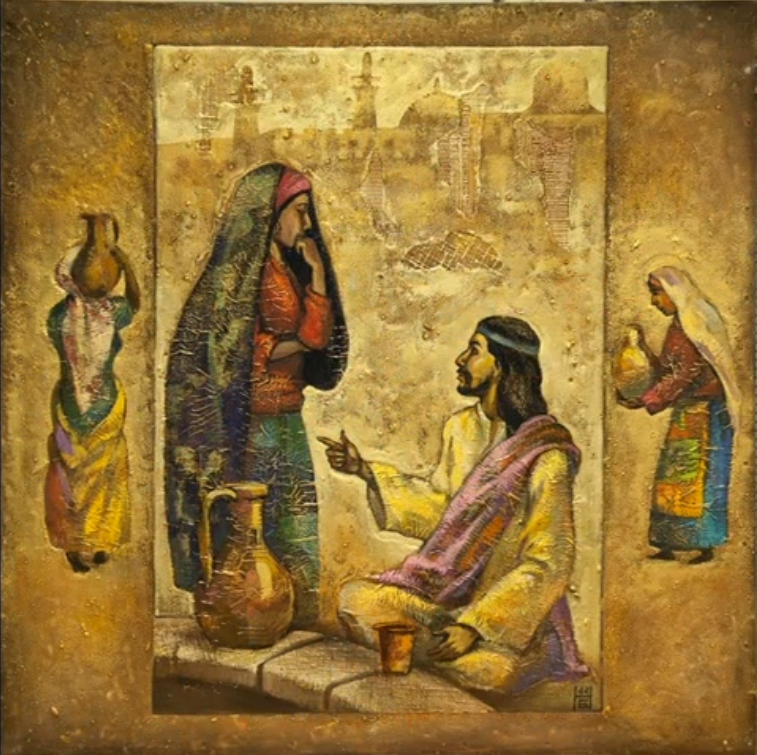
“Jesus is dressed in a different style of clothing than the style of the woman who is shown as a Lanna Thai northerner. It is unusual for him to talk to a person from a different region, especially a woman. The clothes, the roof of the house in the background, and the dipper for water all indicate that this is in northern Thailand.”
Ketut Lasia is one of the last traditional Balinese painters in the Ubud style. As an adult, Lasia converted from Hinduism to Christianity, and he paints primarily biblical scenes. You can find artwork from Ketut Lasia in a variety of formats for sale at Fine Art America .
Click or tap here to see the rest of this insight.
Like a number of other East Asian languages, Japanese uses a complex system of honorifics, i.e. a system where a number of different levels of politeness are expressed in language via words, word forms or grammatical constructs. These can range from addressing someone or referring to someone with contempt (very informal) to expressing the highest level of reference (as used in addressing or referring to God) or any number of levels in-between.
One way to do this is through the usage of lexical honorific forms, i.e., completely different words, as shown here in the widely-used Japanese Shinkaiyaku (新改訳) Bible of 2017. In these verses, kudasaru (下さる), a respectful form of kureru (くれる) or “give” is used.
The word Sir is the same word used in verse 11 (see there).
Said is literally “said to him,” but in English “to him” is unnecessary in the context.
Quoted with permission from Newman, Barclay M. and Nida, Eugene A. A Handbook on the Gospel of John. (UBS Handbook Series). New York: UBS, 1980. For this and other handbooks for translators see here .
Sir: The Greek word that the Berean Standard Bible translates as Sir is a title of respect. It is the same word as in 4:11a.
give me this water: The Greek phrase that the Berean Standard Bible translates as give me this water is a request for a drink. Translate it in a way that is polite and natural in your language. For example:
Sir, please give me a drink of that water! (Contemporary English Version)
4:15b
so that I will not get thirsty and have to keep coming here to draw water: The woman misunderstood Jesus. She thought he was talking about literal water and being literally thirsty. She wanted to drink Jesus’ water so that she would not be thirsty again. She did not want to have to come back to the well for water.
This is a negative purpose clause. There were two things the woman wanted to avoid: being thirsty and returning to the well again and again. These two things may be connected either by a word meaning “or” or by a word meaning “and.” For example:
and then I shall not be thirsty, nor have to come all this way to draw water (Revised English Bible) -or-
Then I’ll never be thirsty again, and I won’t have to come here to get water. (God’s Word)



Leave a Reply
You must be logged in to post a comment.