
Image taken from the Wiedmann Bible. For more information about the images and ways to adopt them, see here .
For other images of Willy Wiedmann paintings in TIPs, see here.

בִּשְׁנַת־מוֹת֙ הַמֶּ֣לֶךְ עֻזִּיָּ֔הוּ וָאֶרְאֶ֧ה אֶת־אֲדֹנָ֛י יֹשֵׁ֥ב עַל־כִּסֵּ֖א רָ֣ם וְנִשָּׂ֑א וְשׁוּלָ֖יו מְלֵאִ֥ים אֶת־הַהֵיכָֽל׃
Isaiah 6
A Vision of God in the Temple
1In the year that King Uzziah died, I saw the Lord sitting on a throne, high and lofty, and the hem of his robe filled the temple.
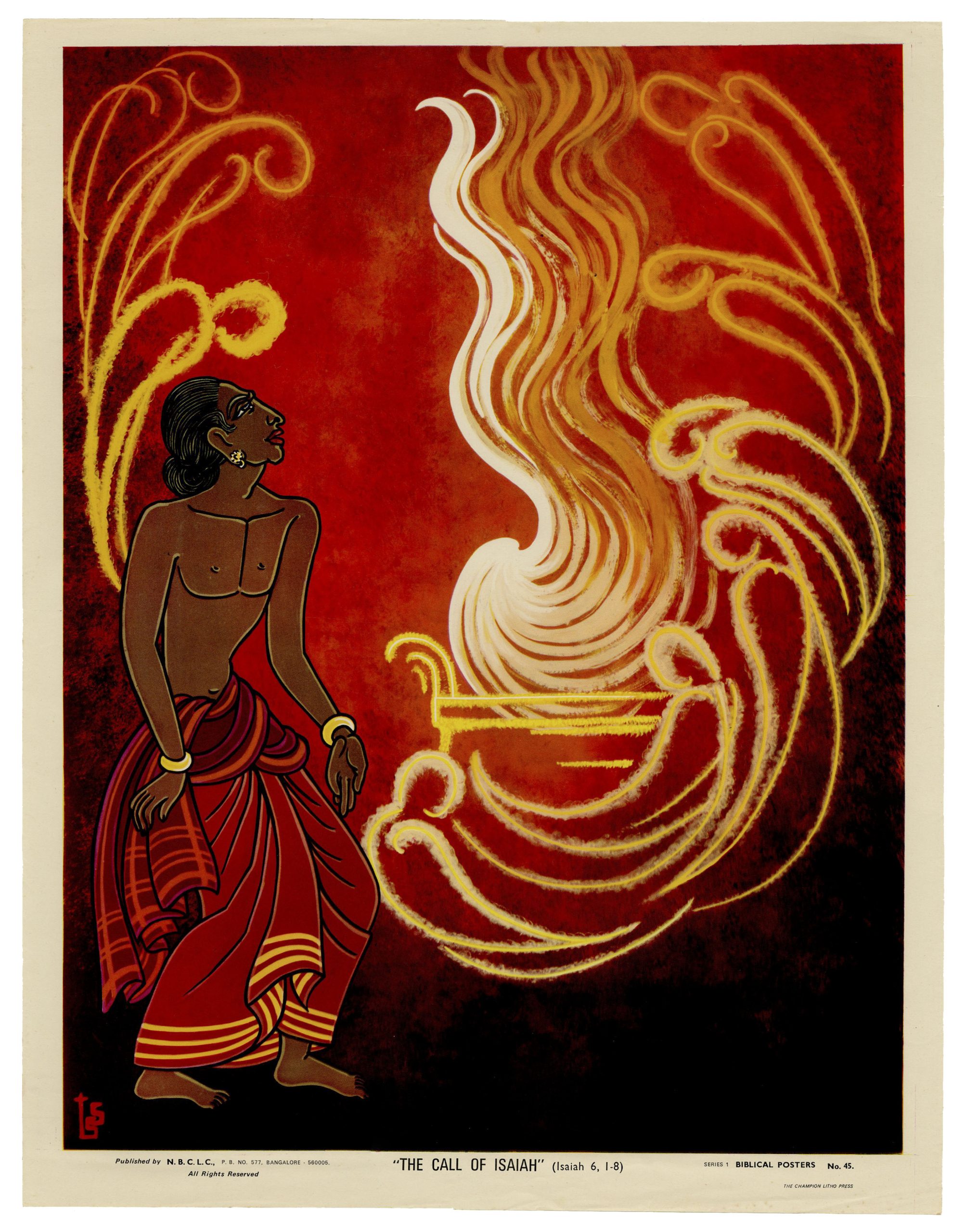
Artwork by Sister Marie Claire , SMMI (1937–2018) from Bengaluru, India.
For more information about images by Sister Marie Claire and ways to purchase them as lithographs, see here .
For other images of Sister Marie Claire paintings in TIPs, see here.
The name that is transliterated as “Uzziah” in English is translated in Libras (Brazilian Sign Language) with a sign that refers to Uzziah contracting a rare forehead disease until he died as a result of him wrongly wanting to make an offering in the temple (see 2 Chronicles 26:16, 26:19, and 26:21). (Source: Missão Kophós )
“Uzziah” in Libras (source )
More information under Uzziah .
For more information on translations of proper names with sign language see Sign Language Bible Translations Have Something to Say to Hearing Christians .
Like a number of other East Asian languages, Japanese uses a complex system of honorifics, i.e. a system where a number of different levels of politeness are expressed in language via words, word forms or grammatical constructs. These can range from addressing someone or referring to someone with contempt (very informal) to expressing the highest level of reference (as used in addressing or referring to God) or any number of levels in-between.
One way to do this is through the usage (or a lack) of an honorific prefix as shown here in the widely-used Japanese Shinkaiyaku (新改訳) Bible of 2017. When the referent is God, the “divine” honorific prefix mi- (御 or み) can be used, as in mi-za (御座), mi-kura (みくら) (Psalm 7:7), or mi-kurai (御位) (Psalm 113:5) in the referenced verses, all relating to the “throne (or: high seat) (of God)”.
(Source: S. E. Doi, see also S. E. Doi in Journal of Translation, 18/2022, p. 37ff. )
See also throne (of God).
Following are a number of back-translations as well as a sample translation for translators of Isaiah 6:1:
The Hebrew adonai in the Old Testament typically refers to God. The shorter adon (and in two cases in the book of Daniel the Aramaic mare [מָרֵא]) is also used to refer to God but more often for concepts like “master,” “owner,” etc. In English Bible translations all of those are translated with “Lord” if they refer to God.
In English Old Testament translations, as in Old Testament translations in many other languages, the use of Lord (or an equivalent term in other languages) is not to be confused with Lord (or the equivalent term with a different typographical display for other languages). While the former translates adonai, adon and mare, the latter is a translation for the tetragrammaton (YHWH) or the Name of God. See tetragrammaton (YHWH) and the article by Andy Warren-Rothlin in Noss / Houser, p. 618ff. for more information.
In the New Testament, the Greek term kurios has at least four different kinds of use:
In the first and fourth case, it is also translated as “Lord” in English.
Most languages naturally don’t have one word that covers all these meanings. According to Bratcher / Nida, “the alternatives are usually (1) a term which is an honorific title of respect for a high-ranking person and (2) a word meaning ‘boss’, ‘master’, or ‘chief.’ (…) and on the whole it has generally seemed better to employ a word of the second category, in order to emphasize the immediate personal relationship, and then by context to build into the word the prestigeful character, since its very association with Jesus Christ will tend to accomplish this purpose.”
When looking at the following list of back-translations of the terms that translators in the different languages have used for both kurios and adonai to refer to God and Jesus respectively, it might be helpful for English readers to recall the etymology of the English “Lord.” While this term might have gained an exalted meaning in the understanding of many, it actually comes from hlaford or “loaf-ward,” referring to the lord of the castle who was the keeper of the bread (source: Rosin 1956, p. 121).
Following are some of the solutions that don’t rely on a different typographical display (see above):
We have come to rely on another term which emphasizes God’s essential nature as YHWH, namely jukurrarnu (see tetragrammaton (YHWH)). This word is built on the same root jukurr– as is jukurrpa, ‘dreaming.’ Its basic meaning is ‘timelessness’ and it is used to describe physical features of the land which are viewed as always being there. Some speakers view jukurrarnu in terms of ‘history.’ In all Genesis references to YHWH we have used Kaatu Jukurrarnu. In all Mark passages where kurios refers to God and not specifically to Christ we have also used Kaatu Jukurrarnu.
New Testament references to Christ as kurios are handled differently. At one stage we experimented with the term Watirirririrri which refers to a ceremonial boss of highest rank who has the authority to instigate ceremonies. While adequately conveying the sense of Christ’s authority, there remained potential negative connotations relating to Warlpiri ceremonial life of which we might be unaware.
Here it is that the Holy Spirit led us to make a chance discovery. Transcribing the personal testimony of the local Warlpiri pastor, I noticed that he described how ‘my Warlaljamarri called and embraced me (to the faith)’. Warlaljamarri is based on the root warlalja which means variously ‘family, possessions, belongingness’. A warlaljamarri is the ‘owner’ or ‘possessor’ of something. While previously being aware of the ‘ownership’ aspect of warlaljamarri, this was the first time I had heard it applied spontaneously and naturally in a fashion which did justice to the entire concept of ‘Lordship’. Thus references to Christ as kurios are now being handled by Warlaljamarri.” (Source: Stephen Swartz, The Bible Translator 1985, p. 415ff. )
Law (2013, p. 97) writes about how the Ancient Greek Septuagint‘s translation of the Hebrew adonai was used by the New Testament writers as a bridge between the Old and New Testaments: “Another case is the use of kurios referring to Jesus. For Yahweh (in English Bibles: ‘the Lord‘), the Septuagint uses kurios. Although the term kurios usually has to do with one’s authority over others, when the New Testament authors use this word from the Septuagint to refer to Jesus, they are making an extraordinary claim: Jesus of Nazareth is to be identified with Yahweh.”
See also Father / Lord.
Like a number of other East Asian languages, Japanese uses a complex system of honorifics, i.e. a system where a number of different levels of politeness are expressed in language via words, word forms or grammatical constructs. These can range from addressing someone or referring to someone with contempt (very informal) to expressing the highest level of reference (as used in addressing or referring to God) or any number of levels in-between.
One way Japanese shows different degree of politeness is through the usage of an honorific construction where the morpheme rare (られ) is affixed on the verb as shown here in the widely-used Japanese Shinkaiyaku (新改訳) Bible of 2017. This is particularly done with verbs that have God as the agent to show a deep sense of reverence. Here, tsuiteo-rare-ru (着いておられる) or “arriving” is used.
(Source: S. E. Doi, see also S. E. Doi in Journal of Translation, 18/2022, p. 37ff. )
(Click or tap here to see details)
Faye Edgerton retells how the term in Navajo (Dinė) was determined:
“[This term was] easily expressed in the language of Biblical culture, which had kings and noblemen with their brilliant trappings and their position of honor and praise. But leadership among the Navajos is not accompanied by any such titles or distinctions of dress. Those most respected, especially in earlier days, were their headmen, who were the leaders in raids, and the shaman, who was able to serve the people by appealing for them to the gods, or by exorcising evil spirits. Neither of these made any outward show. Neither held his position by political intrigue or heredity. If the headman failed consistently in raids, he was superceded by a better warrior. If the shaman failed many times in his healing ceremonies, it was considered that he was making mistakes in the chants, or had lost favor with the gods, and another was sought. The term Navajos use for headman is derived from a verb meaning ‘to move the head from side to side as in making an oration.’ The headman must be a good orator, able to move the people to go to war, or to follow him in any important decision. This word is naat’áanii which now means ‘one who rules or bosses.’ It is employed now for a foreman or boss of any kind of labor, as well as for the chairman of the tribal council. So in order to show that the king is not just a common boss but the highest ruler, the word ‘aláahgo, which expresses the superlative degree, was put before naat’áanii, and so ‘aláahgo naat’áanii ‘anyone-more-than-being around-he-moves-his-head-the-one-who’ means ‘the highest ruler.’ Naat’áanii was used for governor as the context usually shows that the person was a ruler of a country or associated with kings.”
(Source: Faye Edgerton in The Bible Translator 1962, p. 25ff. )
See also king (Japanese honorifics).
No comments yet.
Leave a Reply
You must be logged in to post a comment.