
Image taken from the Wiedmann Bible. For more information about the images and ways to adopt them, see here .
For other images of Willy Wiedmann paintings in TIPs, see here.

שְׂרָפִ֨ים עֹמְדִ֤ים ׀ מִמַּ֨עַל֙ ל֔וֹ שֵׁ֧שׁ כְּנָפַ֛יִם שֵׁ֥שׁ כְּנָפַ֖יִם לְאֶחָ֑ד בִּשְׁתַּ֣יִם ׀ יְכַסֶּ֣ה פָנָ֗יו וּבִשְׁתַּ֛יִם יְכַסֶּ֥ה רַגְלָ֖יו וּבִשְׁתַּ֥יִם יְעוֹפֵֽף׃
2Seraphs were in attendance above him; each had six wings: with two they covered their faces, and with two they covered their feet, and with two they flew.
The Hebrew that is often translated as “seraphs” or “seraphim” in English is translated in Hiligaynon as “heavenly creatures.” (Source: Hiligaynon Back Translation)
See also cherub.
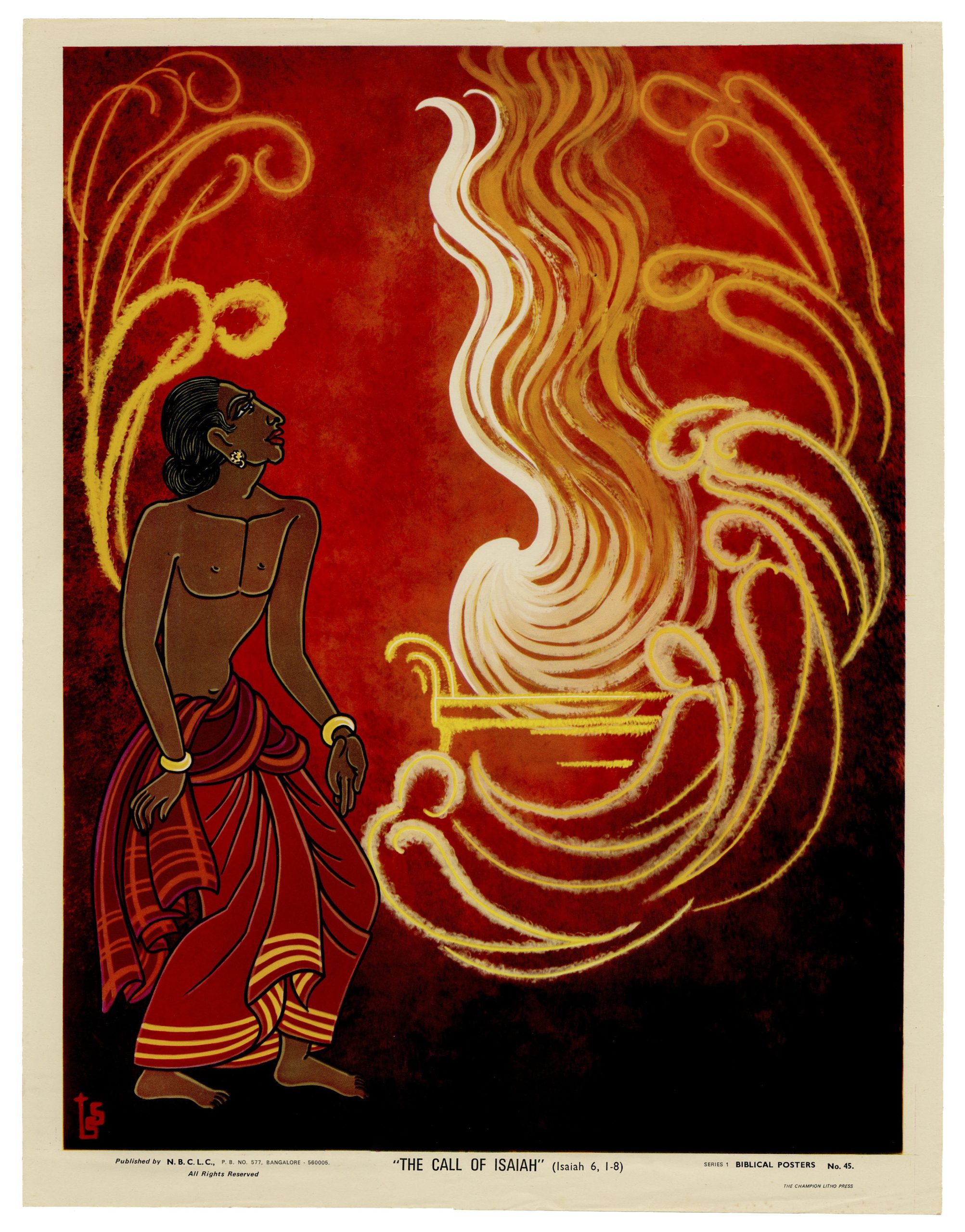
Artwork by Sister Marie Claire , SMMI (1937–2018) from Bengaluru, India.
For more information about images by Sister Marie Claire and ways to purchase them as lithographs, see here .
For other images of Sister Marie Claire paintings in TIPs, see here.
Following are a number of back-translations as well as a sample translation for translators of Isaiah 6:2:
God transcends gender, but most languages are limited to grammatical gender expressed in pronouns. In the case of English, this is traditionally confined to “he” (or in the forms “his,” “him,” and “himself”), “she” (and “her,” “hers,” and “herself”), and “it” (and “its” and “itself”).
Modern Mandarin Chinese, however, offers another possibility. Here, the third-person singular pronoun is always pronounced the same (tā), but it is written differently according to its gender (他 is “he,” 她 is “she,” and 它/牠 is “it” and their respective derivative forms). In each of these characters, the first (or upper) part defines the gender (man, woman, or thing/animal), while the second element gives the clue to its pronunciation.
In 1930, after a full century with dozens of Chinese translations, Bible translator Wang Yuande (王元德) coined a new “godly” pronoun: 祂. Chinese readers immediately knew how to pronounce it: tā. But they also recognized that the first part of that character, signifying something spiritual, clarified that each person of the Trinity has no gender aside from being God.
While the most important Protestant and Catholic Chinese versions respectively have opted not to use 祂, some Bible translations do and it is widely used in hymnals and other Christian materials. Among the translations that use 祂 to refer to “God” were early versions of Lü Zhenzhong’s (呂振中) version (New Testament: 1946, complete Bible: 1970). R.P. Kramers (in The Bible Translator 1956, p. 152ff. ) explains why later versions of Lü’s translation did not continue with this practice: “This new way of writing ‘He,’ however, has created a minor problem of its own: must this polite form be used whenever Jesus is referred to? Lü follows the rule that, wherever Jesus is referred to as a human being, the normal tā (他) is written; where he is referred to as divine, especially after the ascension, the reverential tā (祂) is used.”
In that system, one kind of pronoun is used for humans (male and female alike) and others for natural elements, non-liquid masses, and some spiritual entities (one other is used for large animals and another one for miscellaneous items). While in these languages the pronoun for spiritual entities used to be employed when referring to God, this has changed into the use of the human pronoun.
Lynell Zogbo (in The Bible Translator 1989, p. 401ff. ) explains: “From informal discussions with young Christians especially, it would appear that, at least for some people, the experience and/or concepts of Christianity are affecting the choice of pronoun for God. Some people explain that God is no longer ‘far away,’ but is somehow tangible and personal. For these speakers God has shifted over into the human category.”
In Kouya, God (the Father) and Jesus are referred to with the human pronoun ɔ, whereas the Holy Spirit is referred to with a non-human pronoun. (Northern Grebo and Western Krahn make a similar distinction.)
Eddie Arthur, a former Kouya Bible translation consultant, says the following: “We tried to insist that this shouldn’t happen, but the Kouya team members were insistent that the human pronoun for the Spirit would not work.”
In Burmese, the pronoun ko taw (ကိုယ်တော်) is used either as 2nd person (you) or 3rd person (he, him, his) reference. “This term clearly has its root in the religious language in Burmese. No ordinary persons are addressed or known by this pronoun because it is reserved for Buddhist monks, famous religious teachers, and in the case of Christianity, the Trinity.” (Source: Gam Seng Shae in The Bible Translator 2002, p. 202ff. )
In Thai, the pronoun phra`ong (พระองค์) is used, a gender-neutral pronoun which must refer to a previously introduced royal or divine being. Similarly, in Northern Khmer, which is spoken in Thailand, “an honorific divine pronoun” is used for the pronoun referring to the persons of the Trinity (source: David Thomas in The Bible Translator 1993, p. 445 ). In Urak Lawoi’, another language spoken in Thailand, the translation often uses tuhat (ตูฮัด) — “God” — ”as a divine pronoun where Thai has phra’ong even though it’s actually a noun.” (Source for Thai and Urak Lawoi’: Stephen Pattemore)
The English “Contemporary Torah” addresses the question of God and gendered pronouns by mostly avoiding pronouns in the first five books of the Hebrew Bible/Old Testament (unless God is referred to as “lord,” “father,” “king,” or “warrior”). It does that by either using passive constructs (“He gave us” vs. “we were given”), by using the adjective “divine” or by using “God” rather than a pronoun.
Some Protestant and Orthodox English Bibles use a referential capitalized spelling when referring to the persons of the Trinity with “He,” “His,” “Him,” or “Himself.” This includes for instance the New American Standard Bible or The Orthodox New Testament, but most translations do not. Two other languages where this is also done (in most Bible translations) are Twents as well as Indonesian and Malay. In the latter two languages this follows the language usage according to the Qur’an, which in turn predicts that usage (see Soesilo in The Bible Translator 1991, p. 442ff. and The Bible Translator 1997, p. 433ff. ).
See also first person pronoun referring to God.
Learn more on Bible Odyssey: Gender of God .
在现代汉语中,第三人称单数代词的读音都是一样的(tā),但是写法并不一样,取决于性别以及是否有生命,即男性为“他”,女性为“她”,动物、植物和无生命事物为“它”(在香港和台湾的汉语使用,动物则为“牠”)。这些字的部首偏旁表明了性别(男人、女人、动物、无生命事物),而另一偏旁通常旁提示发音。
到1930年为止,基督教新教《圣经》经过整整一百年的翻译已经拥有了十几个译本,当时的一位圣经翻译者王元德新造了一个“神圣的”代词“祂”,偏旁“礻”表示神明。一般汉语读者会立即知道这字的发音是tā,而这个偏旁表示属灵的事物,因此他们明白这个字指出,三位一体的所有位格都没有性别之分,而单单是上帝。
然而,最重要的新教圣经译本(1919年的《和合本》)和天主教圣经译本(1968年的《思高圣经》)都没有采用“祂”;虽然如此,许多其他的圣经译本采用了这个字,另外还广泛出现在赞美诗和其他基督信仰的书刊中。(资料来源:Zetzsche)
《吕振中译本》的几个早期版本也使用“祂”来指称“上帝”;这个译本的《新约》于1946年译成,整部《圣经》于1970年完成。克拉默斯(Kramers)指出:“‘他’的这种新写法(即‘祂’)产生了一个小问题,就是在指称耶稣的时候,是否一律使用这个敬语代词?《吕振中译本》遵循的原则是,在称呼耶稣这个人的时候,用一般的‘他’,而在称呼耶稣神性的时候,特别是升天之后的耶稣,则用尊称‘祂’。”
Translator: Simon Wong
The description of the vision continues. Here Isaiah observes the “divine council” or “heavenly court.” Other references to it can be found in 1 Kgs 22.19-22; Job 1.6-12; 2.1-6; Psa 82.1. A feature of these imaginary heavenly scenes is the presence of divine beings, called seraphs or angels, surrounding Yahweh. It was an awesome sight.
Above him stood the seraphim: The preposition Above renders a Hebrew term that literally indicates a position that is higher than something else. Although most English translations use the preposition “above,” it is also possible to say “around” (so Good News Translation) in this context, which is supported by the Septuagint. The divine throne was surrounded by divine beings called seraphim, which is a transliteration of the plural Hebrew word here. Some English versions say “seraphs” (New Jerusalem Bible, New Jewish Publication Society’s Tanakh). Translators may borrow “seraphim” or “seraphs” and explain the term in a footnote or in the glossary together with the word “cherubim” (Gen 3.24; Exo 25.18). They may also use a descriptive expression. The Hebrew word rendered seraphim comes from the same root as the word for “fiery serpents” in Num 21.6, so many scholars suggest that seraphim are winged serpents. Good News Translation and Contemporary English Version say “flaming creatures,” and Bible en français courant has “fiery angels.” The description of the seraphs that follows is the most detailed one the Old Testament gives.
Each had six wings is literally “six wings six wings to each.” For wings some languages will use the word “arms,” so this clause may be rendered “each had arms like a bird, six arms each.” The word for “feathers” or “plumage” would probably not be suitable.
With two he covered his face, and with two he covered his feet shows the awesomeness of the scene. When the Hebrew word for feet is used with the verb “to [un]cover,” it is often euphemistic for the genitals. Rather than using feet or what it represents, Contemporary English Version says “bodies.” For these two clauses it has “They covered their faces with two of their wings and their bodies with two more” (similarly Good News Translation). Another possibility is “They used two wings to cover their faces and two to cover their feet [or, bodies].”
The Hebrew word for seraphim is masculine, so there are masculine pronouns here. We should not assume that these heavenly beings were masculine. Although many languages do not make a distinction between masculine and feminine, those that do can use a neutral form; for example, the plural pronouns “they” and “their” may be used here in English (so New International Version, Contemporary English Version, Revised English Bible, New American Bible).
And with two he flew: The verb flew links this verse with verse 6 to describe the seraphs’ role in the cleansing ceremony. If flew is difficult to use here, a general verb such as “moved” or “came” is possible. The verb “walked” should not be used.
For the translation of this verse we suggest:
• Around him seraphs were standing. Each of them had six wings. Two wings covered their faces, two their bodies, and with two they flew.
• Flaming angels stood around him, each of whom had six wings. They used two wings to cover their faces and two to cover their feet. With the other two they flew.
Quoted with permission from Ogden, Graham S. and Sterk, Jan. A Handbook on Isaiah. (UBS Helps for Translators). New York: UBS, 2011. For this and other handbooks for translators see here .
No comments yet.
Leave a Reply
You must be logged in to post a comment.