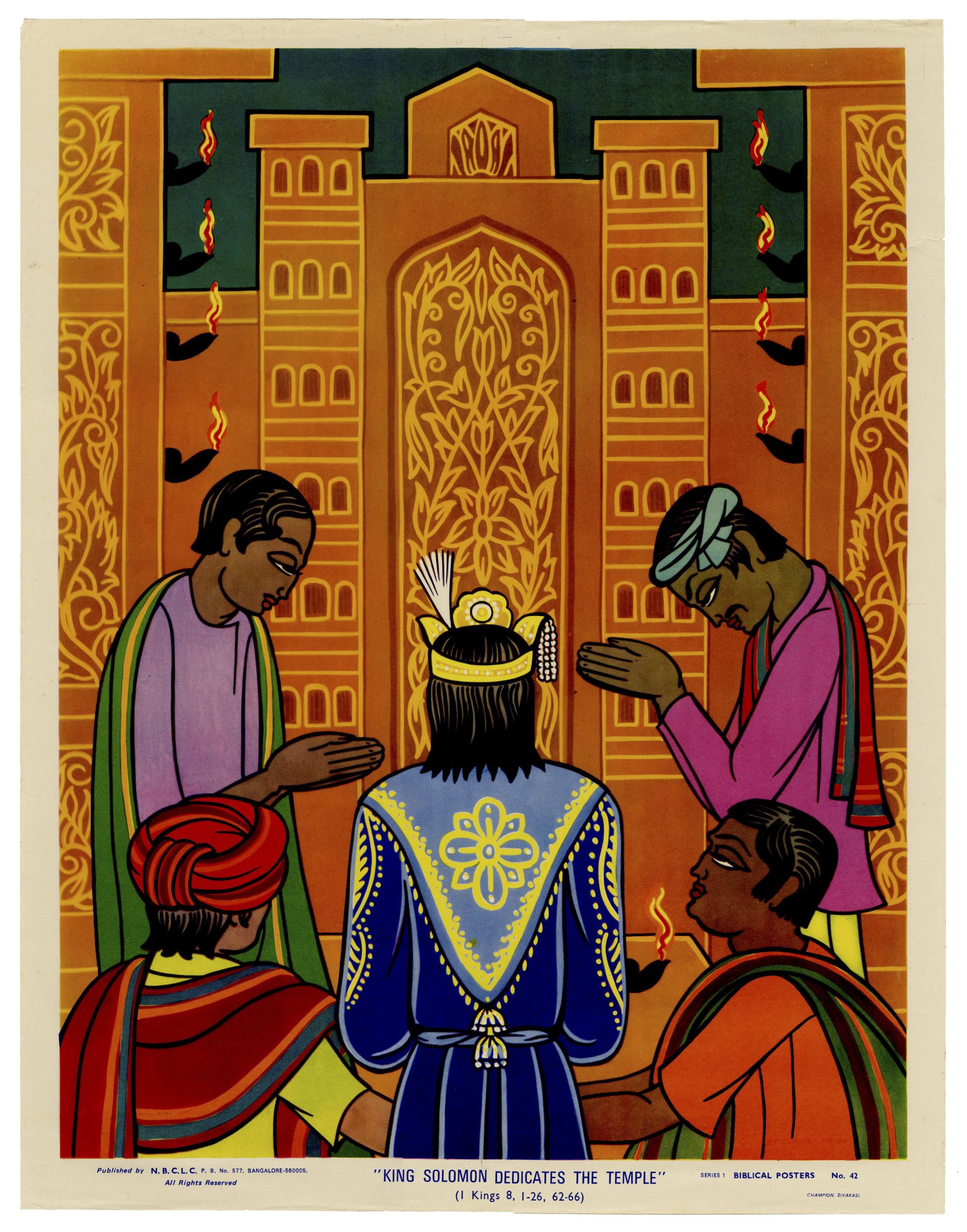
64The same day the king consecrated the middle of the court that was in front of the house of the Lord, for there he offered the burnt offerings and the grain offerings and the fat pieces of the sacrifices of well-being, because the bronze altar that was before the Lord was too small to receive the burnt offerings and the grain offerings and the fat pieces of the sacrifices of well-being.
The Hebrew that is rendered in English as “peace offering” or “sacrifice (or “offerings”) of well-being” or similar is translated into Pökoot as pöghisyö: “gift of peace/fellowship.” This term has the connotations of fellowship, wholeness, restored relationships, etc. The word pöghisyö is also used as a common greeting (much like Shalom in Hebrew).
In the ItalianTraduzione interconfessionale in lingua corrente (2014) it is translated as “sacrificio per il banchetto sacro” (“sacrifice for the holy banquet”), in the Contemporary Russian Version (2nd ed., 2015) as “banquet offering,” or in Tatar as “sacrifice of reconciliation.” (Source: Lénart de Regt in The Bible Translator 2017, p. 131ff. )
The German Jewish translation by Buber and Rosenzweig has “peace meal slaughter” (Friedmahlschlachtung).
The Greek and Hebrew that are translated as “consecration” or “consecrate” in English is translated in Poqomchi’ as “set apart” (when applying to a ritual not to a moral status). (Source: Robert Bascom)
In Newari it is translated as “make holy” (source: Newari Back Translation) and in Kwere as “put to holy work” when it refers to making someone or something suitable for priestly duties, when it refers to individual consecration outside of the priestly duty, “offer (yourselves) for my sake” is also used. (Pioneer Bible Translators, project-specific translation notes in Paratext)
Bura-Pabir: “sacrifice mound” (source: Andy Warrren-Rothlin)
Kalanga: “fireplace of sacrifice” (source: project-specific notes in Paratext)
Cherokee: “fire nurturing place” (source: Bender / Belt 2025, p. 26) (note that the Jewish priest is “fire feeder” in Cherokee)
The Ignaciano translators decided to translate the difficult term in that language according to the focus of each New Testament passage in which the word appears (click or tap here to see the rest of this insight
Willis Ott (in Notes on Translation 88/1982, p. 18ff.) explains:
Matt. 5:23,24: “When you take your offering to God, and arriving, you remember…, do not offer your gift yet. First go to your brother…Then it is fitting to return and offer your offering to God.” (The focus is on improving relationships with people before attempting to improve a relationship with God, so the means of offering, the altar, is not focal.)
Matt. 23:18 (19,20): “You also teach erroneously: ‘If someone makes a promise, swearing by the offering-place/table, he is not guilty if he should break the promise. But if he swears by the gift that he put on the offering-place/table, he will be guilty if he breaks the promise.'”
Luke 1:11: “…to the right side of the table where they burn incense.”
Luke 11.51. “…the one they killed in front of the temple (or the temple enclosure).” (The focus is on location, with overtones on: “their crime was all the more heinous for killing him there”.)
Rom. 11:3: “Lord, they have killed all my fellow prophets that spoke for you. They do not want anyone to give offerings to you in worship.” (The focus is on the people’s rejection of religion, with God as the object of worship.)
1Cor. 9:13 (10:18): “Remember that those that attend the temple have rights to eat the foods that people bring as offerings to God. They have rights to the meat that the people offer.” (The focus is on the right of priests to the offered food.)
Heb. 7:13: “This one of whom we are talking is from another clan. No one from that clan was ever a priest.” (The focus in on the legitimacy of this priest’s vocation.)
Jas. 2:21: “Remember our ancestor Abraham, when God tested him by asking him to give him his son by death. Abraham was to the point of stabbing/killing his son, thus proving his obedience.” (The focus is on the sacrifice as a demonstration of faith/obedience.)
Rev. 6:9 (8:3,5; 9:13; 14:18; 16:7): “I saw the souls of them that…They were under the table that holds God’s fire/coals.” (This keeps the concepts of: furniture, receptacle for keeping fire, and location near God.)
Rev. 11:1: “Go to the temple, Measure the building and the inside enclosure (the outside is contrasted in v. 2). Measure the burning place for offered animals. Then count the people who are worshiping there.” (This altar is probably the brazen altar in a temple on earth, since people are worshiping there and since outside this area conquerors are allowed to subjugate for a certain time.)
In the Hebraic English translation of Everett Fox it is translated as slaughter-site and likewise in the German translation by Buber / Rosenzweig as Schlachtstatt.
The Hebrew olah (עֹלָה) originally means “that which goes up (in smoke).” English Bibles often translates it as “burnt-offering” or “whole burnt-offering,” focusing on the aspect of the complete burning of the offering.
The GreekSeptuagint and the LatinVulgate Bibles translate it as holokautōma / holocautōsis (ὁλοκαύτωμα / ὁλοκαύτωσις) and holocaustum, respectively, meaning “wholly burnt.” While a form of this term is widely used in many Romance languages (Spanish: holocaustos, French: holocaustes, Italian: olocausti, Portuguese: holocaustos) and originally also in the Catholic tradition of English Bible translations, it is largely not used in English anymore today (the preface of the revised edition of the Catholic New American Bible of 2011: “There have been changes in vocabulary; for example, the term ‘holocaust’ is now normally reserved for the sacrilegious attempt to destroy the Jewish people by the Third Reich.”)
Since translation into Georgian was traditionally done on the basis of the Greek Septuagint, a transliteration of holokautōma was used as well, which was changed to a translation with the meaning of “burnt offering” when the Old Testament was retranslated in the 1980’s on the basis of the Hebrew text.
In the Koongo (Ki-manianga) translation by the Alliance Biblique de la R.D. Congo (publ. in 2015) olah is translated as “kill and offer sacrifice” (source: Anicet Bassilua) and in Elhomwe as “fire offering.” (Source: project-specific translation notes in Paratext)
The English translation of Everett Fox uses offering-up (similarly, the German translation by Buber-Rosenzweig has Darhöhung and the French translation by Chouraqui montée).
The Hebrew that is translated as “offering” in English is translated in Venda as nduvho. J. A. van Rooy (in The Bible Translator 1974, p. 439ff. ) explains: “It is derived from the verb u luvha (‘to pay homage to; to acknowledge the superiority of; at the same time usually asking for a favour’). It is sometimes used as a synonym for ‘asking something from a chief. The noun nduvho means ‘a gift of allegiance,’ which corresponds closely with minchah (מִנְחָה) as ‘offering of allegiance.’ This term nduvho has in it the elements of subjugation, of reciprocity (asking for a favor), of being taken up into the same community as the chief in allegiance to him. Only the element of expiation is missing.”
In Northern Emberá, it is translated as “given to God freely.” (Source: Loewen 1980, p. 108)
The Hebrew that is translated as “bronze altar” in English is illustrated for use in Bible translations in East Africa by Pioneer Bible Translators like this:
Image owned by PBT and Jonathan McDaniel and licensed with the Creative Commons Attribution 3.0 Unported License.
The Hebrew, Latin, Ge’ez, and Greek that is translated as “bronze” in English is translated in Newari as “bell-metal,” since bells are made of bronze in Nepal (source: Newari Back Translation).


Leave a Reply
You must be logged in to post a comment.