The Greek that is translated as “the Alpha and the Omega” in English, referring to the first and the last letter of the Greek alphabet is translated in German as “das A und O.” Even though the German alphabet does not end with the letter O, “das A und O” has become an idiom, that — like the Greek — refers to the end and the beginning or the whole.
Languages that versions of “the Alpha and the Omega” have become an idiom with the same meaning include:
The Greek that is translated as “the Beginning and the End” in English is translated in the Swabian 2007 translation by Rudolf Paul as Åfang ond Ziel or “beginning and destination (or: “goal”).”
Following are a number of back-translations of Revelation 22:13:
Uma: “I am the First and the Last. I am the Beginning and the End.'” (Source: Uma Back Translation)
Yakan: “I am the first and I am the last. I am the beginning and I am the end.'” (Source: Yakan Back Translation)
Western Bukidnon Manobo: “I am the Alpha and Omega, which is to say, the origin and the ending of everything,’ said Jesus.” (Source: Western Bukidnon Manobo Back Translation)
Kankanaey: “I am the one who is designated as Alfa and Omega, because I am the first and last. I also am the beginning-place and ending-place of everything.'” (Source: Kankanaey Back Translation)
Tagbanwa: “Because I am the one who was first before all and I indeed will be at the very end. I am the one who created everything and under my authority is its conclusion/being-finished-with.” (Source: Tagbanwa Back Translation)
Tenango Otomi: “The letter A until the letter Z are at the beginning and the end. But I already was living when all things began. And at the day all things are finished, I will continue living forever,’ he said.” (Source: Tenango Otomi Back Translation)
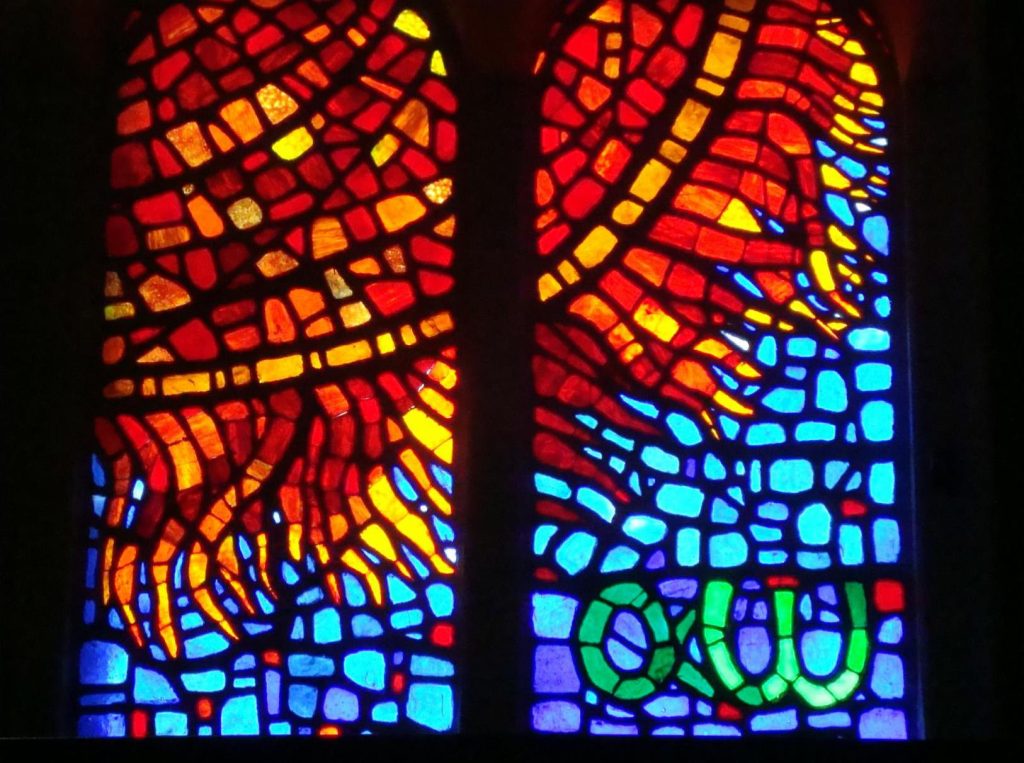
The following is a stained glass window from the Parroquia de los Santos Reyes, Mexico City:
Source:
Stained glass is not just highly decorative, it’s a medium which has been used to express important religious messages for centuries. Literacy was not widespread in the medieval and Renaissance periods and the Church used stained glass and other artworks to teach the central beliefs of Christianity. In Gothic churches, the windows were filled with extensive narrative scenes in stained glass — like huge and colorful picture storybooks — in which worshipers could ‘read’ the stories of Christ and the saints and learn what was required for their religious salvation. (Source: Victoria and Albert Museum )
Click or tap here to see the rest of this insight.
Like a number of other East Asian languages, Japanese uses a complex system of honorifics, i.e. a system where a number of different levels of politeness are expressed in language via words, word forms or grammatical constructs. These can range from addressing someone or referring to someone with contempt (very informal) to expressing the highest level of reference (as used in addressing or referring to God) or any number of levels in-between.
One way Japanese shows different degree of politeness is through the choice of a first person singular and plural pronoun (“I” and “we” and its various forms) as shown here in the widely-used Japanese Shinkaiyaku (新改訳) Bible of 2017. The most commonly used watashi/watakushi (私) is typically used when the speaker is humble and asking for help. In these verses, where God / Jesus is referring to himself, watashi is also used but instead of the kanji writing system (私) the syllabary hiragana (わたし) is used to distinguish God from others.
I am the Alpha and the Omega: see 1.8; 21.6; the first and the last: see 1.17; 2.8; the beginning and the end: see 21.6. All three phrases proclaim the same basic truth in three different ways.
Quoted with permission from Bratcher, Robert G. and Hatton, Howard A. A Handbook on The Revelation to John. (UBS Handbook Series). New York: UBS, 1993. For this and other handbooks for translators see here .
I am the Alpha and the Omega, the First and the Last, the Beginning and the End: These three titles are similar in meaning. Together they emphasize the similar meaning of the titles.
22:13a
I am the Alpha and the Omega:Alpha is the name of the first letter of the Greek alphabet. Omega is the name of the last letter of that alphabet. Here the phrase the Alpha and the Omega is used as a title. It is also a figure of speech. It indicates that Jesus is eternal and has authority over all things. See how you translated this phrase in 1:8 or 21:6.
22:13b
the First and the Last: The title the First and the Last indicates that Jesus existed before all things and will exist after everything in this world ends. This title implies that he is therefore greater than anything and has authority over everything. It is similar in meaning to the title “the Alpha and the Omega.”
If possible, you should translate this title in a different way than the title “the Alpha and the Omega,” because both appear here. See how you translated this phrase in 1:17 or 2:8.
22:13c
the Beginning and the End: The title the Beginning and the End indicates figuratively that Jesus is eternal and has authority over all things. It is similar in meaning to the two previous titles (22:13a–b).
If possible, you should translate this title in a different way than either of those titles. See how you translated this phrase in 21:6.
Living Water is produced for the Bible translation movement in association with Lutheran Bible Translators. Lyrics derived from the ESV® Bible (The Holy Bible, English Standard Version®).

Leave a Reply
You must be logged in to post a comment.