Orthodox Icons are not drawings or creations of imagination. They are in fact writings of things not of this world. Icons can represent our Lord Jesus Christ, the Virgin Mary, and the Saints. They can also represent the Holy Trinity, Angels, the Heavenly hosts, and even events. Orthodox icons, unlike Western pictures, change the perspective and form of the image so that it is not naturalistic. This is done so that we can look beyond appearances of the world, and instead look to the spiritual truth of the holy person or event. (Source )
For purchasing artworks by Kateryna Shadrina go to IconArt Gallery .
Following are a number of back-translations of Revelation 22:14:
Uma: “Fortunate are the people who wash their clothes until they are clean, for they are the ones who are allowed to eat the fruit of the tree of life. They will be allowed to enter into the village through its doors.” (Source: Uma Back Translation)
Yakan: “Happy are the people who wash their clothes so that they are very clean, that means that their livers are clean/holy. Because they will be given authority to enter the doors of that city. And they will also be given authority to eat the fruit of the tree that gives life.” (Source: Yakan Back Translation)
Western Bukidnon Manobo: “How happy all those are who wash their clothes to make them white, which is to say, they let their sins be removed, because if they do that they will be given the right to eat the fruit of the tree which gives life and to enter into the gates of the city.” (Source: Western Bukidnon Manobo Back Translation)
Kankanaey: “The people who launder their clothes are fortunate, because they have authority to enter the entrance of the city and to eat the fruit of the tree which gives life.” (Source: Kankanaey Back Translation)
Tagbanwa: “They can really be happy who are always making their clothes clean, which means, they repent of each sin so that it can be removed. For they will be given authority/the-right to enter into this city and to eat the fruit of this tree which gives life.” (Source: Tagbanwa Back Translation)
Tenango Otomi: “The good fortune has been met by the person who will wash his clothing so that it will always be white. Because those are the persons who will be given the right to eat the fruits of the tree which gives new life. And they will be given the right to enter into the city.” (Source: Tenango Otomi Back Translation)
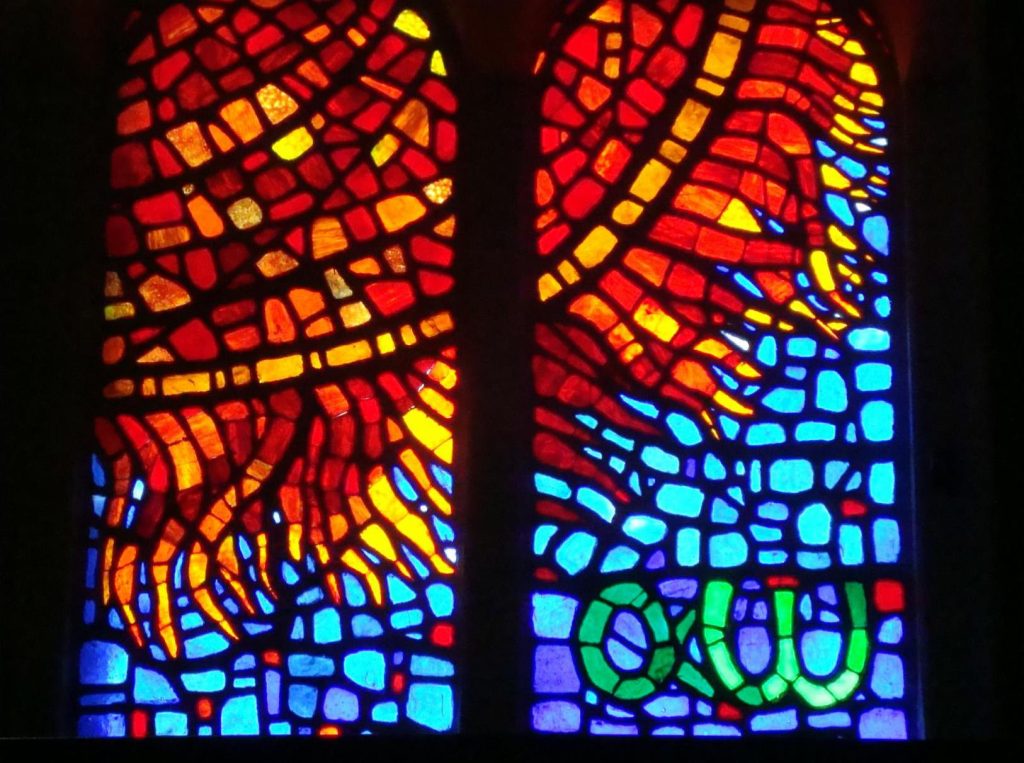
The following is a stained glass window from the Parroquia de los Santos Reyes, Mexico City:
Source:
Stained glass is not just highly decorative, it’s a medium which has been used to express important religious messages for centuries. Literacy was not widespread in the medieval and Renaissance periods and the Church used stained glass and other artworks to teach the central beliefs of Christianity. In Gothic churches, the windows were filled with extensive narrative scenes in stained glass — like huge and colorful picture storybooks — in which worshipers could ‘read’ the stories of Christ and the saints and learn what was required for their religious salvation. (Source: Victoria and Albert Museum )
Those who wash their robes: see 7.14. Here nothing is said about “in the blood of the Lamb,” as in 7.14. It is implied, of course, that this washing makes the robes clean, and this may be expressly stated, “those who wash their robes clean” (Good News Translation). For robes see 6.11.
As the RSV footnote indicates, instead of who wash their robes, some Greek manuscripts have “who do his commandments” (see 12.17; 14.12). The text translated by Revised Standard Version and Good News Translation is to be preferred.
That: this appears to indicate purpose; and by placing a comma after robes, Revised Standard Version seems to connect that with Blessed. It is possible to take the Greek conjunction translated that to express purpose and connect it with the verbal phrase wash their robes: “those who wash their robes in order to….” But it seems better to take the conjunction as final, indicating result: “and as a result they have….” So New Revised Standard Version “so that they will have the right….”
Have the right to the tree of life: that is, have the right to eat the fruit of the tree (see 22.2).
Enter the city by the gates: this is somewhat strange, for it seems to imply that others will have to enter by some other way. The force of this statement may be what would be expressed in English by “the right to enter the city freely,” “full and free access to the city.” Since the tree of life is inside the city, it may be desirable to reverse the two actions as follows: “And so they will have the right to go through the gates into the city and eat the fruit from the tree of life.”
Quoted with permission from Bratcher, Robert G. and Hatton, Howard A. A Handbook on The Revelation to John. (UBS Handbook Series). New York: UBS, 1993. For this and other handbooks for translators see here .
Blessed: The Greek word that the Berean Standard Bible translates as Blessed describes a person who is a good situation. In the Bible, the good situation results from God showing favor/kindness to the person. See how you translated this word in 22:7.
those who wash their robes:
This phrase refers figuratively to becoming clean from their sins. The blood of Jesus cleansed them (7:14).
In some languages a literal translation would not indicate the figurative meaning. If that is true in your language, you may want to:
• Explain the figurative meaning in your translation. For example:
those who wash their robes, ⌊that is, become clean⌋ ⌊from their sins⌋
• Translate the meaning without the figure of speech. For example:
those who become clean ⌊from their sins⌋
You may then want to indicate the literal phrase in a footnote. An example footnote is:
Literally: “those who wash their robes.”
• Translate the literal meaning and explain its figurative meaning in a footnote. For example:
This refers figuratively to becoming clean from their sins.
See how you translated a similar phrase (“have washed their robes”) in 7:14.
wash their robes: This phrase implies that the robes were dirty. For example:
wash their robes clean (Good News Translation)
22:14b
so that: The conjunction so that introduces the result of washing their robes. Other ways to translate this word are:
and so (Good News Translation) -or-
that (New International Version)
they may have the right to the tree of life: This clause indicates that the people who wash their robes have permission or the privilege to eat the fruit of the tree of life. Other ways to translate this clause are:
will be permitted to…eat the fruit from the tree of life (New Living Translation (2004)) -or-
They shall be free to eat from the tree of life (Revised English Bible)
the tree of life: This phrase indicates that the tree is a source of life. Those who eat the fruit will have eternal life. For example:
life-giving tree
See how you translated this phrase in 2:7 or 22:2.
22:14c
may enter the city by its gates: The people who wash their robes will be able to enter the city. For example:
may go through the gates into the city (New International Version)
Living Water is produced for the Bible translation movement in association with Lutheran Bible Translators. Lyrics derived from the ESV® Bible (The Holy Bible, English Standard Version®).


Leave a Reply
You must be logged in to post a comment.