Following are a number of back-translations of Revelation 22:12:
Uma: “The Lord Yesus said: ‘I am about to arrive-e’, [particle connoting: ‘watch out, listen up!’] and I will reward the behavior of each person according to what they have done.” (Source: Uma Back Translation)
Yakan: “‘Listen,’ says Isa. ‘My coming is near and I will reward/repay you each one according to your doings.” (Source: Yakan Back Translation)
Western Bukidnon Manobo: “‘Listen,’ says Jesus, ‘I am coming and then I will reward each one according to what he has done.” (Source: Western Bukidnon Manobo Back Translation)
Kankanaey: “Jesus says, ‘Listen to this. My coming will-be soon. And when I come, I will bring a reward to give to each one according to what he has done.” (Source: Kankanaey Back Translation)
Tagbanwa: “‘For listen,’ says Jesus. ‘Really before long now I will come there to you. I will bring the rewards which I will distribute to each one, according to what he has done.” (Source: Tagbanwa Back Translation)
Tenango Otomi: “Jesus again said: ‘It will be soon when I come. I will bring the wages for each person for his payment. Whether good or evil he has done, that is what the payment is determined by.” (Source: Tenango Otomi Back Translation)
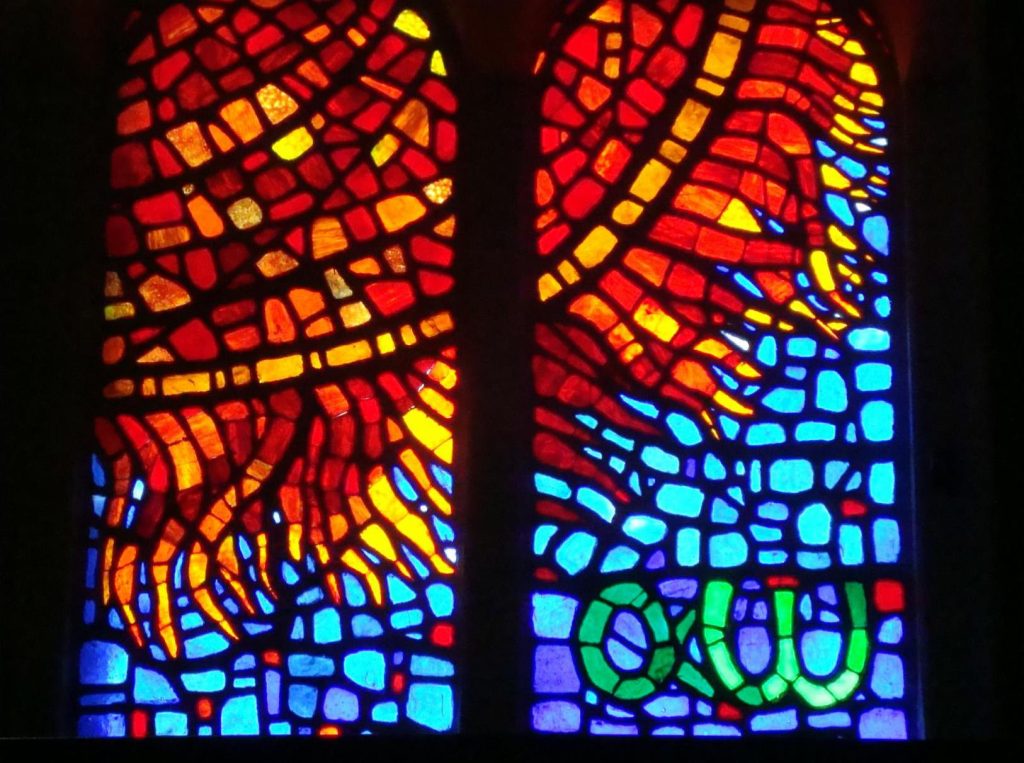
The following is a stained glass window from the Parroquia de los Santos Reyes, Mexico City:
Source:
Stained glass is not just highly decorative, it’s a medium which has been used to express important religious messages for centuries. Literacy was not widespread in the medieval and Renaissance periods and the Church used stained glass and other artworks to teach the central beliefs of Christianity. In Gothic churches, the windows were filled with extensive narrative scenes in stained glass — like huge and colorful picture storybooks — in which worshipers could ‘read’ the stories of Christ and the saints and learn what was required for their religious salvation. (Source: Victoria and Albert Museum )
Click or tap here to see the rest of this insight.
Like a number of other East Asian languages, Japanese uses a complex system of honorifics, i.e. a system where a number of different levels of politeness are expressed in language via words, word forms or grammatical constructs. These can range from addressing someone or referring to someone with contempt (very informal) to expressing the highest level of reference (as used in addressing or referring to God) or any number of levels in-between.
One way Japanese shows different degree of politeness is through the choice of a first person singular and plural pronoun (“I” and “we” and its various forms) as shown here in the widely-used Japanese Shinkaiyaku (新改訳) Bible of 2017. The most commonly used watashi/watakushi (私) is typically used when the speaker is humble and asking for help. In these verses, where God / Jesus is referring to himself, watashi is also used but instead of the kanji writing system (私) the syllabary hiragana (わたし) is used to distinguish God from others.
Behold, I am coming soon: for Behold see 1.7; and see comment at Rev. 22.7, above. By its use of quotation marks, Revised Standard Version intends to show that someone other than the writer is speaking. It is better to indicate that Jesus is the speaker, as Good News Translation, Bible en français courant, and Nova Tradução na Linguagem de Hoje do.
Bringing my recompense, to repay every one: this applies to all, the righteous and the evil alike. So my recompense may be reward (see 11.18) or it may be punishment (see 18.6). Another way of expressing this is “I am coming to either reward or punish all people for what they have done.”
For what he has done: see 2.23, “as your works deserve”; 20.12, 13.
Quoted with permission from Bratcher, Robert G. and Hatton, Howard A. A Handbook on The Revelation to John. (UBS Handbook Series). New York: UBS, 1993. For this and other handbooks for translators see here .
There are several ways to interpret who spoke these verses:
(1) 22:12–16 are the words of Jesus. For example, the God’s Word says:
12 “I’m coming soon! I will bring my reward with me to pay all people based on what they have done. 13 I am the A and the Z, the first and the last, the beginning and the end.
14 “Blessed are those who wash their robes so that they may have the right to the tree of life and may go through the gates into the city. 15 Outside are dogs, sorcerers, sexual sinners, murderers, idolaters, and all who lie in what they say and what they do.
16 “I, Jesus, have sent my angel to give this testimony to you for the churches. I am the root and descendant of David. I am the bright morning star.”
(2) 22:12,13 are the words of someone, probably Jesus ; 22:14,15 are the words of John ; and 22:16 are the words of Jesus. For example, the English Standard Version says:
12 “Behold, I am coming soon, bringing my recompense with me, to repay everyone for what he has done. 13 I am the Alpha and the Omega, the first and the last, the beginning and the end.”
14 Blessed are those who wash their robes, so that they may have the right to the tree of life and that they may enter the city by the gates. 15 Outside are the dogs and sorcerers and the sexually immoral and murderers and idolaters, and everyone who loves and practices falsehood.
16 “I, Jesus, have sent my angel to testify to you about these things for the churches. I am the root and the descendant of David, the bright morning star.”
(3) 22:12–15 are the words of the angel, and 22:16 are the words of Jesus. For example, the New Jerusalem Bible says:
…holy. 12 Look, I am coming soon, and my reward is with me, to repay everyone as their deeds deserve. 13 I am the Alpha and the Omega, the First and the Last, the Beginning and the End. 14 Blessed are those who will have washed their robes clean, so that they will have the right to feed on the tree of life and can come through the gates into the city. 15 Others must stay outside: dogs, fortune–tellers, and the sexually immoral, murderers, idolaters, and everyone of false speech and false life.’
16 I, Jesus, have sent my angel to attest these things to you for the sake of the churches. I am the sprig from the root of David and the bright star of the morning.
It is recommended that you follow interpretation (1), because there is no sign in the Greek that the speaker changes in 22:14 (interpretation 2), and 22:12–13 are more appropriate coming from Jesus than from the angel (22:9–11).
22:12a
Behold: This word means “look.” The word emphasizes or calls attention to the words that follow. It is not a command to look at something. See how you translated this word in 22:7.
I am coming soon: This clause refers to Jesus coming back to his people on earth. The Greek word that the Berean Standard Bible translates as soon can also mean “without delay” or “quickly.” See how you translated this clause in 22:7.
22:12b
My reward is with Me: This clause indicates that Jesus is ready to give a reward. For example:
I will bring my reward with me (New Century Version)
My reward: The Greek word that the Berean Standard Bible translates as reward refers to both benefits and punishment. If possible, use a word that refers to both. In some languages two words are needed to refer to both benefits and punishment. For example:
My reward and my punishment
In some languages it is necessary or more natural to translate the noun reward as a verb or verbs. For example:
I will reward and I will punish
22:12c
to give to each one according to what he has done: This clause indicates that Jesus will both reward good deeds and punish bad deeds. Other ways to translate this clause are:
I will give to each person as his deeds deserve -or-
I will repay all people according to what they have done
Living Water is produced for the Bible translation movement in association with Lutheran Bible Translators. Lyrics derived from the ESV® Bible (The Holy Bible, English Standard Version®).

Leave a Reply
You must be logged in to post a comment.