The Greek that is translated as “saint” in English is rendered into Highland Puebla Nahuatl as “one with a clean hearts,” into Northwestern Dinka as “one with a white hearts,” and into Western Kanjobal as “person of prayer.” (Source: Nida 1952, p. 146)
Chichewa “(person with a) white heart” since “white” is the word that is used in Chichewa for the translation of “holy.” (Source: Mawu a Mulungu mu Chichewa Chalero Back Translation)
The Hebrew, Ge’ez, and Greek that is translated as “widow” in English is translated in West Kewa as ona wasa or “woman shadow” (source: Karl J. Franklin in Notes on Translation 70/1978, pp. 13ff.) and in Newari as “husband already died ones” or “ones who have no husband” (source: Newari Back Translation).
In Cherokee the term is gender neutral and translates to “one who has lost someone.” (Source: Bender / Belt 2025, p. 100)
The etymological meaning of the Hebrewalmanah (אַלְמָנָה) is likely “pain, ache,” the Greekchéra (χήρα) is likely “to leave behind,” “abandon,” and the Englishwidow (as well as related terms in languages such as Dutch, German, Sanskrit, Welsh, or Persian) is “to separate,” “divide” (source: Wiktionary).
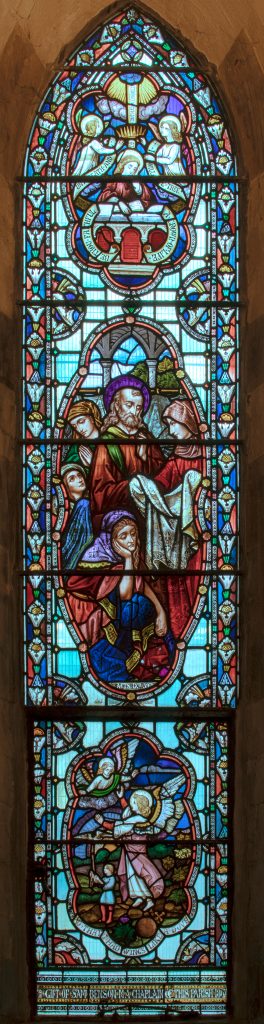
The top scene bears the inscription ‘Be thou faithful unto death and I will give thee a crown of life’; below St Peter is shown healing Tabitha at Joppa, and below again is the inscription ‘O that I had wings like a dove’ (Psalm 55) with a small boy and his kite. (Source: Southwark Cathedral website )
Stained glass is not just highly decorative, it’s a medium which has been used to express important religious messages for centuries. Literacy was not widespread in the medieval and Renaissance periods and the Church used stained glass and other artworks to teach the central beliefs of Christianity. In Gothic churches, the windows were filled with extensive narrative scenes in stained glass — like huge and colorful picture storybooks — in which worshipers could ‘read’ the stories of Christ and the saints and learn what was required for their religious salvation. (Source: Victoria and Albert Museum )
Stained glass is not just highly decorative, it’s a medium which has been used to express important religious messages for centuries. Literacy was not widespread in the medieval and Renaissance periods and the Church used stained glass and other artworks to teach the central beliefs of Christianity. In Gothic churches, the windows were filled with extensive narrative scenes in stained glass — like huge and colorful picture storybooks — in which worshipers could ‘read’ the stories of Christ and the saints and learn what was required for their religious salvation. (Source: Victoria and Albert Museum )
Following are a number of back-translations of Acts 9:41:
Uma: “Petrus held her hand and pulled her until she was standing. After that, he called back all the followers of Yesus and the widows that he had ordered out earlier, and he said to them: ‘Here is your friend, she lives again.'” (Source: Uma Back Translation)
Yakan: “Petros stretched forth his hand and helped her get up. Then he called the disciples of Isa and the widows and he handed-over/presented Dorkas to them alive already.” (Source: Yakan Back Translation)
Western Bukidnon Manobo: “And Peter took hold of her hand, and he caused her to stand. And then Peter called her companion believers and the widow women and he caused them to see Tabitha.” (Source: Western Bukidnon Manobo Back Translation)
Kankanaey: “Pedro took-her-by-the-hand to cause-her-to-stand. Then he called those-aforementioned widows and the other believers, and he showed her alive again.” (Source: Kankanaey Back Translation)
Tagbanwa: “Pedro took hold of her hand and caused her to stand. And then he called the widows and those other believers to come in again, for he presented (her) to them really alive again.” (Source: Tagbanwa Back Translation)
The believers translates the same word as was translated God’s people in verse 32 (see also v. 13). The phrase the believers and the widows does not imply that the widows were not Christians (see 1.14 the women … and Mary; also Mark 16.7). In a number of languages one must indicate clearly the inclusion of “the widows” in the group of “believers,” therefore “the believers, including the widows.”
Quoted with permission from Newman, Barclay M. and Nida, Eugene A. A Handbook on The Acts of the Apostles. (UBS Handbook Series). New York: UBS, 1972. For this and other handbooks for translators see here .
Living Water is produced for the Bible translation movement in association with Lutheran Bible Translators. Lyrics derived from the ESV® Bible (The Holy Bible, English Standard Version®).



Leave a Reply
You must be logged in to post a comment.