
partridge

Partridges have been hunted and trapped for millennia. In the land of Israel there are three common types of partridge which are still found today: the Rock Partridge Alectoris graeca (also known in the Middle East as the Chukar Alectoris chukar), the Black Francolin Francolinus francolinus, and the Sand Partridge Ammoperdix heyi. In modern Hebrew the sand partridge is still called qore’, but in biblical times all three types of partridge were probably referred to by this name. The name means “the caller”, a reference to the ringing crowing of the males, typically while standing on top of a rock.

Partridges were hunted with stones, slings, and throwing sticks, and were also caught in snares. In 1 Samuel 26:20 David likens himself to a partridge being hunted. This is a very apt simile, since he had been moving from one refuge to another, just as a partridge flies short distances from cover to cover when being chased. He had also been hiding in the same rocky hills that partridges inhabit near En Gedi.

In Sirach 11:30 there is reference to “a decoy partridge in a cage”. This refers to a practice still common in many parts of the world. A male partridge is captured and the caged bird is left in an area where it is known there are partridges, or it is taken from the cage and tethered to a bush by its leg. Grain is scattered around and slip noose snares are set. Toward sundown the captive partridge begins to call, and this attracts other partridges, which begin to feed on the grain and are snared. [See also decoy partridge.]

Partridge eggs were also an important part of the ancient diet, and many Bedouin tribes still collect these eggs regularly. Up until the twentieth century partridges of all three types were abundant throughout Palestine. Today they still exist but in much smaller numbers.

The three partridges mentioned above live in slightly different habitats. The rock partridge, as its name suggests, frequents rocky hill terrain. It is found all over Israel, where it makes good use of the broken terrain to remain hidden. The black francolin prefers denser vegetation in wadis or river valleys. The presence of both these partridges is usually known from their calls rather than from actual sightings of the birds. The sand partridge frequents the Judean Desert and can still be seen coming to drink at pools in wadis along the Dead Sea.

All three types of partridge, in spite of their different markings and the fact that the sand partridge is smaller than the other two, are typical of the partridge family. They live in small flocks called coveys, lay a great many eggs, and prefer to run when in danger, flying only when necessary. Even when they take flight they fly for only a short distance before dropping back to the ground. They also have the ability to squat absolutely still, almost in a trance. With their natural camouflage this ability usually means that the birds will not be seen even by someone passing very near them.

The rock partridge is about 35 centimeters (14 inches) in length and has striking white cheeks with a black band running from its brow, through its eyes, down its neck, and curving around its breast. It also has striking black and chestnut stripes on its flanks. Its back and wings are gray. The beak and legs are red. Both sexes look alike.
The black francolin is about the same size but has a slightly shorter tail. The male has a black breast and flanks. The female is a speckled brown.
The sand partridge is the color of the local sand and is about half the size of the other two types.

Partridges or their close relatives the button quails and pheasants are found all over the world, and finding a local equivalent should not prove difficult. In Asia the Bamboo Partridge Alectoris orientalis is found from Pakistan to China and down through Southeast Asia. In Australia the Brown Quail Coturnix australis and the Stubble Quail Coturnix pectoralis are probably the closest equivalents, rather than the mallee fowl or the scrub fowl, which are mound builders, a very specialized type of bird.
In Africa any of the francolins are a good equivalent. They are found all over Africa.
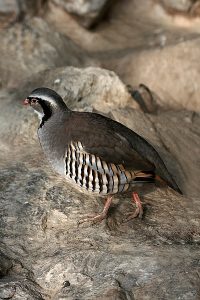
Rock partridge, Wikimedia Commons

Source: All Creatures Great and Small: Living things in the Bible (UBS Helps for Translators)

In Newari it is translated as “pheasant” (source: Newari Back Translation).

Pantokrator

The Ancient Greek Septuagint translation of the Hebrew Bible used the word pantokrator (παντοκράτωρ) or “Ruler of All” as a translation of the second part of the Hebrew term YHWH Tz’vaót (יְהוָ֨ה צְבָא֜וֹת) or “Lord of hosts” (see here) and occasionally ʼĒl Šadạy (אֵל שַׁדַּי‎), translated in English commonly as “God Almighty.” In the deuterocanonical/apocryphal books, pantokrator might have also been used in the original writing. The New Testament uses it one time in the writings of Paul (2 Cor. 6:18) and several times in the book of Revelation (see esp. Rev. 1:8).

One of the most influential icon styles of the Orthodox church has developed from this concept: Christ Pantocrator. In this icon style, Christ is looking straight at the viewer, his right hand is typically spelling a short form of “Jesus Christ” (see the bottom of the entry on Jesus and icons for an explanation), and his left hand holds a New Testament. His head is often surrounded by a halo.

The earliest preserved icon is found in the Greek Orthodox Saint Catherine’s Monastery on Mount Sinai from the 6th century:

In order to express the two natures of Christ, the two sides of the face are not symmetrical. The right side might represent the qualities of his divinity, while his left side represents human nature. (Source )

Orthodox icons are not drawings or creations of imagination. They are in fact writings of things not of this world. Icons can represent our Lord Jesus Christ, the Virgin Mary, and the Saints. They can also represent the Holy Trinity, Angels, the Heavenly hosts, and even events. Orthodox icons, unlike Western pictures, change the perspective and form of the image so that it is not naturalistic. This is done so that we can look beyond appearances of the world, and instead look to the spiritual truth of the holy person or event. (Source )

“Almighty” is translated in Newari as “the strongest of all” (source: Newari Back Translation) and in the English Job translation by E.L. Greenstein (2019) as name: “Shaddai.”

See also LORD of hosts.

LORD of hosts

The Hebrew that is translated as “Lord of hosts” in English (or: “Yahweh of Armies” [translation by John Goldingay, 2018], “Hashem, Master of Legions” [ArtScroll Tanach translation, 2011]) is translated in various ways:

  • Kankanaey: “God the Highest Ruler” (source: Kankanaey Back Translation)
  • Newari: Lord Almighty” (source: Newari Back Translation)
  • Kutu: Mndewa Imulungu or “Lord with all power” (source: Pioneer Bible Translators, project-specific translation notes in Paratext)
  • Mandarin Chinese: Wànjūnzhī Yēhéhuá / Shàngzhǔ (万军之耶和华 / 上主) or “Jehovah / Lord of 10,000 [=all] armies”
  • Mandinka: “Yawe God of the universe” (source: Rob Koops)
  • German (Luther) Bible the second part of the name is transliterated: Herr Zebaoth or “Lord Zebaoth” (Swedish, Finnish and Latvian use the same translation strategy). The Russian Orthodox Synod translation uses a transliteration of the second part of the designation as well: Господь Саваоф / Gospod’ Savaof.
  • Finnish Ortodoksinen Liturginen Psalttari (2021): taivaan voimien Herra or “the Lord of the forces of heaven” (source: Seppo Sipilä in The Bible Translator 2011, p. 12ff. )

The traditional French translation of l’Eternel/Yahve/le Seigneur/Seigneur des armées (“Lord of the armies”) presents a problem when listened to, as Jean-Marc Babut explains (in The Bible Translator 1985, p. 411ff. ):

“For the hearer, the traditional translation l’Eternel/Yahvé/le Seigneur des armées can easily be taken in a bad sense: there is nothing, in fact, to prevent the listener from hearing l’Eternel désarmé, ‘the Eternal One disarmed’ or ‘stripped of his power’! (…). Thus the Bible en français courant [publ. 1997] has decided to use the expression Seigneur/Dieu de l’univers, “Lord/God of the Universe”. This formula, which has an undeniably liturgical ring, seems to have been favorably received by users.”

Other, later French Bibles who have chosen a similar strategy, include Parole de Vie (publ. 2017) with Seigneur de l’univers or Bible Segond 21 (publ. 2007) with l’Eternel, le maître de l’univers.

See also Lord of hosts, host / powers, Pantokrator, and Lord Almighty.

leprosy, leprous

The Greek and Hebrew terms that are often translated as “leprosy (or: defiling/skin disease)” or “leprous (person)” in English is translated in Mairasi as “the bad sickness,” since “leprosy is very common in the Mairasi area” (source: Enggavoter 2004).

Following are various other translations:

  • Shilluk: “disease of animals”
  • San Mateo Del Mar Huave: “devil sore” (this and the above are indigenous expressions)
  • Inupiaq: “decaying sores”
  • Kaqchikel: “skin-rotting disease” (source for this and three above: Eugene Nida in The Bible Translator 1960, p. 34f. )
  • Noongar: “bad skin disease” (source: Warda-Kwabba Luke-Ang)
  • Usila Chinantec “sickness like mal de pinta” (a skin disease involving discoloration by loss of pigment and that also involved social isolation) (source: B. Moore / G. Turner in Notes on Translation 1967, p. 1ff.)
  • Hiligaynon: “dangerous skin disease” (source: Hiligaynon Back Translation)
  • Kankanaey: “fearful skin disease” (source: Kankanaey Back Translation)
  • Tenango Otomi: “terrible rotting” (source: Tenango Otomi Back Translation)
  • Newari: “infectious skin disease” (source: Newari Back Translation)

Targumim (or: Targums) are translations of the Hebrew Bible into Aramaic. They were translated and used when Jewish congregations increasingly could not understand the biblical Hebrew anymore. Targum Onqelos (also: Onkelos) is the name of the Aramaic translation of the Torah (the first five books of the Hebrew Bible) probably composed in Israel/Palestine in the 1st or 2nd century CE and later edited in Babylon in the 4th or 5th century, making it reflect Jewish Babylonian Aramaic. It is the most famous Aramaic translation and was widely used throughout the Jewish communities. In Leviticus 13 and 14 it translates tzaraat as a “quarantining affliction” — focusing “on what occurs to individuals after they suffer the affliction; the person is isolated from the community.” (Source: Israel Drazin in this article ). Similarly, the English Jewish Orthodox ArtScroll Tanach translation (publ. 2011) transliterates it as tzaraat affliction.

See also stricken and leprosy healed.

Learn more on Bible Odyssey: Leprosy (Word Study) and Bible Translations Are for People .

widow

The Hebrew, Ge’ez, and Greek that is translated as “widow” in English is translated in West Kewa as ona wasa or “woman shadow” (source: Karl J. Franklin in Notes on Translation 70/1978, pp. 13ff.) and in Newari as “husband already died ones” or “ones who have no husband” (source: Newari Back Translation).

In Cherokee the term is gender neutral and translates to “one who has lost someone.” (Source: Bender / Belt 2025, p. 100)

The etymological meaning of the Hebrew almanah (אַלְמָנָה) is likely “pain, ache,” the Greek chéra (χήρα) is likely “to leave behind,” “abandon,” and the English widow (as well as related terms in languages such as Dutch, German, Sanskrit, Welsh, or Persian) is “to separate,” “divide” (source: Wiktionary).

See also widows.

cried out the LORD (Lord)

The Hebrew and Greek that is translated as “cried out the Lord (or: Lord)” in English is translated in Newari as “took the name of the Lord (or: Lord)” (source: Newari Back Translation).