The now commonly-used German term Lockvogel, which now refers to someone used as a decoy with a bad, often criminal intent (literally “decoy bird” — partridges were not used as decoys in German hunting during Luther’s time), was made popular in 1534 in the German Bible translation by Martin Luther. (Source: Günther 2017, p. 87)
For other idioms or terms in German that were coined by Bible translation, see here.
Partridges have been hunted and trapped for millennia. In the land of Israel there are three common types of partridge which are still found today: the Rock Partridge Alectoris graeca (also known in the Middle East as the Chukar Alectoris chukar), the Black Francolin Francolinus francolinus, and the Sand Partridge Ammoperdix heyi. In modern Hebrew the sand partridge is still called qore’, but in biblical times all three types of partridge were probably referred to by this name. The name means “the caller”, a reference to the ringing crowing of the males, typically while standing on top of a rock.
Partridges were hunted with stones, slings, and throwing sticks, and were also caught in snares. In 1 Samuel 26:20 David likens himself to a partridge being hunted. This is a very apt simile, since he had been moving from one refuge to another, just as a partridge flies short distances from cover to cover when being chased. He had also been hiding in the same rocky hills that partridges inhabit near En Gedi.
In Sirach 11:30 there is reference to “a decoy partridge in a cage”. This refers to a practice still common in many parts of the world. A male partridge is captured and the caged bird is left in an area where it is known there are partridges, or it is taken from the cage and tethered to a bush by its leg. Grain is scattered around and slip noose snares are set. Toward sundown the captive partridge begins to call, and this attracts other partridges, which begin to feed on the grain and are snared. [See also decoy partridge.]
Partridge eggs were also an important part of the ancient diet, and many Bedouin tribes still collect these eggs regularly. Up until the twentieth century partridges of all three types were abundant throughout Palestine. Today they still exist but in much smaller numbers.
The three partridges mentioned above live in slightly different habitats. The rock partridge, as its name suggests, frequents rocky hill terrain. It is found all over Israel, where it makes good use of the broken terrain to remain hidden. The black francolin prefers denser vegetation in wadis or river valleys. The presence of both these partridges is usually known from their calls rather than from actual sightings of the birds. The sand partridge frequents the Judean Desert and can still be seen coming to drink at pools in wadis along the Dead Sea.
All three types of partridge, in spite of their different markings and the fact that the sand partridge is smaller than the other two, are typical of the partridge family. They live in small flocks called coveys, lay a great many eggs, and prefer to run when in danger, flying only when necessary. Even when they take flight they fly for only a short distance before dropping back to the ground. They also have the ability to squat absolutely still, almost in a trance. With their natural camouflage this ability usually means that the birds will not be seen even by someone passing very near them.
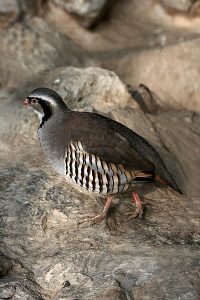
The rock partridge is about 35 centimeters (14 inches) in length and has striking white cheeks with a black band running from its brow, through its eyes, down its neck, and curving around its breast. It also has striking black and chestnut stripes on its flanks. Its back and wings are gray. The beak and legs are red. Both sexes look alike.
The black francolin is about the same size but has a slightly shorter tail. The male has a black breast and flanks. The female is a speckled brown.
The sand partridge is the color of the local sand and is about half the size of the other two types.
Partridges or their close relatives the button quails and pheasants are found all over the world, and finding a local equivalent should not prove difficult. In Asia the Bamboo Partridge Alectoris orientalis is found from Pakistan to China and down through Southeast Asia. In Australia the Brown Quail Coturnix australis and the Stubble Quail Coturnix pectoralis are probably the closest equivalents, rather than the mallee fowl or the scrub fowl, which are mound builders, a very specialized type of bird.
In Africa any of the francolins are a good equivalent. They are found all over Africa.
Like a decoy partridge in a cage, so is the mind of a proud man: Although this line is long in translation, it is one line in the Greek text. The picture here is of a bird trap (not really a cage but a trap) into which birds can come but from which they cannot escape. The trap would be set by placing a partridge in the trap to attract other birds; this bird is the decoy. A partridge is a ground bird about the size of a chicken that is hunted for food. The mind of a proud man is compared to such a baited trap. Such a person schemes to make other people do as he wishes, to “lure [them] into danger” (Good News Translation). Proud is used here in a bad sense; it does not refer to wholesome self-confidence, but to arrogance and disregard for others. Again, man refers to any person, not just a male. In some languages the picture of a “bird trap” will not be clear to readers. In such cases we may render this whole line as “Proud people will lure you into danger just like a decoy that hunters use to trap birds,” or we may omit the picture completely as Good News Translation does with “A proud person is a decoy to lure you into danger.”
And like a spy he observes your weakness: Revised Standard Version, like Good News Translation and most versions, is reading the Hebrew; the Greek says “downfall” rather than weakness. The Hebrew is literally “nakedness.” The same Hebrew word is used in Gen 42.9 (where Revised Standard Version also renders it “weakness”) in connection with “spies.” What spies do is look for an enemy’s weak spots. The textual decision here can go either way, so to be on the conservative side this Handbook suggests translating the Greek; for example, “They [the proud] watch you like spies waiting for you to fall [or, do something wrong].” But translators who wish to follow Revised Standard Version and Good News Translation will be on good ground.
Quoted with permission from Bullard, Roger A. and Hatton, Howard A. A Handbook on Sirach. (UBS Helps for Translators). New York: UBS, 2008. For this and other handbooks for translators see here.


Leave a Reply
You must be logged in to post a comment.