
altar

The Greek, Latin and Hebrew that is translated as “altar” in English is translated in a number of ways:

  • Obolo: ntook or “raised structure for keeping utensils (esp. sacrifice)” (source: Enene Enene)
  • Muna: medha kaefoampe’a or “offering table” (source: René van den Berg)
  • Luchazi: muytula or “the place where one sets the burden down”/”the place where the life is laid down” (source: E. Pearson in The Bible Translator 1954, p. 160ff. )
  • Tzotzil: “where they place God’s gifts” (source: John Beekman in Notes on Translation, March 1965, p. 2ff.)
  • Tsafiki: “table for giving to God” (source: Bruce Moore in Notes on Translation 1/1992, p. 1ff.)
  • Noongar: karla-kooranyi or “sacred fire” (source: Warda-Kwabba Luke-Ang)
  • Uma: “offering-burning table” (source: Uma Back Translation)
  • Yakan: “place for sacrificing” (source: Yakan Back Translation)
  • Tagbanwa: “burning-place” (source: Tagbanwa Back Translation)
  • Tibetan: mchod khri (མཆོད་​ཁྲི།) or “offering throne” (source: gSungrab website )
  • Bura-Pabir: “sacrifice mound” (source: Andy Warrren-Rothlin)
  • Kalanga: “fireplace of sacrifice” (source: project-specific notes in Paratext)
  • Cherokee: “fire nurturing place” (source: Bender / Belt 2025, p. 26) (note that the Jewish priest is “fire feeder” in Cherokee)
The Ignaciano translators decided to translate the difficult term in that language according to the focus of each New Testament passage in which the word appears (click or tap here to see the rest of this insight

Willis Ott (in Notes on Translation 88/1982, p. 18ff.) explains:

  • Matt. 5:23,24: “When you take your offering to God, and arriving, you remember…, do not offer your gift yet. First go to your brother…Then it is fitting to return and offer your offering to God.” (The focus is on improving relationships with people before attempting to improve a relationship with God, so the means of offering, the altar, is not focal.)
  • Matt. 23:18 (19,20): “You also teach erroneously: ‘If someone makes a promise, swearing by the offering-place/table, he is not guilty if he should break the promise. But if he swears by the gift that he put on the offering-place/table, he will be guilty if he breaks the promise.'”
  • Luke 1:11: “…to the right side of the table where they burn incense.”
  • Luke 11.51. “…the one they killed in front of the temple (or the temple enclosure).” (The focus is on location, with overtones on: “their crime was all the more heinous for killing him there”.)
  • Rom. 11:3: “Lord, they have killed all my fellow prophets that spoke for you. They do not want anyone to give offerings to you in worship.” (The focus is on the people’s rejection of religion, with God as the object of worship.)
  • 1Cor. 9:13 (10:18): “Remember that those that attend the temple have rights to eat the foods that people bring as offerings to God. They have rights to the meat that the people offer.” (The focus is on the right of priests to the offered food.)
  • Heb. 7:13: “This one of whom we are talking is from another clan. No one from that clan was ever a priest.” (The focus in on the legitimacy of this priest’s vocation.)
  • Jas. 2:21: “Remember our ancestor Abraham, when God tested him by asking him to give him his son by death. Abraham was to the point of stabbing/killing his son, thus proving his obedience.” (The focus is on the sacrifice as a demonstration of faith/obedience.)
  • Rev. 6:9 (8:3,5; 9:13; 14:18; 16:7): “I saw the souls of them that…They were under the table that holds God’s fire/coals.” (This keeps the concepts of: furniture, receptacle for keeping fire, and location near God.)
  • Rev. 11:1: “Go to the temple, Measure the building and the inside enclosure (the outside is contrasted in v. 2). Measure the burning place for offered animals. Then count the people who are worshiping there.” (This altar is probably the brazen altar in a temple on earth, since people are worshiping there and since outside this area conquerors are allowed to subjugate for a certain time.)

See also altar (Acts 17:23).


In the Hebraic English translation of Everett Fox it is translated as slaughter-site and likewise in the German translation by Buber / Rosenzweig as Schlachtstatt.
flat

In Gbaya, the notion of a something flattened (like a wafer, plates, tablets or a covering is emphasized with ndaɗa-ndaɗa, an ideophone used to designate something that is flat and light in appearance, like a flattened box.

Ideophones are a class of sound symbolic words expressing human sensation that are used as literary devices in many African languages. (Source: Philip Noss)

bronze

The Hebrew, Latin, Ge’ez, and Greek that is translated as “bronze” in English is translated in Newari as “bell-metal,” since bells are made of bronze in Nepal (source: Newari Back Translation).

See also bronze vessel.

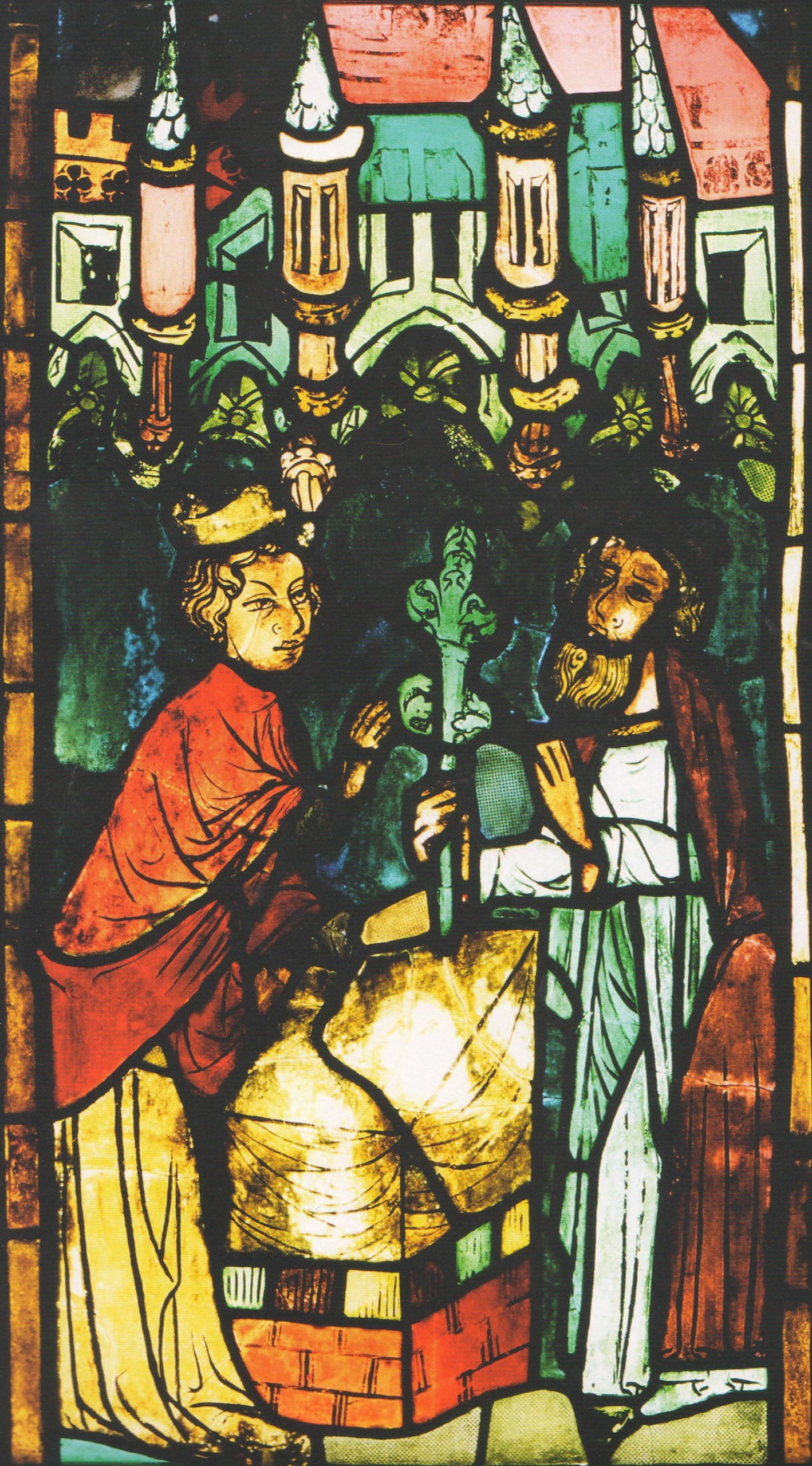
The Budding of Aaron’s Rod

The following is a stained glass window from the Three choir windows in the Marienkirche, Frankfurt (Oder), Germany, of the 14th century, depicting the budding of Aaron’s rod:

Source: Der gläserne Schatz: Die Bilderbibel der St. Marienkirche in Frankfurt (Oder), Neuer Berlin Verlag, 2005, copyright for this image: Brandenburgisches Landesamt für Denkmalpflege und Archäologisches Landesmuseum

Stained glass is not just highly decorative, it’s a medium which has been used to express important religious messages for centuries. Literacy was not widespread in the medieval and Renaissance periods and the Church used stained glass and other artworks to teach the central beliefs of Christianity. In Gothic churches, the windows were filled with extensive narrative scenes in stained glass — like huge and colorful picture storybooks — in which worshipers could ‘read’ the stories of Christ and the saints and learn what was required for their religious salvation. (Source: Victoria and Albert Museum )

See also other stained glass windows from the Marienkirche in Frankfurt.

complete verse (Numbers 17:4)

Following are a number of back-translations as well as a sample translation for translators of Numbers 17:4:

  • Kupsabiny: “Bring the sticks to my Tent to stay where we meet there in front of the Ark of the Covenant.” (Source: Kupsabiny Back Translation)
  • Newari: “Put them in front of the ark of the covenant in the Most Holy Place, in the place where I meet with you.” (Source: Newari Back Translation)
  • Hiligaynon: “Place/Put them all in the Meeting-Together-Place Tent, in front of the Box of the Law where I meet both with you (plur.) (and) Aaron.” (Source: Hiligaynon Back Translation)
  • English: “Put those sticks inside the Sacred Tent, in front of the sacred chest that has in it the tablets on which the Ten Commandments are written. That is the place where I always talk with you.” (Source: Translation for Translators)

1st person pronoun referring to God (Japanese)

Click or tap here to see the rest of this insight.

Like a number of other East Asian languages, Japanese uses a complex system of honorifics, i.e. a system where a number of different levels of politeness are expressed in language via words, word forms or grammatical constructs. These can range from addressing someone or referring to someone with contempt (very informal) to expressing the highest level of reference (as used in addressing or referring to God) or any number of levels in-between.

One way Japanese shows different degree of politeness is through the choice of a first person singular and plural pronoun (“I” and “we” and its various forms) as shown here in the widely-used Japanese Shinkaiyaku (新改訳) Bible of 2017. The most commonly used watashi/watakushi (私) is typically used when the speaker is humble and asking for help. In these verses, where God / Jesus is referring to himself, watashi is also used but instead of the kanji writing system (私) the syllabary hiragana (わたし) is used to distinguish God from others.

(Source: S. E. Doi, see also S. E. Doi in Journal of Translation, 18/2022, p. 37ff. )

See also pronoun for “God”.

formal 2nd person plural pronoun (Japanese)

Click or tap here to see the rest of this insight.

Like a number of other East Asian languages, Japanese uses a complex system of honorifics, i.e. a system where a number of different levels of politeness are expressed in language via words, word forms or grammatical constructs. These can range from addressing someone or referring to someone with contempt (very informal) to expressing the highest level of reference (as used in addressing or referring to God) or any number of levels in-between.

One way Japanese shows different degree of politeness is through the choice of a formal plural suffix to the second person pronoun (“you” and its various forms) as shown here in the widely-used Japanese Shinkaiyaku (新改訳) Bible of 2017. In these verses, anata-gata (あなたがた) is used, combining the second person pronoun anata and the plural suffix -gata to create a formal plural pronoun (“you” [plural] in English).

(Source: S. E. Doi, see also S. E. Doi in Journal of Translation, 18/2022, p. 37ff. )