The Hebrew, Greek, Ge’ez, and Latin that is translated as “soul” in English is translated in Chol with a term that refers to the invisible aspects of human beings (source: Robert Bascom), in Yagaria with oune or “shadow, reflection” (source: Renck, p. 81), and in Elhomwe as “heart” (source: project-specific translation notes in Paratext).
The Mandarin Chineselínghún (靈魂 / 灵魂), literally “spirit-soul,” is often used for “soul” (along with xīn [心] or “heart”). This is a term that was adopted from Buddhist sources into early Catholic writings and later also by Protestant translators. (Source: Zetzsche 1996, p. 32, see also Clara Ho-yan Chan in this article )
In Chichewa, moyo means both “soul” and “life.” (Source: Mawu a Mulungu mu Chichewa Chalero Back Translation)
Retrotraducciones en español (haga clic o pulse aquí)
El grupo llegó al lugar de Getsemaní y Jesús dijo a los discípulos: “Uds, sientense y queden esperando mientras yo voy a orar.”
Jesús llamó a Pedro, Jacobo y Juan que vinieran con él. Jesús sentió angustiado y triste y dijo: “Mi alma adentro de mi está angustiado y muy triste, siento que ahorita ya he muerto, uds 3 quedense a vigilar.”
Jesús se fue a orar a Dios que quitara su sufrimiento, Jesús caminó y se arrodilló en el suelo, inclinó su cabeza hacia el suelo y se prostró.
Oró: “Padre, mi papá, tú puedes hacer todo, por favor no dejame sufrir, es como beber una copa amarga, por favor, quitamela, pero no (haga) mi voluntad sino tú voluntad.”
Se paró y caminó hacia los discípulos y vio a los tres acostados durmiendo, y cuando vio que Pedro también estaba dormido, dijo: “Simón, ¿estás dormido? ¿No puedes mantener los ojos abiertos por un ratito, una mera hora?
Uds vigilen y oren que no caigan en tentación. El espíritu adentro de uds tiene ganas, pero la carne del cuerpo es débil.”
Otra vez Jesús caminó en la otra dirección y oró lo mismo. Adentro, los ojos de los discípulos gradualmente se cerraron y durmieron fuerte.
Jesús caminó (hacia los discípulos) y vio que estaban dormidos. Los discípulos abrieron los ojos: ¡caray! no sabían qué decirlo.
Jesús caminó hacia el otro lado y oró por tercera vez, y regresó diciendo: “Uds sigan dormidos y descansen, ya basta.
Mira, un poco por allá ya están las personas que arrestarán al hijo del hombre y lo llevarán ante pecadores.
Ya viene el hombre que me traicionará, ya levantense y vamonos.”
The group arrived at the place (called) Gethsemane and Jesus said to the disciples: “You sit down and stay here waiting while go to pray.”
Jesus called Peter, James and John to go with him. Jesus felt distressed and sad and said: “My soul is distressed in me and very sad, I feel as if I have already died now. You three stay here and keep watch.”
Jesus went off to pray that God would take away his suffering, Jesus walked and knelt down on the ground, inlcined his head to the ground and prostrated himself.
He prayed: “Father, my Dad, you can do everything, please don’t let me suffer, it’s like drinking a bitter cup, please, take it away from me, but not my will, but yours.”
He got up and walked to the disciples and saw the three of them sleeping, and when he saw that Peter also was sleeping, he said: “Simon, are you sleeping? Can you not keep your eyes open for a little while, not even one hour?
“Keep watch and pray that you don’t fall in temptation. The spirit inside you is willing but the flesh of the body is weak.”
Again, Jesus walked the other way and prayed the same way. Inside, the eyes of the disciples were gradually closing and they slept deeply.
Jesus walked over (to the disciples) and saw they were sleeping. The disciples opened their eyes: oh no!, they didn’t know what to say.
Jesus walked the other way and prayed a third time and he walked back saying: “Continue sleeping, and resting, it’s enough.
“Look, over there just a little ways off are the people who will arrest the Son of Man and will take him before sinners.
“The man who will betray me is already coming, it’s time to get up, let’s go.”
Jesus and his disciples came to a place called Gethsemane. There Jesus said to his disciples:
— Stay here, I’ll go and pray.
He took three disciples with him — Peter, James, John. The four of them went. On the way, Jesus felt a strong anxiety in his heart. He said to the disciples:
— My heart suffers! The time of my death is approaching. You stay here, stay awake, do not sleep. I will go and pray.
Jesus stepped aside, fell to the ground and began to pray:
— My God! Make this terrible suffering pass me by! You are my father! You can do everything. Please, make this suffering not happen to me. But let it be what you want, not what I want.
Then Jesus returned to the three disciples and saw that they were sleeping. He said:
— Peter! Couldn’t you stay awake for just one hour? You, disciples, be attentive, pray! Be prepared for the hour when trouble happens. The spirit is strong, but the body is weak.
Jesus went to pray again. He prayed the same words, then came back and again saw the disciples sleeping. Jesus called them, but the disciples barely opened their eyes, they could not say anything. Jesus went to pray for the third time, and when he returned, the disciples were still sleeping.
Jesus said:
— You’re sleeping sweetly. Enough! The time is coming when sinners will seize the Son of Man. Rise!
The disciples got up and followed Jesus. As they walked, they noticed a man in the distance.
Jesus said to his disciples:
— You see, a man is approaching along the road. He will betray me.
Original Russian back-translation (click or tap here):
Иисус с учениками пришли в место, которое называлось Гефсимания. Там Иисус сказал ученикам:
— Оставайтесь здесь, я же отойду помолиться.
Трех учеников — Петра, Иакова, Иоанна — он взял с собой. Вчетвером они пошли. Иисус по дороге чувствовал сильную тревогу на сердце. Он сказал ученикам:
— Сердце мое страдает! Приближается время моей смерти. Вы оставайтесь тут, бодрствуйте, не спите. Я же пойду молиться.
Иисус отошел в сторону, пал на землю и начал молиться:
— Бог мой! Сделай так, чтобы эти страшные страдания прошли мимо меня! Ты — мой отец! Ты можешь сделать все. Прошу, сделай так, чтобы не случились со мной эти страдания. Но пусть будет то, что хочешь ты, а не я.
Потом Иисус вернулся к трем ученикам и увидел, что они спят. Он сказал:
— Петр! Неужели ты не мог один только час бодрствовать? Вы, ученики, будьте внимательны, молитесь! Будьте готовы к тому часу, когда случится беда. Дух силен — а тело слабо.
Иисус снова пошел молиться. Он молился тем же словами, потом вернулся обратно и опять увидел учеников спящими. Иисус звал их, но ученики едва приоткрывали глаза, сказать ничего не могли. Иисус в третий раз отправился молиться, а когда вернулся, ученики по-прежнему спали.
Иисус сказал:
— Вы сладко спите. Довольно! Приближается время, когда грешники схватят Сына человеческого. Вставайте!
Ученики поднялись и последовали за Иисусом. По дороге они заметили вдали человека.
Иисус сказал ученикам:
— Видите, приближается человек по дороге. Он предаст меня.
Following are a number of back-translations of Mark 14:34:
Uma: “He said to them: ‘My heart is so sad, I feel like I’m about to die. You stay here for now and keep-watch!'” (Source: Uma Back Translation)
Yakan: “So-then he said to them, ‘My liver is very grieved, it almost kills me. Stay/remain here and keep-watch (jaga).'” (Source: Yakan Back Translation)
Western Bukidnon Manobo: “and he said to them, ‘My breath is very painful. It’s as if I were about to die. You stay here and don’t go to sleep.'” (Source: Western Bukidnon Manobo Back Translation)
Kankanaey: “and he said to them, ‘My sadness is excessive. It’s as if this will be my death. You stay here and don’t go to sleep.'” (Source: Kankanaey Back Translation)
Tagbanwa: “He said to those three, ‘I am really very sad/troubled like it would kill me. I ask you please to wait here and don’t go to sleep. Just stay awake.'” (Source: Tagbanwa Back Translation)
Hand colored stencil print on momigami by Sadao Watanabe (1962). Image taken with permission from the SadaoHanga Catalogue where you can find many more images and information about Sadao Watanabe. For other images of Sadao Watanabe art works in TIPs, see here.
Following is a painting (“Jesus’ agony in the garden of Gethsemane”) by Kim Ki-chang (1913-2001):
Kim Ki-chang (pen name: Unbo) had been deaf and partially mute since the age of 7. He painted a series of 30 paintings for the “Life of Christ” cycle in 1952 during the Korean War. Kim portrayed Jesus as a seonbi / 선비, or a Joseon Period (1392-1910) gentleman scholar, wearing a gat / 갓 (hat) and dopo / 도포 (robe). For other images of Kim Ki-chang art works in TIPs, see here.
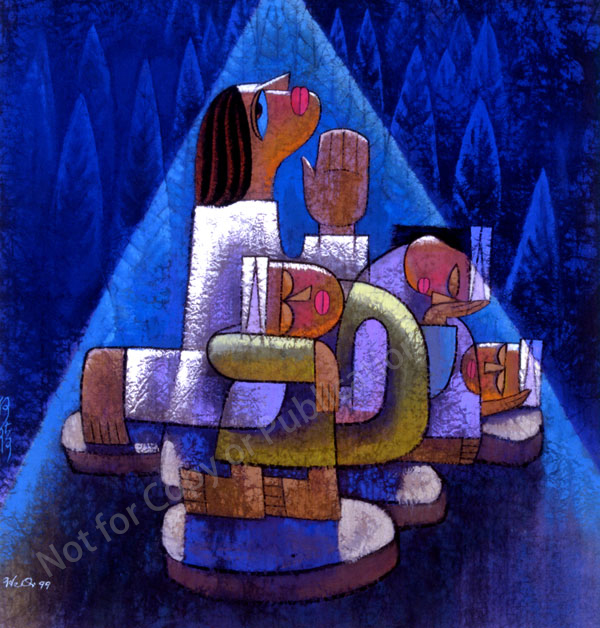
Following is a painting (“Prayer at Gethsemane”) by He Qi:
Image taken from He Qi Art . For purchasing prints of this and other artworks by He Qi go to heqiart.com . For other images of He Qi art works in TIPs, see here
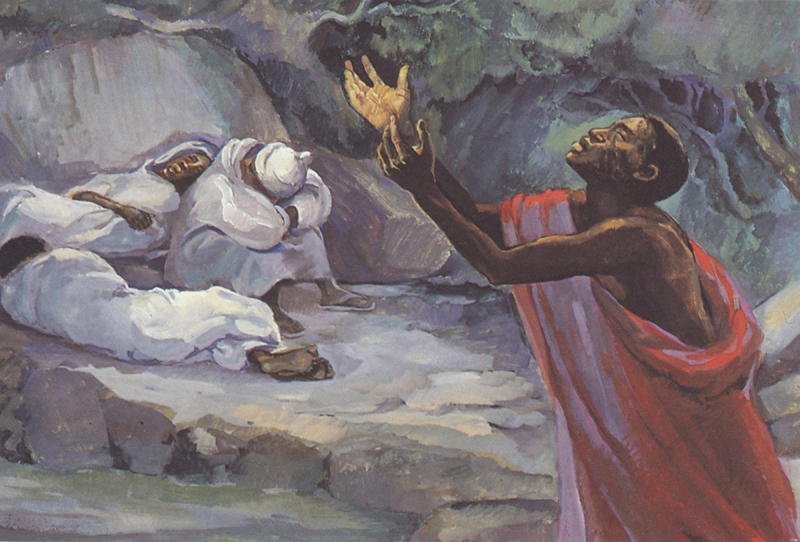
Following is a 1973 painting of the JESUS MAFA project, a response to New Testament readings from the Lectionary by a Christian community in Cameroon, Africa. Each of the readings was selected and adapted to dramatic interpretation by the community members. Photographs of their interpretations were made, and these were then transcribed to paintings:
From Art in the Christian Tradition, a project of the Vanderbilt Divinity Library, Nashville, TN. Image retrieved March 23, 2026. Original source: librairie-emmanuel.fr.
Photo by NateBergin, hosted by Wikimedia Commons under a Creative Commons Attribution 4.0 International license
Stained glass is not just highly decorative, it’s a medium which has been used to express important religious messages for centuries. Literacy was not widespread in the medieval and Renaissance periods and the Church used stained glass and other artworks to teach the central beliefs of Christianity. In Gothic churches, the windows were filled with extensive narrative scenes in stained glass — like huge and colorful picture storybooks — in which worshipers could ‘read’ the stories of Christ and the saints and learn what was required for their religious salvation. (Source: Victoria and Albert Museum )
Click or tap here to see the rest of this insight.
Like a number of other East Asian languages, Japanese uses a complex system of honorifics, i.e. a system where a number of different levels of politeness are expressed in language via words, word forms or grammatical constructs. These can range from addressing someone or referring to someone with contempt (very informal) to expressing the highest level of reference (as used in addressing or referring to God) or any number of levels in-between.
One way Japanese shows different degree of politeness is through the choice of a first person singular and plural pronoun (“I” and “we” and its various forms) as shown here in the widely-used Japanese Shinkaiyaku (新改訳) Bible of 2017. The most commonly used watashi/watakushi (私) is typically used when the speaker is humble and asking for help. In these verses, where God / Jesus is referring to himself, watashi is also used but instead of the kanji writing system (私) the syllabary hiragana (わたし) is used to distinguish God from others.
Click or tap here to see the rest of this insight.
Like a number of other East Asian languages, Japanese uses a complex system of honorifics, i.e. a system where a number of different levels of politeness are expressed in language via words, word forms or grammatical constructs. These can range from addressing someone or referring to someone with contempt (very informal) to expressing the highest level of reference (as used in addressing or referring to God) or any number of levels in-between.
One way Japanese shows different degree of politeness is through the usage of an honorific construction where the morpheme are (され) is affixed on the verb as shown here in the widely-used Japanese Shinkaiyaku (新改訳) Bible of 2017. This is particularly done with verbs that have God as the agent to show a deep sense of reverence. Here, iw-are-ru (言われる) or “say” is used.
Living Water is produced for the Bible translation movement in association with Lutheran Bible Translators. Lyrics derived from the ESV® Bible (The Holy Bible, English Standard Version®).






Leave a Reply
You must be logged in to post a comment.