In Gbaya, the notion of “weighed down with sleep” in Luke 9:32 is emphasized with gbéyéŋ, an ideophone used to describe something falling to the ground. Ideophones are a class of sound symbolic words expressing human sensation that are used as literary devices in many African languages. (Source: Philip Noss)
In the Catholic Mandarin ChineseSigao version it is translated with a historical Chinese idiom: hūnhūn yùshuì (昏昏欲睡), lit. “drowsy and wanting to sleep.” (Source: Toshikazu S. Foley in Hong Kong Journal of Catholic Studies, 2011, p. 45ff.)
In Gbaya, the notion of being flat on the ground or falling to the ground is emphasized in the referenced verses with gbéyéŋ, an ideophone that expresses the fact of being flat on the ground, or falling to the ground.
Ideophones are a class of sound symbolic words expressing human sensation that are used as literary devices in many African languages. (Source: Philip Noss)
Following is a Ukrainian Orthodox icon of the Transfiguration by Ivan Rutkovych (c. 1650 – c. 1708) (for the Church of Christ’s Nativity in Zhovkva, Ukraine, today in the Lviv National Museum).
Orthodox Icons are not drawings or creations of imagination. They are in fact writings of things not of this world. Icons can represent our Lord Jesus Christ, the Virgin Mary, and the Saints. They can also represent the Holy Trinity, Angels, the Heavenly hosts, and even events. Orthodox icons, unlike Western pictures, change the perspective and form of the image so that it is not naturalistic. This is done so that we can look beyond appearances of the world, and instead look to the spiritual truth of the holy person or event. (Source )
Orthodox Icons are not drawings or creations of imagination. They are in fact writings of things not of this world. Icons can represent our Lord Jesus Christ, the Virgin Mary, and the Saints. They can also represent the Holy Trinity, Angels, the Heavenly hosts, and even events. Orthodox icons, unlike Western pictures, change the perspective and form of the image so that it is not naturalistic. This is done so that we can look beyond appearances of the world, and instead look to the spiritual truth of the holy person or event. (Source )
Following is a hand colored stencil print on momigami of Peter by Sadao Watanabe (1970):
Image taken with permission from the SadaoHanga Catalogue where you can find many more images and information about Sadao Watanabe. For other images of Sadao Watanabe art works in TIPs, see here.
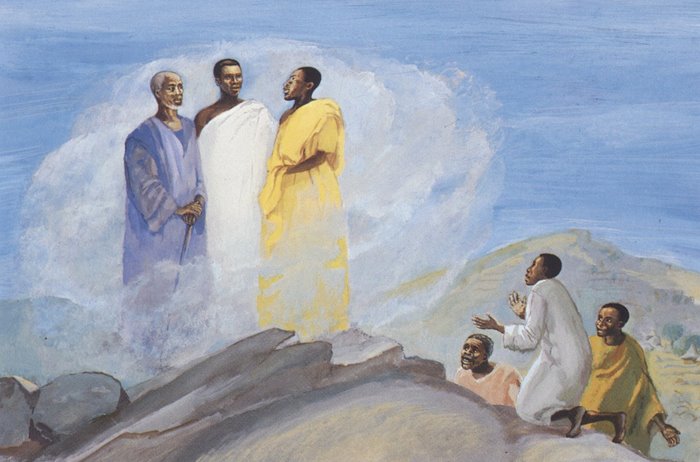
Following is a 1973 painting of the JESUS MAFA project, a response to New Testament readings from the Lectionary by a Christian community in Cameroon, Africa. Each of the readings was selected and adapted to dramatic interpretation by the community members. Photographs of their interpretations were made, and these were then transcribed to paintings:
In this theatrical representation of Jesus’ transfiguration, Jesus is robed in a dazzling white garment, as the story in the gospels describes. He appears to be greeting Moses and Elijah like old friends as they are surrounded by a cloud that makes the whole scene feel ethereal. Peter, James, and John look on with flabbergasted and fearful expressions, bewildered at what they should do. This painting invites the viewer to imagine what it would be like to have seen such amazing things. Undoubtedly, it would inspire one to follow and obey Jesus, just as God commands in the story: “This is my son, the beloved. Listen to him!”
From Art in the Christian Tradition, a project of the Vanderbilt Divinity Library, Nashville, TN. Image retrieved March 23, 2026. Original source: librairie-emmanuel.fr.
Following are a number of back-translations of Luke 9:32:
Noongar: “Peter and the other disciples were lying asleep, but they woke up and saw Jesus, shining white, and two men standing with him.” (Source: Warda-Kwabba Luke-Ang)
Uma: “At that time, Petrus and his companions were sound asleep. When they woke up, they saw Yesus shining beautiful with those two people who were with him.” (Source: Uma Back Translation)
Yakan: “Na, Petros and his companions had fallen asleep hep but they woke up and they saw the brightness of Isa and the two standing beside him.” (Source: Yakan Back Translation)
Western Bukidnon Manobo: “Now as for Peter and his companions, they fell asleep and when they awoke, they saw the powerful shining of Jesus and the two men who were with Jesus.” (Source: Western Bukidnon Manobo Back Translation)
Kankanaey: “Meanwhile plural Pedro were sleeping, but then they woke-up and they saw the dazzling of Jesus and the two men who were standing-with him.” (Source: Kankanaey Back Translation)
Tagbanwa: “Well, Pedro and those two companions of his were sound asleep. But it’s like they were-suddenly-awakened. And then they saw the praiseworthiness/glory of Jesus and those two people who were standing close to him.” (Source: Tagbanwa Back Translation)
God transcends gender, but most languages are limited to grammatical gender expressed in pronouns. In the case of English, this is traditionally confined to “he” (or in the forms “his,” “him,” and “himself”), “she” (and “her,” “hers,” and “herself”), and “it” (and “its” and “itself”).
Modern Mandarin Chinese, however, offers another possibility. Here, the third-person singular pronoun is always pronounced the same (tā), but it is written differently according to its gender (他 is “he,” 她 is “she,” and 它/牠 is “it” and their respective derivative forms). In each of these characters, the first (or upper) part defines the gender (man, woman, or thing/animal), while the second element gives the clue to its pronunciation.
In 1930, after a full century with dozens of Chinese translations, Bible translator Wang Yuande (王元德) coined a new “godly” pronoun: 祂. Chinese readers immediately knew how to pronounce it: tā. But they also recognized that the first part of that character, signifying something spiritual, clarified that each person of the Trinity has no gender aside from being God.
While the most important Protestant and Catholic Chinese versions respectively have opted not to use 祂, some Bible translations do and it is widely used in hymnals and other Christian materials. Among the translations that use 祂 to refer to “God” were early versions of Lü Zhenzhong’s (呂振中) version (New Testament: 1946, complete Bible: 1970). R.P. Kramers (in The Bible Translator 1956, p. 152ff. ) explains why later versions of Lü’s translation did not continue with this practice: “This new way of writing ‘He,’ however, has created a minor problem of its own: must this polite form be used whenever Jesus is referred to? Lü follows the rule that, wherever Jesus is referred to as a human being, the normal tā (他) is written; where he is referred to as divine, especially after the ascension, the reverential tā (祂) is used.”
In that system, one kind of pronoun is used for humans (male and female alike) and others for natural elements, non-liquid masses, and some spiritual entities (one other is used for large animals and another one for miscellaneous items). While in these languages the pronoun for spiritual entities used to be employed when referring to God, this has changed into the use of the human pronoun.
Lynell Zogbo (in The Bible Translator 1989, p. 401ff. ) explains: “From informal discussions with young Christians especially, it would appear that, at least for some people, the experience and/or concepts of Christianity are affecting the choice of pronoun for God. Some people explain that God is no longer ‘far away,’ but is somehow tangible and personal. For these speakers God has shifted over into the human category.”
In Kouya, God (the Father) and Jesus are referred to with the human pronoun ɔ, whereas the Holy Spirit is referred to with a non-human pronoun. (Northern Grebo and Western Krahn make a similar distinction.)
Eddie Arthur, a former Kouya Bible translation consultant, says the following: “We tried to insist that this shouldn’t happen, but the Kouya team members were insistent that the human pronoun for the Spirit would not work.”
In Burmese, the pronoun ko taw (ကိုယ်တော်) is used either as 2nd person (you) or 3rd person (he, him, his) reference. “This term clearly has its root in the religious language in Burmese. No ordinary persons are addressed or known by this pronoun because it is reserved for Buddhist monks, famous religious teachers, and in the case of Christianity, the Trinity.” (Source: Gam Seng Shae in The Bible Translator 2002, p. 202ff. )
In Thai, the pronoun phra`ong (พระองค์) is used, a gender-neutral pronoun which must refer to a previously introduced royal or divine being. Similarly, in Northern Khmer, which is spoken in Thailand, “an honorific divine pronoun” is used for the pronoun referring to the persons of the Trinity (source: David Thomas in The Bible Translator 1993, p. 445 ). In Urak Lawoi’, another language spoken in Thailand, the translation often uses tuhat (ตูฮัด) — “God” — ”as a divine pronoun where Thai has phra’ong even though it’s actually a noun.” (Source for Thai and Urak Lawoi’: Stephen Pattemore)
The English “Contemporary Torah” addresses the question of God and gendered pronouns by mostly avoiding pronouns in the first five books of the Hebrew Bible/Old Testament (unless God is referred to as “lord,” “father,” “king,” or “warrior”). It does that by either using passive constructs (“He gave us” vs. “we were given”), by using the adjective “divine” or by using “God” rather than a pronoun.
Some Protestant and Orthodox English Bibles use a referential capitalized spelling when referring to the persons of the Trinity with “He,” “His,” “Him,” or “Himself.” This includes for instance the New American Standard Bible or The Orthodox New Testament, but most translations do not. Other languages where this is also done (in most Bible translations) are Twents as well as Indonesian and Malay. In the latter two languages this follows the language usage according to the Qur’an, which in turn predicts that usage (see Soesilo in The Bible Translator 1991, p. 442ff. and The Bible Translator 1997, p. 433ff. ).
Living Water is produced for the Bible translation movement in association with Lutheran Bible Translators. Lyrics derived from the ESV® Bible (The Holy Bible, English Standard Version®).





Leave a Reply
You must be logged in to post a comment.