Image taken from He Qi Art . For purchasing prints of this and other artworks by He Qi go to heqiart.com . For other images of He Qi art works in TIPs, see here.
Following is a painting by Kim Ki-chang (1913-2001):
Kim Ki-chang (pen name: Unbo) had been deaf and partially mute since the age of 7. He painted a series of 30 paintings for the “Life of Christ” cycle in 1952 during the Korean War. Kim portrayed Jesus as a seonbi / 선비, or a Joseon Period (1392-1910) gentleman scholar, wearing a gat / 갓 (hat) and dopo / 도포 (robe). For other images of Kim Ki-chang art works in TIPs, see here.
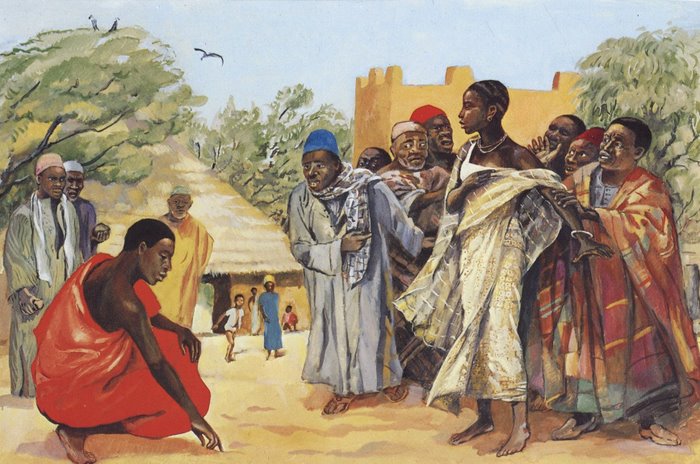
Following is a 1973 painting of the JESUS MAFA project, a response to New Testament readings from the Lectionary by a Christian community in Cameroon, Africa. Each of the readings was selected and adapted to dramatic interpretation by the community members. Photographs of their interpretations were made, and these were then transcribed to paintings:
From Art in the Christian Tradition, a project of the Vanderbilt Divinity Library, Nashville, TN. Image retrieved March 23, 2026. Original source: librairie-emmanuel.fr.
The Greek Iēsous is “only” a proper name but one with great importance. The following quote by John Ellington (in The Bible Translator1993, p. 401ff. ) illustrates this:
“In Matthew’s account of the birth of Jesus Christ, Joseph is told that when Mary gives birth to a son ‘you will name him Jesus, because he will save his people from their sins’ (1:21). This name is a Greek transliteration of the Hebrew name [Yeshua (יֵשׁוּעַ) which is a short form of a name meaning] ‘the Lord [Yahweh] saves.’ The name is very significant and is in itself especially dear to Christians around the world. (…) Unquestionably great importance is attached to the name of Jesus by Christians of all persuasions and backgrounds.”
While Iēsous (pronounced: /i.ɛː.suːs/) is transliterated as “Jesus” (pronounced /ˈdʒiːzəs/) in English (but was translated as “Hælend” [the “healing one”] in Old English — see Swain 2019) it is transliterated and pronounced in a large variety of other ways as well, following the different rules of different languages’ orthographies, writing systems and rules of pronunciation. The following is a (partial) list of forms of Jesus in Latin characters: aYeso, Azezi, Boiyesuq, Cecoc, Chesús, Chi̍i̍sū, Chisɔsi, Ciisahs, Ciise, Ciisusu, Djesu, Ɛisa, Ƹisa, Eyesu, Gesù, Gesû, Gesü, Ġesù, Ghjesù, Giêsu, ꞌGiê‑ꞌsu, Giê-xu, Gyisɛse, Hesu, Hesús, Hisus, Hisuw, Ià-sŭ, Iesen, Ié:sos, Iesu, Iesui, Iesusɨn, Iesusiva, Ié:sos, Ihu, Īhu, Iisus, Iisussa, Ijeesu, iJisọsị, Iji̍sɔ̄ɔsi, Iosa, Íosa, Ìosa, İsa, I’sa, Isiso, Isõs, Ísu, Isus, Isusa, Iisussa, Isuthi, Itota, Îtu, Isuva, Izesu, Izesuq, Jasus, Jeeju, Jeesus, Jeesuse, Jeezas, Jehu, Jeisu, Jeju, Jejus, Jesesi, Jeshu, Jeso, Jesoe, Jesosa, Jesoshi, Jesosi, Jesosy, Jesu, Jesû, Jesua, Jesuh, Jesuhs, Jesuo, Jesús, Jésus, Jesúsu, Jethu, Jezed, Jezi, Jézi, Ježiš, Jezu, Jezus, Jézus, Jėzus, Jēzus, Jezusi, Jėzus, Jezuz, Jiijajju, Jíísas, Jiisusi, Jiizas, Jíìzọ̀s, Jisas, Jisase, Jisasi, Jisasɨ, Jisaso, Jisesi, Jisɛ̀, Jisos, Jisọs, Jisɔs, Jisu, Jiszs, Jizọs, Jizɔs, Jizọsi, Jizọsu, Jòso, Jusu, Jweesus, Ketsutsi, Njises, Sesi, Sisa, Sísa, Sisas, Sises, Sīsū, Sizi, Txesusu, uJesu, Ujísɔ̄si, ŵaYesu, Xesosi, ´Xesús, Xesús, Yasu, Ya:su, yasuɛ, Yasuuⓐ, Ɣaysa, Yecu, Yeeb Sub, Yeeh Suh, Yeesey, Yeeso, Yeesso, Yēēsu, Yehsu, Yëësu, Yeiqsul, Yeisu, Yeisuw, Yeshu, Yē shú, Yeso, Yéso, Yesò, Yëso, Yɛso, ye-su, Yésu, Yêsu, Yẹ́sụ̃, Yěsù, Yésʉs, Yeswa, Yet Sut, Yetut, Yexus, Yezo, Yezu, Yiesu, Yiisa, Yiisu, Yiitju, Yis, Yisɔs, Yisufa, Yitati, Yusu, ‑Yusu, :Yusu’, Zeezi, Zezi, Zezì, Zezuz, Zezwii, Ziizɛ, Zisas, Zîsɛ, Zjezus, Zozi, Zozii, and this (much more incomplete) list with other writings systems: ᔩᓱᓯ, ᒋᓴᔅ, Հիսուս, ᏥᏌ, ኢየሱስ, ያሱስ, ܝܫܘܥ, Ісус, Їисъ, 耶稣, იესო, ईसा, イエス, イイスス, イエスス, 예수, येशू, येशो, ਈਸਾ, ພຣະເຢຊູ, ජේසුස්, যীশু, ଯୀଶୁ, ཡེ་ཤུ་, ‘ঈছা, இயேசு, ಯೇಸು, ພຣະເຢຊູ, ယေရှု, ઇસુ, जेजू, येसु, เยซู, យេស៊ូ, ᱡᱤᱥᱩ, ယေသှု, యేసు, ᤕᤧᤛᤢ᤺ᤴ, އީސާގެފާނު, ਯਿਸੂ, ꕉꖷ ꔤꕢ ꕞ, ⵏ⵿ⵗⵢⵙⴰ, ଜୀସୁ, يَسُوعَ,ㄧㄝㄙㄨ, YE-SU, ꓬꓰ꓿ꓢꓴ, 𖽃𖽡𖾐𖼺𖽹𖾏𖼽𖽔𖾏, ꑳꌠ, ᠶᠡᠰᠦᠰ (note that some of these might not display correctly if your device does not have the correct fonts installed).
Click or tap here to read more.
In some languages the different confessions have selected different transliterations, such as in Belarusian with Isus (Ісус) by the Orthodox and Protestant churches and Yezus (Езус) by the Catholic church, Bulgarian with Iisus (Иисус) by the Orthodox and Isus (Исус) by the Protestant church, Japanese with Iesu (イエス) (Protestant and Catholic) and Iisusu (イイスス) (Orthodox), or Lingala with Yesu (Protestant) or Yezu (Catholic). These differences have come to the forefront especially during the work on interconfessional translations such as one in Lingala where “many hours were spent on a single letter difference” (source: Ellington, p. 401).
In Literary and Mandarin Chinese where transliterations of proper names between the Catholic and Protestant versions typically differ vastly, the Chinese name of Jesus (Yēsū 耶稣) remarkably was never brought into question between and by those two confessions, likely due to its ingenious choice. (Click or tap here to see more).
The proper name of God in the Old Testament, Yahweh (YHWH), is rendered in most Chinese Bible translations as Yēhéhuá 耶和華 — Jehovah. According to Chinese naming conventions, Yēhéhuá could be interpreted as Yē Héhuá, in which Yē would be the family name and Héhuá — “harmonic and radiant” — the given name. In the same manner, Yē 耶 would be the family name of Jesus and Sū 稣 would be his given name. Because in China the children inherit the family name from the father, the sonship of Jesus to God the Father, Jehovah, would be illustrated through this. Though this line of argumentation sounds theologically unsound, it is indeed used effectively in the Chinese church (see Wright 1953, p. 298).
Moreover, the “given name” of Sū 稣 carries the meaning ‘to revive, to rise again’ and seems to point to the resurrected Jesus. (Source: J. Zetzsche in Malek 2002, p. 141ff., see also tetragrammaton (YHWH))
There are different ways that Bible translators have chosen historically and today in how to translate the name of Jesus in predominantly Muslim areas: with a form of the Arabic Isa (عيسى) (which is used for “Jesus” in the Qur’an), the Greek Iēsous, or, like major 20th century Bible translations into Standard Arabic, the Aramaic Yēšūaʿ: Yasua (يَسُوعَ). (Click or tap here to see more.)
Following are languages and language groups that use a form of Isa include the following (note that this list is not complete):
In Indonesian, while most Bible translations had already used Yesus Kristus rather than Isa al Masih, three public holidays used to be described using the term Isa Al Masih. From 2024 on the government is using Yesus Kristus in those holiday names instead (see this article in Christianity Today ).
Some languages have additional “TAZI” editions (TAZI stands for “Tawrat, Anbiya, Zabur, and Injil” the “Torah, Prophets, Psalms and Gospel”) of the New Testament that are geared towards Muslim readers where there is also a translation in the same language for non-Muslims. In those editions, Isa is typically used as well (for example, the Khmer TAZI edition uses Isa (អ៊ីសា) rather than the commonly used Yesaou (យេស៊ូ), the Thai edition uses Isa (อีซา) rather than Yesu (เยซู), the Chinese edition uses Ěrsā (尔撒) vs. Yēsū (耶稣), and the English edition also has Isa rather than Jesus.)
In German the name Jesus (pronounced: /ˈjeːzʊs/) is distinguished by its grammatical forms. Into the 20th century the grammatical rules prescribed a unique Greek-Latin declination: Jesus (nominative), Jesu (genitive, dative, vocative), Jesum (accusative), from which today only the genitive case “Jesu” is still in active use. Likewise, in Seediq (Taroko), the morphological treatment of “Jesus” also occupies a special category by not falling under the normal rule of experiencing a vowel reduction when the object-specific suffix an is added “since it was felt that the readers might resent that the name has been changed that drastically.” (Compare Msian for “Moses” (Mosi) as an object, but Yisuan for “Jesus” (Yisu).) (Source: Covell 1998. p. 249)
In Lamba the name ŵaYesu consists of a transliteration Yesu and the prefix ŵa, a plural form for “proper names when addressing and referring to persons in any position of seniority or honor.” While this was avoided in early translations to avoid possible misunderstandings of more than one Jesus, once the church was established it was felt that it was both “safe” and respectful to use the honorific (pl.) prefix. (Source C. M. Doke in The Bible Translator 1958, p. 57ff. )
In virtually all sign languages, “Jesus” is signed with the middle finger of each hand pointing to the palm (or wrist) of the other in succession (signing the nails of the cross). In the context of Bible translation this has been pointed out as theologically problematic since the “semantic connections of the original name Jesus do point towards ‘salvation,’ they do not naturally lead to crucifixion.” (Source: Phil King in Journal of Translation 1 (2020), p. 33ff.)
Following is the oldest remaining Ethiopian Orthodox icon of Jesus from the 14th or possibly 13th century (found in the Church of the Saviour of the World in Gurji, Ethiopia). As in many Orthodox icons, Jesus’ right hand forms the Greek letters I-C-X-C for IHCOYCXPICTOC or “Jesus Christ.” Another interpretation of the right hand is that it shows three fingers pointing to the Trinity, while the two other fingers point to Jesus’ two natures.
Orthodox icons are not drawings or creations of imagination. They are in fact writings of things not of this world. Icons can represent our Lord Jesus Christ, the Virgin Mary, and the Saints. They can also represent the Holy Trinity, Angels, the Heavenly hosts, and even events. Orthodox icons, unlike Western pictures, change the perspective and form of the image so that it is not naturalistic. This is done so that we can look beyond appearances of the world, and instead look to the spiritual truth of the holy person or event. (Source )
The following is the so-called “Wales Window for Alabama.” It is a stained-glass window by the artist John Petts from Carmarthenshire, Wales, created in response to the 16th Street Baptist Church bombing which took place in 1963:
Stained glass is not just highly decorative, it’s a medium which has been used to express important religious messages for centuries. Literacy was not widespread in the medieval and Renaissance periods and the Church used stained glass and other artworks to teach the central beliefs of Christianity. In Gothic churches, the windows were filled with extensive narrative scenes in stained glass — like huge and colorful picture storybooks — in which worshipers could ‘read’ the stories of Christ and the saints and learn what was required for their religious salvation. (Source: Victoria and Albert Museum )
The style of the following drawing of Jesus by Annie Vallotton is described by the artist as this: “By using few lines the readers fill in the outlines with their imagination and freedom. That is when the drawings begin to communicate.” (see here ; see also We All are One in Christ)
Illustration by Annie Vallotton, copyright by Donald and Patricia Griggs of Griggs Educational Service.
Click or tap here to see the rest of this insight.
Like a number of other East Asian languages, Japanese uses a complex system of honorifics, i.e. a system where a number of different levels of politeness are expressed in language via words, word forms or grammatical constructs. These can range from addressing someone or referring to someone with contempt (very informal) to expressing the highest level of reference (as used in addressing or referring to God) or any number of levels in-between.
One way Japanese shows different degree of politeness is through the usage of an honorific construction where the morpheme are (され) is affixed on the verb as shown here in the widely-used Japanese Shinkaiyaku (新改訳) Bible of 2017. This is particularly done with verbs that have God as the agent to show a deep sense of reverence. Here, ik-are-ru (行かれる) or “go” is used.
The olive family has over four hundred species in the world. Many of them grow in Africa, India, and Australia, but it is the one in the Bible, the European Olive Olea europaea, that has become famous. It is likely that the olive was domesticated in Egypt or the eastern Mediterranean basin in the third millennium B.C. The botanist Newberry argued that Egypt was its original home. We know from the Bible that olives grew in the hills of Samaria and in the foothills. There is a wild variety, called Olea europaea sylvestris, that is smaller than the domestic one; it produces a smaller fruit with less oil. The Apostle Paul refers to this wild variety in Romans 11:17 and 11:24. Olives are easily propagated by cuttings and by grafting fruitful species into less fruitful ones. They grow best on hillsides where the rain drains off quickly. The fruit forms by August but does not ripen until December or January.
The olive is not a big tree, reaching up to perhaps 10 meters (33 feet), but with pruning it is usually kept to around 5 meters (17 feet) tall. The leaves are grayish green above, and whitish underneath. The bark of young trees is silvery gray but gets darker and rougher as the tree ages. The trunk also gets twisted and hollow and may reach over a meter in thickness. Olives grow for hundreds of years, and some in Israel have possibly reached two thousand years.
The fruit of the olive is about 2 centimeters (1 inch) long and a bit more than a centimeter (1/2 inch) thick. It has a hard stone inside and a soft skin that covers the oily flesh. Today a mature tree may yield 10-20 kilograms (22-44 pounds) of fruit, which, when processed, will yield 1.3-2.6 kilograms (3.6 pounds) of oil.
For the Jews the “big three” trees were the vine, the fig, and the olive. People ate olive fruits, but more importantly, they squeezed the oil from the fruits, and used it for cooking, for lamps, for rubbing on the body, for medicine, and in religion. Jacob poured olive oil on the stone where he saw a vision of angels, declaring it a holy place (Genesis 28:18). Moses, similarly, anointed the Tabernacle and its equipment with olive oil mixed with sweet-smelling resins (Exodus 40:9). Aaron and the priests who served in the Tabernacle were also anointed (Exodus 29:21).
Some types of wild olive grow in Africa, India, and Australia, but are not well-known. The so-called “African olive” produces a black, oil-bearing fruit much like an olive. It is common as a snack in northern Nigeria. The “Chinese olive” is also a species of Canarium and may be a possible cultural substitute, if it produces edible fruit and oil. The “Russian olive” grown in dry regions of the world is a member of the Elaeagnus family and not a true olive. A variety of olive (Olea cuspidate) is used for building in India and Nepal, but it is probably not possible to use it in the Bible except perhaps in a study Bible where you could say that the biblical olive was related to this tree.
Since most of the kinds of olive trees in the world do not have edible fruit, it may not be possible to substitute a local variety. If it is done, however, a footnote would be required saying that the Palestinian kind produced edible fruit and oil. If a variety of Canarium is eaten in your area, you could use the local name for it. Otherwise transliterate from a major language.
Living Water is produced for the Bible translation movement in association with Lutheran Bible Translators. Lyrics derived from the ESV® Bible (The Holy Bible, English Standard Version®).
Then everyone went home is verse 53 of Chapter 7 in most texts; but Jesus went to the Mount of Olives is verse 1 of Chapter 8. Obviously, this chapter division takes place in an extremely awkward place, in the middle of a sentence! Good News Translation simply omits verse number 53 from Chapter 7 and joins the short statement Then everyone went home to verse 1 of Chapter 8.
Then everyone went home is more literally “and they went each one to his own home.” Jerusalem Bible translates “They all went home.”
Because of the textual problems involved, paragraphing of this section concerning the woman caught in adultery normally begins with 7.53. However, a more logical break in content occurs between verses 1 and 2. Certainly the fact that “everyone went home” is more satisfactorily combined with the preceding account of the reaction of Jewish authorities to Jesus.
The Mount of Olives is mentioned three or four times in each of the Synoptic Gospels but only here in the Gospel of John. It was a hill east of Jerusalem, named for its extensive olive groves, and separated from the city by the deep Kidron Valley. The expression the Mount of Olives should not be so translated as to suggest a mountain consisting of olives. A more satisfactory rendering is found in such a phrase as “a mountain known for its olive trees” or, better still in most languages, “a hill known for its olive trees.” Usually such place names are formed rather succinctly, for example, “Olive Tree Hill.”
Quoted with permission from Newman, Barclay M. and Nida, Eugene A. A Handbook on the Gospel of John. (UBS Handbook Series). New York: UBS, 1980. For this and other handbooks for translators see here .
But: The Greek word that the Berean Standard Bible translates as But indicates a development in the story. It also indicates some contrast. The other men went home, but Jesus went to the Mount of Olives.
Jesus went to the Mount of Olives: The Greek phrase the Berean Standard Bible translates as the Mount of Olives refers to a hill where people had planted olive trees. It was just east of Jerusalem on the other side of the Kidron Valley. It is also mentioned in Matthew 21:1, Mark 11:1, and Luke 19:37. Translate it the same way in all the verses.
The top of the Mount of Olives was about 805 meters (2540 feet) above sea level. Some languages may not consider that high enough to be a mountain. It may be more natural to refer to it as a hill. For example:





Leave a Reply
You must be logged in to post a comment.