Many languages have terms for siblings that define whether one is younger or older in relation to another sibling.
In the case of Peter (Simon) and Andrew, Simon was assumed to be the older of the two brothers in Navajo (Dinė) because he typically is mentioned first (see Wallis 2000, p. 103f.) The same choice was made in Biangai (source: Larson 1998, p. 40).
The Chilcotin translators tried to circumvent specifying who of the two is older, even though the language also uses age-specific terms for siblings. In Mark 1:16, they have used the generic term ˀelhcheliqi (“brother” without specifying who is older). (Source: Quindel King)
Like many languages (but unlike Greek or Hebrew or English), Tuvan uses a formal vs. informal 2nd person pronoun (a familiar vs. a respectful “you”). Unlike other languages that have this feature, however, the translators of the Tuvan Bible have attempted to be very consistent in using the different forms of address in every case a 2nd person pronoun has to be used in the translation of the biblical text.
As Voinov shows in Pronominal Theology in Translating the Gospels (in: The Bible Translator2002, p. 210ff. ), the choice to use either of the pronouns many times involved theological judgment. While the formal pronoun can signal personal distance or a social/power distance between the speaker and addressee, the informal pronoun can indicate familiarity or social/power equality between speaker and addressee.
Here, Jesus is addressing his disciples, individuals and/or crowds with the formal pronoun, showing respect.
In Nepali translations, Jesus addresses his disciples and other people with the medium honorific pronoun timīlē (तिमीले) or timīlēharū (तिमीलेहरू). His disciples respond with a high honorific pronoun. (Source: Chitra Chhetri in The Bible Translator 2009, p. 73ff. )
In most Dutch translations, Jesus addresses his disciples and common people with the informal pronoun, whereas they address him with the formal form.
The Greek and Hebrew that is translated as “brother” in English is translated in Kwere as sekulu, in Elhomwe as mbalaawo´, and in Mandarin Chinese as gēgē (哥哥), all “older brother.”
Note that Kwere also uses lumbu — “older sibling” in some cases. (Source for Kwere and Elhomwe: Pioneer Bible Translators, project-specific translation notes in Paratext; Chinese: Jost Zetzsche)
In Lama it is translated as “older or younger brother.” (Source: Neal Brinneman)
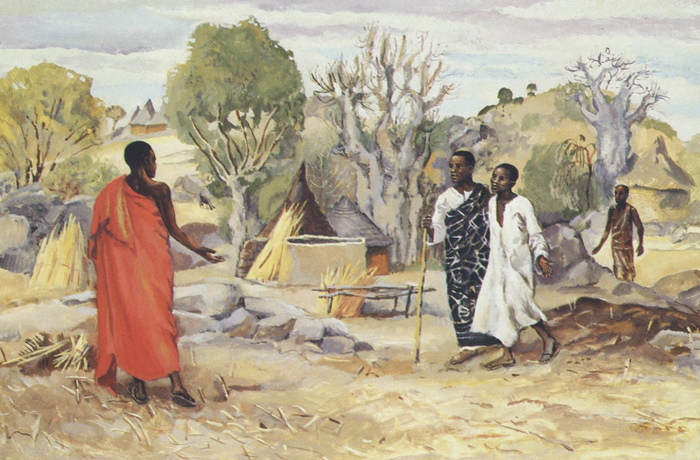
Following is a 1973 painting of the JESUS MAFA project, a response to New Testament readings from the Lectionary by a Christian community in Cameroon, Africa. Each of the readings was selected and adapted to dramatic interpretation by the community members. Photographs of their interpretations were made, and these were then transcribed to paintings:
From Art in the Christian Tradition, a project of the Vanderbilt Divinity Library, Nashville, TN. Image retrieved March 23, 2026. Original source: librairie-emmanuel.fr.
Many languages distinguish between inclusive and exclusive first-person plural pronouns (“we”). (Click or tap here to see more details)
The inclusive “we” specifically includes the addressee (“you and I and possibly others”), while the exclusive “we” specifically excludes the addressee (“he/she/they and I, but not you”). This grammatical distinction is called “clusivity.” While Semitic languages such as Hebrew or most Indo-European languages such as Greek or English do not make that distinction, translators of languages with that distinction have to make a choice every time they encounter “we” or a form thereof (in English: “we,” “our,” or “us”).
For this verse, translators typically select the exclusive form (excluding Simon).
Source: Velma Pickett and Florence Cowan in Notes on Translation January 1962, p. 1ff.
The Greek that is translated as “brother” in English in the referenced verses is translated in Lama as raal or “older brother.” (Source: Neal Brinneman)
Following are a number of back-translations of John 1:41:
Uma: “Andreas immediately went to look for Simon, he said to him: ‘We(excl.) have found the Mesias!’ (meaning: the Redeemer King)” (Source: Uma Back Translation)
Yakan: “So-then Andariyas immediately looked for his brother. When he had found him, he said to him, ‘We (excl.) have now found the Almasi.’ (Almasi is the one chosen by God to be king here in the world.)” (Source: Yakan Back Translation)
Western Bukidnon Manobo: “And as for Andrew, he immediately went to find his brother Simon. ‘We have seen the Messiah,’ he said, (The meaning of the name Messiah is Christ, which is to say, Chosen by God to rule.)” (Source: Western Bukidnon Manobo Back Translation)
Kankanaey: “He immediately-went-and -searched for Simon and said to him, ‘We (excl.) have found the Messiah’ (meaning to say, the Cristo).” (Source: Kankanaey Back Translation)
Tagbanwa: “Andres went on to that brother of his, Simon. On arriving, he said, ‘We (excl.) have met/seen that King who was promised by God’ (which means, Cristo).” (Source: Tagbanwa Back Translation)
Tenango Otomi: “Andrew first went to hunt for his brother Peter. He said to him, ‘We found the Messiah.’ Messiah means the Christ whom God appointed to rule.” (Source: Tenango Otomi Back Translation)
The name that is transliterated as “Simon (Peter)” in English is translated in Libras (Brazilian Sign Language) with a sign that combines a reference to “Peter” (see here for the Libras translation of “Peter”) and “son” (of Jonah / John). (Source: Missão Kophós )

Leave a Reply
You must be logged in to post a comment.