Like many languages (but unlike Greek or Hebrew or English), Tuvan uses a formal vs. informal 2nd person pronoun (a familiar vs. a respectful “you”). Unlike other languages that have this feature, however, the translators of the Tuvan Bible have attempted to be very consistent in using the different forms of address in every case a 2nd person pronoun has to be used in the translation of the biblical text.
As Voinov shows in Pronominal Theology in Translating the Gospels (in: The Bible Translator2002, p. 210ff. ), the choice to use either of the pronouns many times involved theological judgment. While the formal pronoun can signal personal distance or a social/power distance between the speaker and addressee, the informal pronoun can indicate familiarity or social/power equality between speaker and addressee.
Here, Jesus is addressing his disciples, individuals and/or crowds with the formal pronoun, showing respect.
In Nepali translations, Jesus addresses his disciples and other people with the medium honorific pronoun timīlē (तिमीले) or timīlēharū (तिमीलेहरू). His disciples respond with a high honorific pronoun. (Source: Chitra Chhetri in The Bible Translator 2009, p. 73ff. )
In most Dutch translations, Jesus addresses his disciples and common people with the informal pronoun, whereas they address him with the formal form.
The Greek that is transliterated “Cephas” in English — and is an alternative name for Peter — is transliterated in Mandarin Chinese Protestant translations as jīfǎ (traditional Chinese: 磯法, simplified Chinese: 矶法). The first character jī (磯 / 矶) is not only chosen because of its sound but also because of its meaning: “rock,” corresponding to the meaning of the Aramaic kēp̄ā (כֵּיפָא), to which the Greek Kēphâs (Κηφᾶς) refers and also alluding to Jesus’ proclamation in Matthew 16:18 (see Peter – rock).
Note that Catholic Chinese versions don’t follow the English pronunciation of “Cephas” with its opening [s] sound. They use kēfǎ (刻法) transliterating the [k] sound from the Aramaic and Greek. Kēfǎ does not carry the additional meaning of “rock.” (Source: Jost Zetzsche)
In the Neo-Aramaic language of Assyrian the terms used for both “Peter” (English transliteration of the Greek “πετρος”) and “Cephas” are identical (كِيپَا, pronounced kēpā). (Source: Ken Bunge)
The passage in John 1:42 (“You are to be called Cephas (which is translated Peter)” in English) is solved by various translations like this: “‘I am going to name you Cephas.’ Cephas means ‘Peter.’ Both mean ‘rock.'” (Ojitlán Chinantec), “I am naming you Cephas. ‘Cephas’ in the Jews’ language, ‘Peter’ in the Greek language, the meaning being ‘stone’.” (Alekano), “You will become known as Cephas,’ he said, which in our language means ‘rock.'” (Chol), or “You will be called Cephas and also Peter.” Tenango Otomi. (Source: M. Larson / B. Moore in Notes on Translation February 1970, p. 1-125.)
The Greek and Hebrew that is translated as “son of” in English is translated in all Icelandic Bible versions of the Icelandic Bible Society (latest edition 2007) in parallel with the Icelandic naming system . This means that for instance in Matthew 16:17 the name that is transliterated and translated in English as “Simon son of Jonah” becomes “Simon Jónasson” or in Isaiah 8:2 “Zechariah son of Jeberechiah” becomes “Sakaría Jeberekíason” where in both cases the “-son” means “son of.”
In cases where “son of” does not refer to a literal father or perhaps stepfather but to lineage, however, this system is not used. So in Matthew 1:1 “Jesus the Messiah, the son of David, the son of Abraham” is translated as “Jesú Krists, sonar Davíðs, sonar Abrahams.”
The referenced verses all have at least one instance where the Icelandic patronymic or matronymic naming system is used. (Source: Halldór Elías Guðmundsson)
Orthodox Icons are not drawings or creations of imagination. They are in fact writings of things not of this world. Icons can represent our Lord Jesus Christ, the Virgin Mary, and the Saints. They can also represent the Holy Trinity, Angels, the Heavenly hosts, and even events. Orthodox icons, unlike Western pictures, change the perspective and form of the image so that it is not naturalistic. This is done so that we can look beyond appearances of the world, and instead look to the spiritual truth of the holy person or event. (Source )
Following is a hand colored stencil print on momigami of Peter by Sadao Watanabe (1970):
Image taken with permission from the SadaoHanga Catalogue where you can find many more images and information about Sadao Watanabe. For other images of Sadao Watanabe art works in TIPs, see here.
Following are a number of back-translations of John 1:42:
Uma: “And he accompanied him going to Yesus. Yesus looked at Simon, and he said to him: ‘You (sing.) are Simon son of Yohanes. But beginning from this time, you (sing.) will be called/named Kefas.’ (The name ‘Kefas’ in the Yahudi language, it is the same as the name ‘Petrus’ in the Yunani language. It means: rock.)” (Source: Uma Back Translation)
Yakan: “Then he brought Simon to Isa. Isa looked straight at Simon and said, ‘You are Simon, your father’s name is Yahiya. But I call you Kepas.’ (This name Kepas is the same as the name Petros, it means, rock.)” (Source: Yakan Back Translation)
Western Bukidnon Manobo: “And he took Simon and they went to Jesus. And Jesus, he looked at Simon. ‘You are Simon the son of John. I title you Cephas,’ said Jesus. (The title Cephas is the same as the name Peter, and the meaning of that is ‘stone’.)” (Source: Western Bukidnon Manobo Back Translation)
Kankanaey: “Then he escorted Simon to where Jesus was. Jesus looked-closely at him and said, ‘You (sing.) are Simon the child of Juan. You (sing.) will be nicknamed Cefas.’ (This name, it is the same as Pedro and its meaning is stone.)” (Source: Kankanaey Back Translation)
Tagbanwa: “He had Simon go with him to Jesus.When they had arrived, Jesus looked-closely at Simon and spoke. He said, ‘Your name now is Simon, son of Juan. But you will be named Cefas.’ (Cefas is Pedro in the Griego-language.)” (Source: Tagbanwa Back Translation)
Tenango Otomi: “Andrew took his brother to Jesus. When Jesus saw him, he said, ‘You are Simon, the son of Jonas. Now you will be called Cephas and also Peter.'” (Source: Tenango Otomi Back Translation)
The name that is transliterated as “Simon (Peter)” in English is translated in Libras (Brazilian Sign Language) with a sign that combines a reference to “Peter” (see here for the Libras translation of “Peter”) and “son” (of Jonah / John). (Source: Missão Kophós )
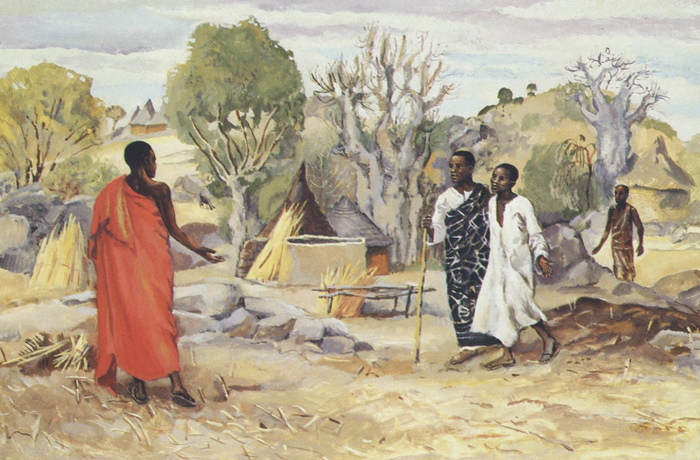
Following is a 1973 painting of the JESUS MAFA project, a response to New Testament readings from the Lectionary by a Christian community in Cameroon, Africa. Each of the readings was selected and adapted to dramatic interpretation by the community members. Photographs of their interpretations were made, and these were then transcribed to paintings:
From Art in the Christian Tradition, a project of the Vanderbilt Divinity Library, Nashville, TN. Image retrieved March 23, 2026. Original source: librairie-emmanuel.fr.
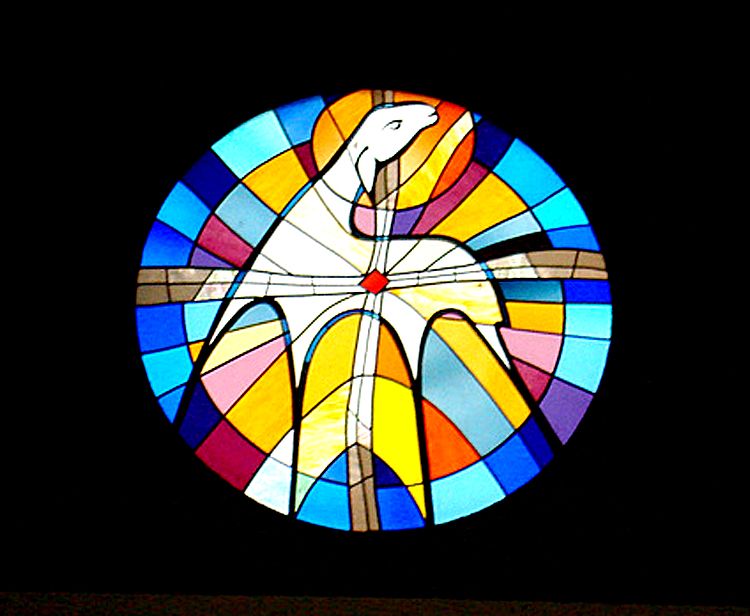
Stained glass is not just highly decorative, it’s a medium which has been used to express important religious messages for centuries. Literacy was not widespread in the medieval and Renaissance periods and the Church used stained glass and other artworks to teach the central beliefs of Christianity. In Gothic churches, the windows were filled with extensive narrative scenes in stained glass — like huge and colorful picture storybooks — in which worshipers could ‘read’ the stories of Christ and the saints and learn what was required for their religious salvation. (Source: Victoria and Albert Museum )





Leave a Reply
You must be logged in to post a comment.