The name that is transliterated as “Azotus” in English is translated in Libras (Brazilian Sign Language) with a sign that depicts “protection” (a possible meaning of the name and the fact that as a port city it gave protection to many sailors). With the right hand the geographical shape of the coast is shown. (Source: Missão Kophós )
The Greek terms that are translated into English as “preach” or “proclaim” are regularly rendered into Aari as “speaking the word of salvation.” (Source: Loren Bliese)
Other languages (back-) translate it in the following manner:
Tzeltal: “he explains, they hear” (“the goal of all preachers”)
Copainalá Zoque: “a preacher is ‘one who speaks-scatters'” (a figure based on the scattering of seed in the process of sowing) (source for this and above: Bratcher / Nida)
Shilluk: “declare the word of of God” (source: Nida 1964, p. 237)
In Luang it is translated with different shades of meaning:
For Acts 9:20, 10:42: nakotnohora: “talk about” (“The generic term for preaching.”)
For Acts 8:4, 8:5, 8:25: rodkiota-ralde’etnohora — “bring words, give news about.” (“This term is used when the preacher is moving from place to place to preach.”)
Source: Kathy Taber in Notes on Translation 1/1999, p. 9-16.
In choosing a word for the Greek that is typically translated as “gospel” in English, a number of languages construct a phrase meaning “good news,” “joyful report” or “happiness-bringing words.” In some instances such a phrase may be slightly expanded in order to convey the proper meaning, e.g. “new good word” (Tzotzil), or it may involve some special local usage:
the Germandas Buch translation by Roland Werner (publ. 2009-2022) translates as “all-transformative good news” (alles verändernde gute Botschaft), also “good news,” and the German translation by Fridolin Stier (1989) as “message of salvation” (Heilsbotschaft)
Vitaly Voinov tells this story about the translation into Rutul (click or tap here to see the rest of this insight):
“In Rutul, it was only during the most recent consultant checking session that I realized that the Rutul word for Gospel – Incir (from Arabic إنجيل — Injil) — sounds and looks exactly like the word that means ‘fig’ in Rutul. This is a case of homonymy, in which two completely non-related words from differing historical sources have come to sound exactly alike. Most Rutul speakers know that incir means ‘fig’ because they grow this fruit in their yard or buy it at the market every week. However, because the religious sphere of discourse was heavily disparaged during the Soviet era, most people simply never encountered Incir with the meaning of ‘Gospel.’ This meaning of the word, which Rutuls of the pre-Soviet era knew from the Koran, simply fell into disuse and never had much reason for returning into contemporary Rutul since there is no Christian church established among the people. So if the translator continues to use the term Incir as the rendering for ‘Gospel,’ he runs the risk that most readers will, at best, read the word with a smile because they know that it also means ‘fig,’ and, at worst, will completely misunderstand the word. The seemingly ‘easy’ solution in this case is for the translator to use a Rutul neologism meaning ‘Joyful Message’ or ‘Good News,’ [see above] instead of Incir; but in fact it is not all that easy to make this change if the translator himself insists on using the historical word because at least some Rutuls still understand it as meaning ‘Gospel.’ This is a situation in which the translation team has to gradually grow into the understanding that a fully intelligible translation of Scripture is preferable to one that maintains old words at the cost of alienating much of the readership.”
Hand colored stencil print on momigami by Sadao Watanabe (1989).
Image taken with permission from the SadaoHanga Catalogue where you can find many more images and information about Sadao Watanabe. For other images of Sadao Watanabe art works in TIPs, see here.
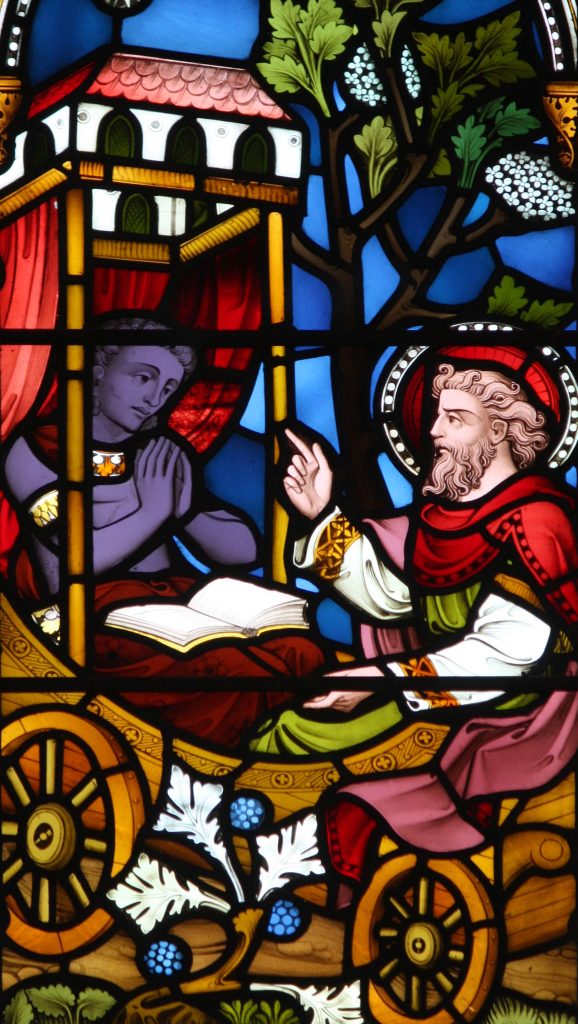
The following is a stained glass window from the Exeter College Chapel in Oxford:
Stained glass is not just highly decorative, it’s a medium which has been used to express important religious messages for centuries. Literacy was not widespread in the medieval and Renaissance periods and the Church used stained glass and other artworks to teach the central beliefs of Christianity. In Gothic churches, the windows were filled with extensive narrative scenes in stained glass — like huge and colorful picture storybooks — in which worshipers could ‘read’ the stories of Christ and the saints and learn what was required for their religious salvation. (Source: Victoria and Albert Museum )
Following are a number of back-translations of Acts 8:40:
Uma: “As for Filipus, he suddenly appeared in the town of Asdod. He left returning to the town of Kaisarea, and along the road he announced the Good News in every town that he passed.” (Source: Uma Back Translation)
Yakan: “And this Pilip, he was now there in the land/place Asotus. He proclaimed the good news in the villages there and in all the places he passed through until he arrived in the place Kesarea.” (Source: Yakan Back Translation)
Western Bukidnon Manobo: “And as for Philip, he was seen again in the village of Ashdod, and he went on his way telling about the good news until he came to Caesarea.” (Source: Western Bukidnon Manobo Back Translation)
Kankanaey: “As for Felipe, he was-suddenly at Azotus, then he walked through the many-towns there preaching the good news until he arrived at Cesarea.” (Source: Kankanaey Back Translation)
Tagbanwa: “Well, as for Felipe, he discovered himself to be in Azoto. Without anything further, he again taught the Good News concerning Jesus in every town his journey passed through from Azoto till he arrived at Cesarea.” (Source: Tagbanwa Back Translation)
Illustration by Horst Lemke (1922-1985) for the GermanGute Nachricht für Sie – NT68, one of the first editions of the Good News Bible in German of 1968. Lemke was a well-known illustrator who illustrated books by Erich Kästner , Astrid Lindgren and many others.
Philip found himself in Ashdod (see New English Bible, Jerusalem Bible, Moffatt, Phillips) correctly translates the force of the Greek verb; “Philip was found at Azotus” (King James Version) sounds rather odd and seems to suggest a passive force for the Greek verb form. The phrase found himself in Ashdod is equivalent in some languages to “saw that he was in Ashdod.” One must, of course, avoid a term for found which would suggest “looking for something.”
Ashdod (Azotus, the Greek form of the name as used in many translations) was an ancient Philistine city, twenty miles north of Gaza. Caesarea (meaning “the city of Caesar”) was the chief city of Palestine and the residence of the Roman governor. It was on the coast, fifty-five miles northwest of Jerusalem. Philip seems to have made Caesarea his home, and he was there when he next appears in the Acts narrative (21.8). The clause until he arrived at Caesarea would imply that all the towns would be those towns lying between Ashdod and Caesarea.
Quoted with permission from Newman, Barclay M. and Nida, Eugene A. A Handbook on The Acts of the Apostles. (UBS Handbook Series). New York: UBS, 1972. For this and other handbooks for translators see here .



Leave a Reply
You must be logged in to post a comment.