Ixcatlán Mazatec: “with your best/biggest thinking” (source: Robert Bascom)
Noongar: dwangka-boola, lit. “ear much” (source: Portions of the Holy Bible in the Nyunga language of Australia, 2018 — see also remember)
Kwere “to know how to live well” (source: Pioneer Bible Translators, project-specific translation notes in Paratext)
Dobel: “their ear holes are long-lasting” (in Acts 6:3) (source: Jock Hughes)
Gbaya: iŋa-mgbara-mɔ or “knowing-about-things” (note that in comparison to that, “knowledge” is translated as iŋa-mɔ or “knowing things”) (source: Philip Noss in The Bible Translator 2001, p. 114ff. )
Chichewa: nzeru, meaning both “knowledge” and “wisdom” (source: Mawu a Mulungu mu Chichewa Chalero Back Translation)
Highland Popoluca: “understand what God wants” (Source for this and five above: Viola Waterhouse in Notes on Translation August 1966, p. 86ff.)
In Hungarian Sign Language it is translated with a hand gesture referring to God to indicate a human quality to communicate that wisdom does not originate from man but is linked to and connected with the fear of God (source: Jenjelvi Biblia and HSL Bible Translation Group):
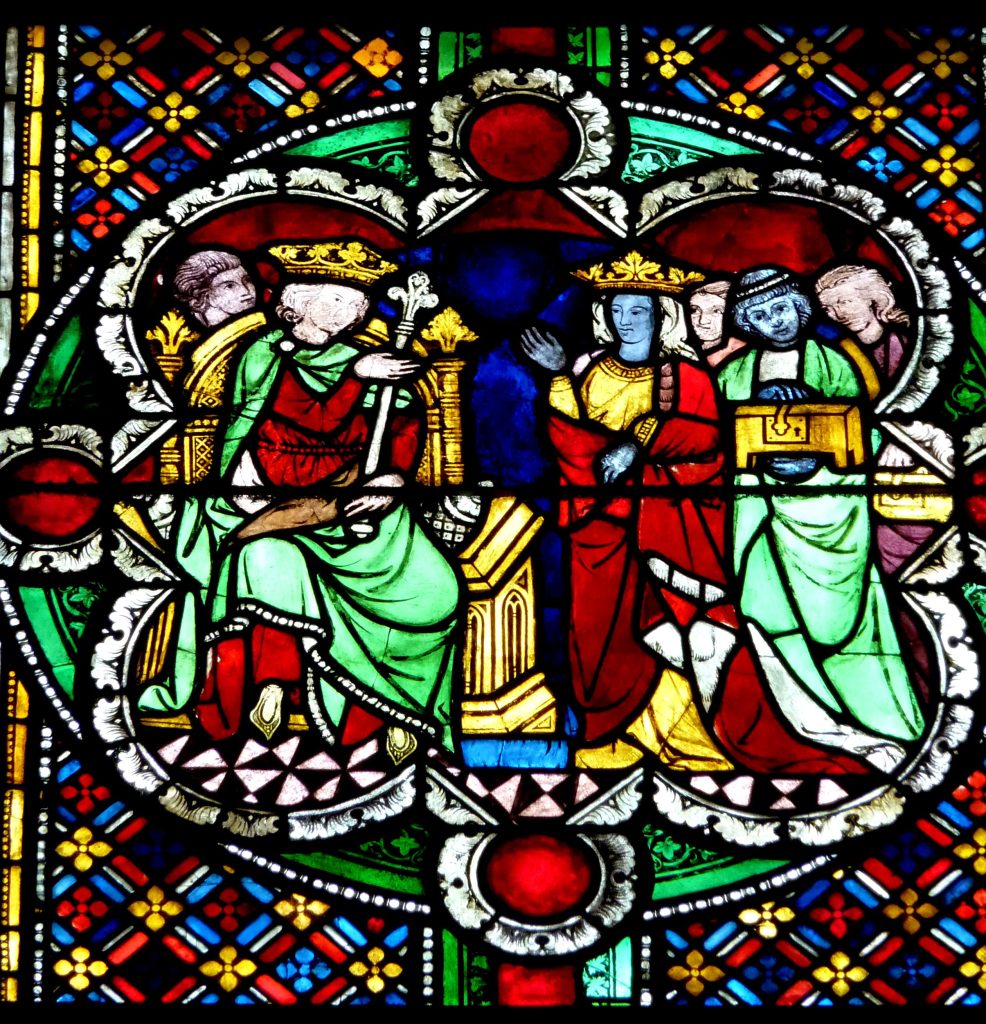
Stained glass is not just highly decorative, it’s a medium which has been used to express important religious messages for centuries. Literacy was not widespread in the medieval and Renaissance periods and the Church used stained glass and other artworks to teach the central beliefs of Christianity. In Gothic churches, the windows were filled with extensive narrative scenes in stained glass — like huge and colorful picture storybooks — in which worshipers could ‘read’ the stories of Christ and the saints and learn what was required for their religious salvation. (Source: Victoria and Albert Museum )
Following are a number of back-translations as well as a sample translation for translators of 2 Chronicles 9:3:
Kupsabiny: “That ruler of Sheba was utterly amazed when she saw/realized how great the wisdom of Solomon was and how his home/palace was.” (Source: Kupsabiny Back Translation)
Newari: “The Queen of Sheba saw Solomon’s wisdom and the palace he built.” (Source: Newari Back Translation)
Hiligaynon: “When the wisdom of Solomon was-able-to-be-proved-of by the queen of Sheba, and when she saw the beauty of the palace that he had-built,” (Source: Hiligaynon Back Translation)
English: “The queen realized that Solomon was very wise. She saw his palace,” (Source: Translation for Translators)
And when the queen of Sheba had seen the wisdom of Solomon: This literal rendering may not be appropriate in many languages since wisdom is not something that can be seen. It may be necessary to supply a different verb here and use “see” with reference only to Solomon’s palace, which would have been visible. New Revised Standard Version and Revised English Bible use the verb “observed,” but this may present the same problems. For this whole clause New Living Translation provides a helpful model, saying “When the queen of Sheba realized how wise Solomon was.”
The house that he had built: In this context the Hebrew word for house refers to the royal palace and not to the Temple.
Quoted with permission from Omanson, Roger L. and Ellington, John E. A Handbook on 1-2 Chronicles, Volume 1. (UBS Helps for Translators). Miami: UBS, 2014. For this and other handbooks for translators see here .


Leave a Reply
You must be logged in to post a comment.