Illustration by Annie Vallotton, copyright by Donald and Patricia Griggs of Griggs Educational Service. More images can be viewed at rotation.org .
The following is a church window based on another image of Annie Vallotton of the same scene. This is installed in a church of the Union des Églises Baptistes du Cameroun in Mowo (Mokong), Cameroon.
Photo and the following description by Ken Hollingsworth
“The windows are open with no screens or glass. The pictures were fabricated by projecting the picture using an overhead projector on a piece of plywood. They were drawn on the plywood with charcoal. Then the fabricator cut pieces of iron rebar to make the picture. Then the iron pieces were welded together. Later, when the pictures were installed, they were painted with different colors to help the people ‘see’ the picture.”
Image taken from the Wiedmann Bible. For more information about the images and ways to adopt them, see here . For other images of Willy Wiedmann paintings in TIPs, see here.
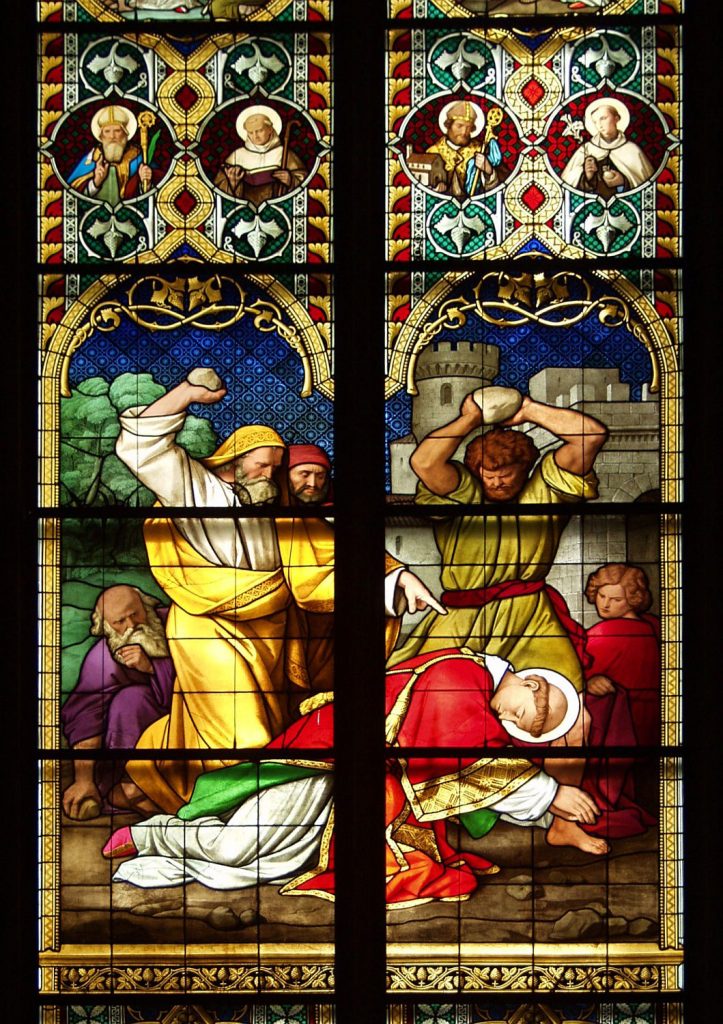
The following is a 19th century stained glass window from the Kölner Dom in Cologne, Germany:
Stained glass is not just highly decorative, it’s a medium which has been used to express important religious messages for centuries. Literacy was not widespread in the medieval and Renaissance periods and the Church used stained glass and other artworks to teach the central beliefs of Christianity. In Gothic churches, the windows were filled with extensive narrative scenes in stained glass — like huge and colorful picture storybooks — in which worshipers could ‘read’ the stories of Christ and the saints and learn what was required for their religious salvation. (Source: Victoria and Albert Museum )
Image taken from the Wiedmann Bible. For more information about the images and ways to adopt them, see here . For other images of Willy Wiedmann paintings in TIPs, see here.
Following is a contemporary tempera / gouache on leather painting by an unknown Ethiopian artist:
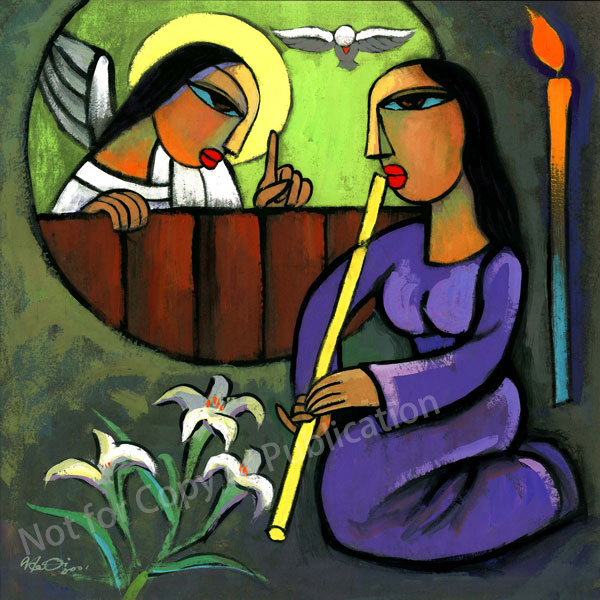
Image taken from He Qi Art . For purchasing prints of this and other artworks by He Qi go to heqiart.com . For other images of He Qi art works in TIPs, see here.
Following is an artwork by Sister Marie Claire , SMMI (1937–2018) from Bengaluru, India:
(Note that supernatural beings are always portrayed with this type of upraised scarf and white circle.)
For more information about images by Sister Marie Claire and ways to purchase them as lithographs, see here . For other images of Sister Marie Claire paintings in TIPs, see here.
The following is a contemporary stained glass window from Our Lady of Pity in Swaffham, United Kingdom:
Stained glass is not just highly decorative, it’s a medium which has been used to express important religious messages for centuries. Literacy was not widespread in the medieval and Renaissance periods and the Church used stained glass and other artworks to teach the central beliefs of Christianity. In Gothic churches, the windows were filled with extensive narrative scenes in stained glass — like huge and colorful picture storybooks — in which worshipers could ‘read’ the stories of Christ and the saints and learn what was required for their religious salvation. (Source: Victoria and Albert Museum )
Image taken from the Wiedmann Bible. For more information about the images and ways to adopt them, see here . For other images of Willy Wiedmann paintings in TIPs, see here.
Following is an artwork by Sister Marie Claire , SMMI (1937–2018) from Bengaluru, India:
For more information about images by Sister Marie Claire and ways to purchase them as lithographs, see here . For other images of Sister Marie Claire paintings in TIPs, see here.
The following is a stained glass window from the Three choir windows in the Marienkirche, Frankfurt (Oder), Germany, of the 14th century, depicting the feeding with manna:
Source: Der gläserne Schatz: Die Bilderbibel der St. Marienkirche in Frankfurt (Oder), Neuer Berlin Verlag, 2005, copyright for this image: Brandenburgisches Landesamt für Denkmalpflege und Archäologisches Landesmuseum
Stained glass is not just highly decorative, it’s a medium which has been used to express important religious messages for centuries. Literacy was not widespread in the medieval and Renaissance periods and the Church used stained glass and other artworks to teach the central beliefs of Christianity. In Gothic churches, the windows were filled with extensive narrative scenes in stained glass — like huge and colorful picture storybooks — in which worshipers could ‘read’ the stories of Christ and the saints and learn what was required for their religious salvation. (Source: Victoria and Albert Museum )
Image taken from the Wiedmann Bible. For more information about the images and ways to adopt them, see here . For other images of Willy Wiedmann paintings in TIPs, see here.
Painting by Sawai Chinnawong, used with permission by the Overseas Ministries Study Center (OMSC) at Princeton Theological Seminary. You can purchase this and many other artworks by artists in residence at the OSMC in high resolution and without a watermark via the OSMC website .
“Sawai Chinnawong of Payap University, Chiang Mai, Thailand, [is] an ethnic Mon whose Buddhist ancestors migrated to Thailand from Myanmar, Mr. Chinnawong committed his life to Christ while in his twenties. Today he is a member of the United Church of Christ of Thailand. His love for art began when he was a child in Thailand when he saw some old men painting on a Buddhist temple wall. He says he would watch them for hours each day. Sawai’s interest in art persisted into adulthood, and he studied art in a vocational school in Bangkok, Thailand. It was at this time that Sawai became a Christian. He says that a missionary was witnessing on the street one day, and soon after, he began to study the Bible every day after art class.
“After completing his art studies, Sawai attended the McGilvary Faculty of Theology at Payap University in Chiang Mai. He was deeply influenced by a series of lectures on the history of Christian Art given there in 1984 by artist and professor Nalini Jayasuriya, another of our OMSC artists. He began creating liturgical art while attending seminary, and designed the artwork for the chapel there. Today his art is appreciated in many places for its portrayal of Christian themes through a Thai graphic idiom that is inspired by Thai culture.
“‘My work represents influences from many styles…I believe Jesus Christ is present in every culture, and I have chosen to celebrate his presence in our lives through Thai traditional cultural forms. My belief is that Jesus did not choose just one people to hear his Word, but chose to make his home in every human heart. And just as his Word may be spoken in every language, so the visual message can be shared in the beauty of the many styles of artistry around the world.’ (Sawai Chinnawong” (Source )
For more images by Sawai Chinnawong in TIPs see here.
The following is a stained glass window in the Chichester Cathedral in England by Marc Chagall from 1967:
Photo by Jules & Jenny, hosted by Wikimedia Common under the cc-by-2.0 license
Stained glass is not just highly decorative, it’s a medium which has been used to express important religious messages for centuries. Literacy was not widespread in the medieval and Renaissance periods and the Church used stained glass and other artworks to teach the central beliefs of Christianity. In Gothic churches, the windows were filled with extensive narrative scenes in stained glass — like huge and colorful picture storybooks — in which worshipers could ‘read’ the stories of Christ and the saints and learn what was required for their religious salvation. (Source: Victoria and Albert Museum )
The Hebrew and Greek that is translated as “root of Jesse” or similar in English is translated as “descendant of the ancient man of God who was called Jesse” in Huehuetla Tepehua, as “a person born in the family line of Jesse” in Yatzachi Zapotec, and as “a son from the people of Jesse the father of David” in Mezquital Otomi. (Source: Waterhouse / Parrott in Notes on Translation October 1967, p. 1ff.)
Photo by Zorba the Geek, hosted by Wikimedia Common under the Creative Commons Attribution-Share Alike 2.0 Generic license
Stained glass is not just highly decorative, it’s a medium which has been used to express important religious messages for centuries. Literacy was not widespread in the medieval and Renaissance periods and the Church used stained glass and other artworks to teach the central beliefs of Christianity. In Gothic churches, the windows were filled with extensive narrative scenes in stained glass — like huge and colorful picture storybooks — in which worshipers could ‘read’ the stories of Christ and the saints and learn what was required for their religious salvation. (Source: Victoria and Albert Museum )
The Greek Iēsous is “only” a proper name but one with great importance. The following quote by John Ellington (in The Bible Translator1993, p. 401ff. ) illustrates this:
“In Matthew’s account of the birth of Jesus Christ, Joseph is told that when Mary gives birth to a son ‘you will name him Jesus, because he will save his people from their sins’ (1:21). This name is a Greek transliteration of the Hebrew name [Yeshua (יֵשׁוּעַ) which is a short form of a name meaning] ‘the Lord [Yahweh] saves.’ The name is very significant and is in itself especially dear to Christians around the world. (…) Unquestionably great importance is attached to the name of Jesus by Christians of all persuasions and backgrounds.”
While Iēsous (pronounced: /i.ɛː.suːs/) is transliterated as “Jesus” (pronounced /ˈdʒiːzəs/) in English (but was translated as “Hælend” [the “healing one”] in Old English — see Swain 2019) it is transliterated and pronounced in a large variety of other ways as well, following the different rules of different languages’ orthographies, writing systems and rules of pronunciation. The following is a (partial) list of forms of Jesus in Latin characters: aYeso, Azezi, Boiyesuq, Cecoc, Chesús, Chi̍i̍sū, Chisɔsi, Ciisahs, Ciise, Ciisusu, Djesu, Ɛisa, Ƹisa, Eyesu, Gesù, Gesû, Gesü, Ġesù, Ghjesù, Giêsu, ꞌGiê‑ꞌsu, Giê-xu, Gyisɛse, Hesu, Hesús, Hisus, Hisuw, Ià-sŭ, Iesen, Ié:sos, Iesu, Iesui, Iesusɨn, Iesusiva, Ié:sos, Ihu, Īhu, Iisus, Iisussa, Ijeesu, iJisọsị, Iji̍sɔ̄ɔsi, Iosa, Íosa, Ìosa, İsa, I’sa, Isiso, Isõs, Ísu, Isus, Isusa, Iisussa, Isuthi, Itota, Îtu, Isuva, Izesu, Izesuq, Jasus, Jeeju, Jeesus, Jeesuse, Jeezas, Jehu, Jeisu, Jeju, Jejus, Jesesi, Jeshu, Jeso, Jesoe, Jesosa, Jesoshi, Jesosi, Jesosy, Jesu, Jesû, Jesua, Jesuh, Jesuhs, Jesuo, Jesús, Jésus, Jesúsu, Jethu, Jezed, Jezi, Jézi, Ježiš, Jezu, Jezus, Jézus, Jėzus, Jēzus, Jezusi, Jėzus, Jezuz, Jiijajju, Jíísas, Jiisusi, Jiizas, Jíìzọ̀s, Jisas, Jisase, Jisasi, Jisasɨ, Jisaso, Jisesi, Jisɛ̀, Jisos, Jisọs, Jisɔs, Jisu, Jiszs, Jizọs, Jizɔs, Jizọsi, Jizọsu, Jòso, Jusu, Jweesus, Ketsutsi, Njises, Sesi, Sisa, Sísa, Sisas, Sises, Sīsū, Sizi, Txesusu, uJesu, Ujísɔ̄si, ŵaYesu, Xesosi, ´Xesús, Xesús, Yasu, Ya:su, yasuɛ, Yasuuⓐ, Ɣaysa, Yecu, Yeeb Sub, Yeeh Suh, Yeesey, Yeeso, Yeesso, Yēēsu, Yehsu, Yëësu, Yeiqsul, Yeisu, Yeisuw, Yeshu, Yē shú, Yeso, Yéso, Yesò, Yëso, Yɛso, ye-su, Yésu, Yêsu, Yẹ́sụ̃, Yěsù, Yésʉs, Yeswa, Yet Sut, Yetut, Yexus, Yezo, Yezu, Yiesu, Yiisa, Yiisu, Yiitju, Yis, Yisɔs, Yisufa, Yitati, Yusu, ‑Yusu, :Yusu’, Zeezi, Zezi, Zezì, Zezuz, Zezwii, Ziizɛ, Zisas, Zîsɛ, Zjezus, Zozi, Zozii, and this (much more incomplete) list with other writings systems: ᔩᓱᓯ, ᒋᓴᔅ, Հիսուս, ᏥᏌ, ኢየሱስ, ያሱስ, ܝܫܘܥ, Ісус, Їисъ, 耶稣, იესო, ईसा, イエス, イイスス, イエスス, 예수, येशू, येशो, ਈਸਾ, ພຣະເຢຊູ, ජේසුස්, যীশু, ଯୀଶୁ, ཡེ་ཤུ་, ‘ঈছা, இயேசு, ಯೇಸು, ພຣະເຢຊູ, ယေရှု, ઇસુ, जेजू, येसु, เยซู, យេស៊ូ, ᱡᱤᱥᱩ, ယေသှု, యేసు, ᤕᤧᤛᤢ᤺ᤴ, އީސާގެފާނު, ਯਿਸੂ, ꕉꖷ ꔤꕢ ꕞ, ⵏ⵿ⵗⵢⵙⴰ, ଜୀସୁ, يَسُوعَ,ㄧㄝㄙㄨ, YE-SU, ꓬꓰ꓿ꓢꓴ, 𖽃𖽡𖾐𖼺𖽹𖾏𖼽𖽔𖾏, ꑳꌠ, ᠶᠡᠰᠦᠰ (note that some of these might not display correctly if your device does not have the correct fonts installed).
Click or tap here to read more.
In some languages the different confessions have selected different transliterations, such as in Belarusian with Isus (Ісус) by the Orthodox and Protestant churches and Yezus (Езус) by the Catholic church, Bulgarian with Iisus (Иисус) by the Orthodox and Isus (Исус) by the Protestant church, Japanese with Iesu (イエス) (Protestant and Catholic) and Iisusu (イイスス) (Orthodox), or Lingala with Yesu (Protestant) or Yezu (Catholic). These differences have come to the forefront especially during the work on interconfessional translations such as one in Lingala where “many hours were spent on a single letter difference” (source: Ellington, p. 401).
In Literary and Mandarin Chinese where transliterations of proper names between the Catholic and Protestant versions typically differ vastly, the Chinese name of Jesus (Yēsū 耶稣) remarkably was never brought into question between and by those two confessions, likely due to its ingenious choice. (Click or tap here to see more).
The proper name of God in the Old Testament, Yahweh (YHWH), is rendered in most Chinese Bible translations as Yēhéhuá 耶和華 — Jehovah. According to Chinese naming conventions, Yēhéhuá could be interpreted as Yē Héhuá, in which Yē would be the family name and Héhuá — “harmonic and radiant” — the given name. In the same manner, Yē 耶 would be the family name of Jesus and Sū 稣 would be his given name. Because in China the children inherit the family name from the father, the sonship of Jesus to God the Father, Jehovah, would be illustrated through this. Though this line of argumentation sounds theologically unsound, it is indeed used effectively in the Chinese church (see Wright 1953, p. 298).
Moreover, the “given name” of Sū 稣 carries the meaning ‘to revive, to rise again’ and seems to point to the resurrected Jesus. (Source: J. Zetzsche in Malek 2002, p. 141ff., see also tetragrammaton (YHWH))
There are different ways that Bible translators have chosen historically and today in how to translate the name of Jesus in predominantly Muslim areas: with a form of the Arabic Isa (عيسى) (which is used for “Jesus” in the Qur’an), the Greek Iēsous, or, like major 20th century Bible translations into Standard Arabic, the Aramaic Yēšūaʿ: Yasua (يَسُوعَ). (Click or tap here to see more.)
Following are languages and language groups that use a form of Isa include the following (note that this list is not complete):
In Indonesian, while most Bible translations had already used Yesus Kristus rather than Isa al Masih, three public holidays used to be described using the term Isa Al Masih. From 2024 on the government is using Yesus Kristus in those holiday names instead (see this article in Christianity Today ).
Some languages have additional “TAZI” editions (TAZI stands for “Tawrat, Anbiya, Zabur, and Injil” the “Torah, Prophets, Psalms and Gospel”) of the New Testament that are geared towards Muslim readers where there is also a translation in the same language for non-Muslims. In those editions, Isa is typically used as well (for example, the Khmer TAZI edition uses Isa (អ៊ីសា) rather than the commonly used Yesaou (យេស៊ូ), the Thai edition uses Isa (อีซา) rather than Yesu (เยซู), the Chinese edition uses Ěrsā (尔撒) vs. Yēsū (耶稣), and the English edition also has Isa rather than Jesus.)
In German the name Jesus (pronounced: /ˈjeːzʊs/) is distinguished by its grammatical forms. Into the 20th century the grammatical rules prescribed a unique Greek-Latin declination: Jesus (nominative), Jesu (genitive, dative, vocative), Jesum (accusative), from which today only the genitive case “Jesu” is still in active use. Likewise, in Seediq (Taroko), the morphological treatment of “Jesus” also occupies a special category by not falling under the normal rule of experiencing a vowel reduction when the object-specific suffix an is added “since it was felt that the readers might resent that the name has been changed that drastically.” (Compare Msian for “Moses” (Mosi) as an object, but Yisuan for “Jesus” (Yisu).) (Source: Covell 1998. p. 249)
In Lamba the name ŵaYesu consists of a transliteration Yesu and the prefix ŵa, a plural form for “proper names when addressing and referring to persons in any position of seniority or honor.” While this was avoided in early translations to avoid possible misunderstandings of more than one Jesus, once the church was established it was felt that it was both “safe” and respectful to use the honorific (pl.) prefix. (Source C. M. Doke in The Bible Translator 1958, p. 57ff. )
In virtually all sign languages, “Jesus” is signed with the middle finger of each hand pointing to the palm (or wrist) of the other in succession (signing the nails of the cross). In the context of Bible translation this has been pointed out as theologically problematic since the “semantic connections of the original name Jesus do point towards ‘salvation,’ they do not naturally lead to crucifixion.” (Source: Phil King in Journal of Translation 1 (2020), p. 33ff.)
Following is the oldest remaining Ethiopian Orthodox icon of Jesus from the 14th or possibly 13th century (found in the Church of the Saviour of the World in Gurji, Ethiopia). As in many Orthodox icons, Jesus’ right hand forms the Greek letters I-C-X-C for IHCOYCXPICTOC or “Jesus Christ.” Another interpretation of the right hand is that it shows three fingers pointing to the Trinity, while the two other fingers point to Jesus’ two natures.
Orthodox icons are not drawings or creations of imagination. They are in fact writings of things not of this world. Icons can represent our Lord Jesus Christ, the Virgin Mary, and the Saints. They can also represent the Holy Trinity, Angels, the Heavenly hosts, and even events. Orthodox icons, unlike Western pictures, change the perspective and form of the image so that it is not naturalistic. This is done so that we can look beyond appearances of the world, and instead look to the spiritual truth of the holy person or event. (Source )
The following is the so-called “Wales Window for Alabama.” It is a stained-glass window by the artist John Petts from Carmarthenshire, Wales, created in response to the 16th Street Baptist Church bombing which took place in 1963:
Stained glass is not just highly decorative, it’s a medium which has been used to express important religious messages for centuries. Literacy was not widespread in the medieval and Renaissance periods and the Church used stained glass and other artworks to teach the central beliefs of Christianity. In Gothic churches, the windows were filled with extensive narrative scenes in stained glass — like huge and colorful picture storybooks — in which worshipers could ‘read’ the stories of Christ and the saints and learn what was required for their religious salvation. (Source: Victoria and Albert Museum )
The style of the following drawing of Jesus by Annie Vallotton is described by the artist as this: “By using few lines the readers fill in the outlines with their imagination and freedom. That is when the drawings begin to communicate.” (see here ; see also We All are One in Christ)
Illustration by Annie Vallotton, copyright by Donald and Patricia Griggs of Griggs Educational Service.
For the Greek in John 19:30 that is translated with an equivalent of “It is finished (or: completed)” in most English Bible translations a perfect tense is used that has no direct equivalent in English. It expresses that an event has happened at a specific point in the past but that that event has ongoing results. The English “Expanded Translation” by Kenneth S. Wuest (publ. 1961) attempted to recreate that by translating “It has been finished and stands complete.”
Irish uses yet a different system of tenses, resulting in these translations:
Atá sé ar na chríochnughadh (Bedell An Biobla Naomhtha, publ. early 17th century): “It is upon its completion”
Tá críoch curtha air (Ó Cuinn Tiomna Nua, publ. 1970): “Completion is put on it”
Tá sé curtha i gcrích (An Bíobla Naofa, publ. 1981): “It is put in completion”
Source for the Irish: Kevin Scannell
In Ojitlán Chinantec it is translated as “My work is finished,” in Aguaruna as “It is completely accomplished,” and in Mezquital Otomi as “Now all is finished which I was commanded to do.” (Source for this and above: M. Larson / B. Moore in Notes on Translation February 1970, p. 1-125.)
In Cherokee an immediate past form of the verb alsgwada (ᎠᎵᏍᏆᏓ) is used. This indicates that “the action is concurrently effected.” (Source: Bender / Belt 2025, p. 56)
In Mandarin Chinese, it is translated as chéng le (成了) which means both “it is completed” and “it is finished” (source: Zetzsche), in Ebira it is translated as Ma sị mẹ ta or “I have finally completed/finished it” (source: Scholz /Scholz 2015, p. 98), and in both German and Dutch major translations it is translated as vollbracht and volbracht respectively, which means “finished” but comes from “to bring (or: deliver) completely.”
The following is a contemporary stained glass window in the Catholic Church of the Resurrection in Bryanston, New Zealand:
The Window of the Saviour: Jesus said, “It is accomplished,” and bowing His head He gave up His spirit (John 19:30). This window with its powerful colours of sorrow and mourning yet glory and new life shows the Saviour at the moment of His supreme sacrifice of Himself for love of all humanity. (Source: Catholic Church of the Resurrection in Bryanston )
Stained glass is not just highly decorative, it’s a medium which has been used to express important religious messages for centuries. Literacy was not widespread in the medieval and Renaissance periods and the Church used stained glass and other artworks to teach the central beliefs of Christianity. In Gothic churches, the windows were filled with extensive narrative scenes in stained glass — like huge and colorful picture storybooks — in which worshipers could ‘read’ the stories of Christ and the saints and learn what was required for their religious salvation. (Source: Victoria and Albert Museum .






.jpg)
