Drawing by Ismar David from H. L. Ginsberg 1969. For other images of Ismar David drawings, see here.
Following is an image of the Jonah Sarcophagus or the 3rd quarter of the 3rd century, housed in the Museo Pio Cristiano (photographed by Richard Stracke , shared under Attribution-NonCommercial-ShareAlike license):
Peppard (2024, p. 119ff.) analyzes the sarcophagus (click or tap here to see the analysis):
The textual version of the short story begins with God calling Jonah as a prophet to go east and preach repentance to the Gentiles of the great city of Nineveh (ancient Assyria; modern Mosul, Iraq). On the left the men load a boat, which Jonah has disobediently boarded to sail westward, away from Israel and away from God’s prophetic commandment (Jonah 1). Moving to the right, the men throw Jonah into the sea, in an attempt to quell the raging storm, which they (rightly) interpret has been caused by Jonah’s disobedience to his god. In this artistic version, he dives straight into the mouth of the great fish—portrayed here, as elsewhere, like a sea monster—and prays to God for salvation over three days and three nights (Jonah 2). He is then spit out onto shore and commanded again by God to preach repentance to Nineveh (Jonah 3). He does so but then becomes disgruntled when the Ninevites do repent and God does not enact his planned punishment. Despite having been saved himself, Jonah doesn’t think these others are deserving of God’s mercy. So God teaches him a final lesson (Jonah 4). While Jonah pouts alone outside of the city, God provides a large new plant to grow over Jonah, to protect him from the desert sun. This scene dominates the upper-right register, with Jonah reclining nude under bountiful shade, as if in a blessed afterlife. But as quickly as the plant grew, God sends a worm to destroy it, so that Jonah is again near death—first from a tempest-tossed ocean, and now from a sun-scorched desert. The story concludes with God delivering a prophetic sermon to his reluctant prophet: if Jonah is concerned over the life and death of just one plant that emerged and vanished so quickly, how much more should God be concerned with the fate of the thousands of lives in Nineveh, at that time the largest city in the known world?
The textual version of the story ends, like many prophetic oracles of the Old Testament, with a question. The question hangs in the air for ancient listeners and modern readers, opening up to reflection and discussion about the tension between justice and mercy, about God’s commitment to a chosen people while offering salvation to others, and about the persistent self-centered ways of even God’s chosen messengers. The earliest Christian textual interpreters seized on two aspects of the story. First, as represented by the Gospel of Luke, Jesus interprets “the sign of Jonah” for his generation to be a call toward repentance (Luke 11:29-32). Just as he began his ministry with, “Repent, for the Kingdom of God is at hand,” along with John’s baptismal ritual to enact such repentance, so, too, does he connect his preaching to the universalism of Jonah’s mission. Luke thus emphasizes chapters 3 and 4 of Jonah, but Matthew’s version of Jesus’ teaching draws from the action of chapter 2. Just as Jonah was in the belly of the great fish for three days, “so will the Son of Man be in the heart of the earth three days and three nights” (Matt 12:40). Matthew includes the same teaching of repentance as Luke but also adds the unique interpretation of Jonah’s “death” and “resurrection” as a foreshadowing of Jesus’ own. This second idea comes to dominate the subsequent reception history. Then, when the apostle Paul describes immersion baptism as a ritualized participation in death and resurrection (Rom 6:3-4), the resources are all present to close the loop on the Jonah cycle. The story of Jonah therefore portrays (for Christians) the necessity of repentance, the salvific role of immersion in water as a death and resurrection, and the universal message of the God of Israel for all people, whether Jews or Gentiles. No matter how wayward a son of Israel has been, no matter how wicked a king of the Gentiles has been, God’s mercy is available and boundless.
The artist of the sarcophagus surrounds the Jonah cycle with other stories to reinforce these meanings for the viewer. Looking closely at the water, between the sea monster and the reclining Jonah, one can see an inset Noah. Depicted in the “Jack-in-the-box” style typical of this era, Noah emerges from the ark to find the dove messenger returning with an olive branch (Gen 8:11), signifying the end of the flood and the salvation of those in the ark.- Early Christian artists often juxtapose various stories of salvation near or through water. One might even read the fisherman on the lower right, whose line casts near to where Jonah comes on shore, as a symbol of Jesus’ first metaphor for preaching and discipleship: “Come, follow me,” Jesus said to Simon Peter and Andrew while they were fishing, “and I will make you fishers of men” (Matt 5:19).
The upper left features Jesus’ raising of Lazarus, a “sign” performed in the Gospel of John that bears obvious connection to the “sign of Jonah” in the Gospel of Matthew. The center of the upper register shows two scenes that are open to multiple interpretations. One possibility is from the Old Testament: here depicts Moses drawing “water from the rock” to satisfy the thirst of the Israelites wandering the wilderness during the exodus (Exod 17 / Num 20); to its right might then be the rebellion of Israelites against Moses (perhaps Num 16).
Another possibility involves a different “water from the rock” miracle, that of Peter summoning a spring of water with which to baptize his repentant jailers. This is a non-canonical story about Peter’s life, but one apparently in very wide circulation, as there are at least 225 examples of it preserved from early Christian art. The scene to its right would thus be the arrest of Peter, another non-canonical but widely depicted story. Either option signifies God’s miraculous provision for salvation through water, whether through thirst-quenching or a new covenant with God. The upper right shows a shepherd guiding sheep out of a mausoleum-like structure, and this calls to mind various biblical images of a shepherd and flock as salvation from death: the “Lord is my shepherd” (Psalm 23), the parables of the lost sheep (Luke 15 / Matt 18), and the “good shepherd” and “gate” for the sheep (John 10), among others. Whoever “enters the gate” of death through Jesus will be saved, say the Gospel of John and the Jonah sarcophagus in unison. Both Jews and Gentiles will be “one flock” with “one shepherd” (John 10:16).
With these details in mind, we can zoom back out to see the big picture one final time. If you allow your eyes to be guided by the overall flow of the shapes and lines, you will see a curved arc of descent and ascent. Begin above the sail of the boat, where there stands in the sky what looks like a person peering through a circular portal in the heavens. In fact, this is the Roman sky god Caelus, who is often pictured this way during the Roman imperial era, with a billowing garment over his head. This personification of the sky or heaven (hence the word “celestial”) was adopted frequently in early Christian art as a way to communicate heavenly realms to the viewer (see also Figure 5.6 below). Some Roman writers even identified the God of Israel (as a sky god) with the Roman god Caelus, so we might imagine him here as a symbol of divine command over the drama below U His gaze looks down along the line of the sail and follows the halyard directly into the snout of the beast. The arc flattens at the center of the sarcophagus and then bends upward through the right-facing snout, upward along the reclining Jonah’s left arm, then his right arm, and above to the plant of his blessed afterlife. From its tiny details to its overall form, this artistic masterwork conjures a treasury of biblical stories and frames the hoped-for arc of salvation from death.
Following is a contemporary Coptic Orthodox icon of Jonah.
Orthodox Icons are not drawings or creations of imagination. They are in fact writings of things not of this world. Icons can represent our Lord Jesus Christ, the Virgin Mary, and the Saints. They can also represent the Holy Trinity, Angels, the Heavenly hosts, and even events. Orthodox icons, unlike Western pictures, change the perspective and form of the image so that it is not naturalistic. This is done so that we can look beyond appearances of the world, and instead look to the spiritual truth of the holy person or event. (Source )
In Spanish Sign Language it is translated with a sign that depicts “swallow (by a large fish).” (Source: Steve Parkhurst)
The Lord’s Prayer was translated into Nyulnyul (and back-translated into English) by the German missionary Hermann Nekes in 1939.
It reads:
Our Father on top sky.
Thy name be feared.
Thou art our boss.
Men-women will listen to Thee this place earth
as the good souls of men-women listen to Thee on top sky.
Give us tucker till this sun goes down.
We did wrong; make us good.
We have good hearts to them who did us wrong.
Watch us against bad place.
Thy hands be stretched out to guard us from bad.
Our Father, high in your Holy Place,
your name is holy.
Let the day come
when you reign as King in our land.
We want you to become Boss of our land,
the same way you are Boss of your Holy Land.
Give us the food we eat every day.
Forgive our wrong-doing
the same way we forgive the wrong-doing people do to us.
And do not take us to the hard place of testing.
But hold us so the Devil cannot get us.
You hold the land.
You hold the power.
You hold the light.
For ever and for ever.
Amen.
Source: Bardip Ruth-Ang 2020
The following is a version of the Lord’s Prayer set to Tibetan music:
In Gbaya, the idea in Psalm 45:13 of the princess being led into the kingʼs palace in clothing of many colors, would have meant she was a prostitute, a terrible insult to the king. The Gbaya equivalent of what is meant in Hebrew is good clean white clothing. To further emphasize the whiteness of that clothing, the translators used ndáká-ndáká, an ideophone used to express extreme whiteness, something very white.
Ideophones are a class of sound symbolic words expressing human sensation that are used as literary devices in many African languages. (Source: Philip Noss)
The Hebrew in Ezekiel 9:4 and Ezekiel 9:6 that is translated as “mark” or “sign” in Protestant English Bibles was translated in the LatinVulgate translation as signa thau or “signs of Thau.” The Hebrew had used tav (תָּו) which means “mark” or “sign,” but was interpreted here as strictly referring to tav (taw) (ת), the last letter of the Hebrew alphabet.
This is a tradition that Catholic Bibles, for into the 1940s which the Vulgate was the source version, have maintained until the present day. While the 16th century EnglishDhouay-Rheims version translated this directly as mark Thau, later versions either translated this as “X” (New American Bible, including its Revised Edition), but were more commonly using cross (Knox, Jerusalem Bible, New Jerusalem Bible, New Catholic Bible, Christian Community Bible). In a footnote it usually says something like this: “Literally, ‘with a tau.’ This was the last letter of the Hebrew alphabet, and in the old script a cross was the symbol for it.”
Indeed, this is what tav looked like historically:
Protestant Bibles in English, with the exception of the recent Evangelical Heritage Version (2019), all use a form of “mark.”
Other languages have the same tradition. The French Catholic La Bible de Jérusalem uses croix, the Mandarin ChineseSigao translation says 一個十字記號 (yīge shízì jìhào) or “a mark in the sign of a cross,” the PortugueseBíblia Ave Maria uses cruz, the PolishBiblia Tysiąclecia uses Taw (and mentions in a footnote that taw used to be written in the form of a cross), the German EinheitsübersetzUng has Taw as well, and the SpanishEl Libro del Pueblo de Dios has “T.”
This last translation (“T”) also found its way into a series of stained glass window from the Three choir windows in the Marienkirche, Frankfurt (Oder), Germany, of the 14th century (note the “T” in the antichrist’s halo as well as on the forehead on his followers):
Incidentally, the German word for devil is “Teufel” (in the spelling “tiuvel” in the 14th century), which likely helped the choice of the “T” for the mark.
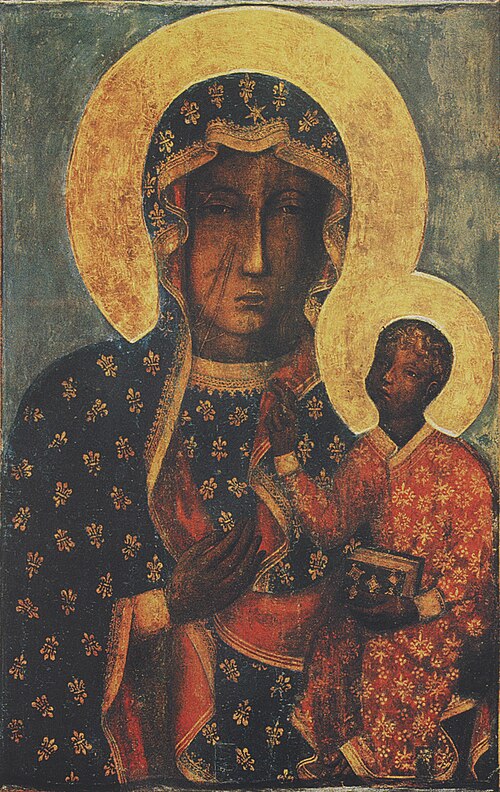
The first line in Song of Songs 1:5 has served as an inspiration for the so-called Black Madonnas in the catholic and Orthodox churches.
Peppard (2024, p. 176) explains: “One of the first things the beloved says in the poem is ‘Black am I, and beautiful.’ Due to the typological connections between this bride and Mary, the textual bride’s blackness seems to have influenced the artistic tradition of ‘Black Madonnas’ (or ‘Black Virgins’) throughout the Catholic world. These are sculptures or painted icons — some dating to the medieval period — that depict Mary (or Mary and Jesus together) carved of dark material or painted with dark skin tones. One catalog of Black Madonnas attests almost two hundred examples, mostly in Europe, with some in Africa, Southeast Asia, and the Americas. Among the most famous in Europe are Our Lady of Einsiedeln (fifteenth century, Austria) and Our Lady of Częstochowa (ninth – fourteenth century, Poland), the latter of which is among the most popular pilgrimage destinations in Europe. Most of them have mysterious origins and wondrous effects on individual pilgrims and national identities.”
Image of the Black Madonna of Częstochowa (source: Wikimedia ):
Icons are not drawings or creations of imagination. They are in fact writings of things not of this world. Icons can represent our Lord Jesus Christ, the Virgin Mary, and the Saints. They can also represent the Holy Trinity, Angels, the Heavenly hosts, and even events. Icons, unlike Western pictures, change the perspective and form of the image so that it is not naturalistic. This is done so that we can look beyond appearances of the world, and instead look to the spiritual truth of the holy person or event. (Source )
The Greek in Revelation 7 and 9 that is translated as “seal” or “sealed” in English is translated in Onobasulu with the word for “father.” That is the same word that is also used to snip off a part of pigs’ ears as a sign of ownership (“like a father”). (Source: Paulus Kieviet in this talk ).