
The first line in Song of Songs 1:5 has served as an inspiration for the so-called Black Madonnas in the catholic and Orthodox churches.
Peppard (2024, p. 176) explains: “One of the first things the beloved says in the poem is ‘Black am I, and beautiful.’ Due to the typological connections between this bride and Mary, the textual bride’s blackness seems to have influenced the artistic tradition of ‘Black Madonnas’ (or ‘Black Virgins’) throughout the Catholic world. These are sculptures or painted icons — some dating to the medieval period — that depict Mary (or Mary and Jesus together) carved of dark material or painted with dark skin tones. One catalog of Black Madonnas attests almost two hundred examples, mostly in Europe, with some in Africa, Southeast Asia, and the Americas. Among the most famous in Europe are Our Lady of Einsiedeln (fifteenth century, Austria) and Our Lady of Częstochowa (ninth – fourteenth century, Poland), the latter of which is among the most popular pilgrimage destinations in Europe. Most of them have mysterious origins and wondrous effects on individual pilgrims and national identities.”
Image of the Black Madonna of Częstochowa (source: Wikimedia ):

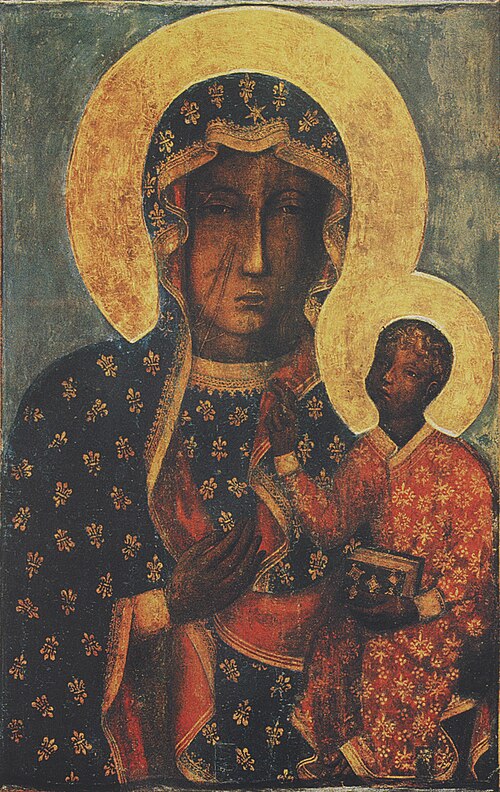
Icons are not drawings or creations of imagination. They are in fact writings of things not of this world. Icons can represent our Lord Jesus Christ, the Virgin Mary, and the Saints. They can also represent the Holy Trinity, Angels, the Heavenly hosts, and even events. Icons, unlike Western pictures, change the perspective and form of the image so that it is not naturalistic. This is done so that we can look beyond appearances of the world, and instead look to the spiritual truth of the holy person or event. (Source )
See also Mary (mother of Jesus).