
The Greek in Luke 9:30 that is translated as “Moses and Elijah” or similar in English is translated in the German New Testament translation by Berger / Nord (publ. 1999) with sie waren als Moses und Elias erkennbar or “they were recognizable as Moses and Elijah.”
Transfiguration (icon)
Following is a Ukrainian Orthodox icon of the Transfiguration by Ivan Rutkovych (c. 1650 – c. 1708) (for the Church of Christ’s Nativity in Zhovkva, Ukraine, today in the Lviv National Museum).


Orthodox Icons are not drawings or creations of imagination. They are in fact writings of things not of this world. Icons can represent our Lord Jesus Christ, the Virgin Mary, and the Saints. They can also represent the Holy Trinity, Angels, the Heavenly hosts, and even events. Orthodox icons, unlike Western pictures, change the perspective and form of the image so that it is not naturalistic. This is done so that we can look beyond appearances of the world, and instead look to the spiritual truth of the holy person or event. (Source )
The Transfiguration
Following is a 1973 painting of the JESUS MAFA project, a response to New Testament readings from the Lectionary by a Christian community in Cameroon, Africa. Each of the readings was selected and adapted to dramatic interpretation by the community members. Photographs of their interpretations were made, and these were then transcribed to paintings:
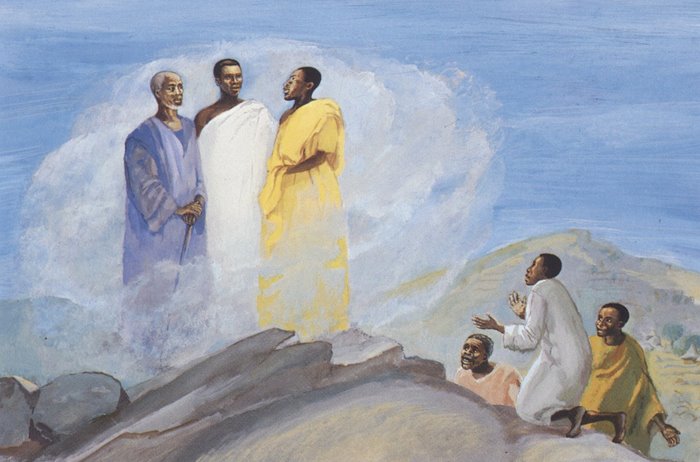
In this theatrical representation of Jesus’ transfiguration, Jesus is robed in a dazzling white garment, as the story in the gospels describes. He appears to be greeting Moses and Elijah like old friends as they are surrounded by a cloud that makes the whole scene feel ethereal. Peter, James, and John look on with flabbergasted and fearful expressions, bewildered at what they should do. This painting invites the viewer to imagine what it would be like to have seen such amazing things. Undoubtedly, it would inspire one to follow and obey Jesus, just as God commands in the story: “This is my son, the beloved. Listen to him!”
From Art in the Christian Tradition , a project of the Vanderbilt Divinity Library, Nashville, TN. Image retrieved March 23, 2026. Original source: librairie-emmanuel.fr.
complete verse (Luke 9:30)
Following are a number of back-translations of Luke 9:30:
- Noongar: “Suddenly, two men came, and spoke to Jesus — Moses and Elijah.” (Source: Warda-Kwabba Luke-Ang)
- Uma: “Suddenly there were two people talking to him, they were the prophets Musa and Elia.” (Source: Uma Back Translation)
- Yakan: “Then suddenly there were two men talking with Isa. They were eymulla (signifying a deceased person) Musa and eymulla Eliyas.” (Source: Yakan Back Translation)
- Western Bukidnon Manobo: “And all of a sudden there appeared two men who talked with him — they were Moses and Elijah, the long ago prophets of God.” (Source: Western Bukidnon Manobo Back Translation)
- Kankanaey: “Right then two men appeared whose appearance was also dazzling talking-with Jesus who were Moses and Elias. What they were talking about was his near-in-time death in Jerusalem to fulfil the plan of God.” (Source: Kankanaey Back Translation)
- Tagbanwa: “When it was like that now, suddenly/unexpectedly there were two men, Moises and Elias,” (Source: Tagbanwa Back Translation)
Elijah
The name that is transliterated as “Elijah” in English means “God-LORD,” “strength of the LORD,” “my God is YHWH.” “the LORD God.” (Source: Cornwall / Smith 1997 )
In Spanish Sign Language it is translated as “whirlwind” (according to 2 Kings 2:11) (Source: John Elwode in The Bible Translator 2008, p. 78ff. )
“Elijah” in Spanish Sign Language, source: Sociedad Bíblica de España
Click or tap here to see how other sign languages are translating “Elijah”
In American Sign Language it is translated with a depiction of being taken up to heaven with a chariot of fire. (Source: ASL Sign Language Directory )
“Elijah” in American Sign Language (source )
Likewise in Estonian Sign Language, but with a different sign (source: Liina Paales in Folklore 47, 2011, p. 43ff.)

“Elijah” in Estonian Sign Language (source )
In Finnish Sign Language it is translated with the sign signifying “fire” (referring to 1 Kings 18:38). (Source: Tarja Sandholm)
“Elijah” in Finnish Sign Language (source )
For more information on translations of proper names with sign language see Sign Language Bible Translations Have Something to Say to Hearing Christians .
Following is a Russian Orthodox icon of Elijah from the late 13h century.


Orthodox Icons are not drawings or creations of imagination. They are in fact writings of things not of this world. Icons can represent our Lord Jesus Christ, the Virgin Mary, and the Saints. They can also represent the Holy Trinity, Angels, the Heavenly hosts, and even events. Orthodox icons, unlike Western pictures, change the perspective and form of the image so that it is not naturalistic. This is done so that we can look beyond appearances of the world, and instead look to the spiritual truth of the holy person or event. (Source )
Learn more on Bible Odyssey: Elijah .
Moses
The name that is transliterated as “Moses” in English means “taken out of the water,” “saved out of the water,” “a son.” (Source: Cornwall / Smith 1997 ). See also Translation commentary on Exodus 2:10.
It is translated in Spanish Sign Language and Polish Sign Language with a sign in accordance with the depiction of Moses in the famous statue by Michelangelo (see here ). (Source: John Elwode in The Bible Translator 2008, p. 78ff. )
“Moses” in Spanish Sign Language, source: Sociedad Bíblica de España
American Sign Language also uses the sign depicting the horns but also has a number of alternative signs (see here ).
In French Sign Language, a similar sign is used, but it is interpreted as “radiance” (see below) and it culminates in a sign for “10,” signifying the 10 commandments:
“Moses” in French Sign Language (source )
The horns that are visible in Michelangelo’s statue are based on a passage in the Latin Vulgate translation (and many Catholic Bible translations that were translated through the 1950ies with that version as the source text). Jerome, the translator, had worked from a Hebrew text without the niqquds, the diacritical marks that signify the vowels in Hebrew and had interpreted the term קרו (k-r-n) in Exodus 34:29 as קֶ֫רֶן — keren “horned,” rather than קָרַו — karan “radiance” (describing the radiance of Moses’ head as he descends from Mount Sinai).
In Swiss-German Sign Language (and Hungarian Sign Language) it is translated with a sign depicting holding a staff. This refers to a number of times where Moses’s staff is used in the context of miracles, including the parting of the sea (see Exodus 14:16), striking of the rock for water (see Exodus 17:5 and following), or the battle with Amalek (see Exodus 17:9 and following).
“Moses” in Swiss-German Sign Language, source: DSGS-Lexikon biblischer Begriffe , © CGG Schweiz
In Vietnamese (Hanoi) Sign Language it is translated with the sign that depicts the eye make up he would have worn as the adopted son of an Egyptian princess. (Source: The Vietnamese Sign Language translation team, VSLBT)
“Moses” in Vietnamese Sign Language, source: SooSL
In Korean Sign Language it is translated with the sign that depicts the arms held up by Moses to assure the Israelites victory over the Amalekites (see Exodus 17:11).
“Moses” in Korean Sign Language, source: Korean Sign Language Bible House
In Estonian Sign Language Moses is depicted with a big beard. (Source: Liina Paales in Folklore 47, 2011, p. 43ff. )

“Moses” in Estonian Sign Language, source: Glossary of the EKNK Toompea kogudus
For more information on translations of proper names with sign language see Sign Language Bible Translations Have Something to Say to Hearing Christians .
Learn more on Bible Odyssey: Moses .
Translation commentary on Luke 9:30 – 9:31
Exegesis:
kai idou ‘and behold,’ focussing the attention strongly on what follows, cf. on 1.20.
andres duo sunelaloun autō ‘two men were talking with him,’ durative imperfect. For sullaleō cf. on 4.36.
hoitines ēsan Mōüsēs kai Ēlias ‘who were Moses and Elijah’; relative clause instead of apposition is more emphatic.
(V. 31) hoi … elegon tēn exodon autou ‘who … spoke about his departure,’ relative clause which has Mōüsēs kai Ēlias as its antecedent. It takes up sunelaloun autō in v. 30 and specifies the subject of the conversation.
exodos ‘departure,’ here euphemistically, ‘passing away,’ ‘death.’
ophthentes en doxē lit. ‘having appeared in glory,’ aorist tense, referring to an event which, in temporal sequence, precedes v. 30. For ophtentes cf. on 1.11; for en doxē cf. on v. 29.
hēn ēmellen plēroun en Ierousalēm ‘which he was to fulfil in Jerusalem.’ ēmellen means here ‘he was destined.’ 1.c.δ. For plēroō cf. on 1.20. Its use here implies that Jesus’ death is in some way a fulfilment of his mission.
Translation:
Talked with him, often a reciprocal form of ‘to speak.’
Moses and Elijah. One may have to add titles, e.g. ‘prophet,’ and/or indicated that the reference is to persons that are no longer among the living.
(V. 31) Who appeared in glory, or, as a new sentence, ‘they, or, these (two) men, had appeared in glory.’ If the linguistic sequence has to parallel the sequence of events, the clause must be shifted, e.g. ‘two men had appeared in glory; these were M. and E. They were talking with him, and spoke of….’ Appeared, or, ‘made their appearance,’ ‘showed themselves.’
His departure, which he was to accomplish at Jerusalem may have to be adjusted rather radically, e.g. ‘the death of Jesus which he had-to die in J.’ (Kituba), ‘his last days, how he would take death in J.’ (Sranan Tongo), “his departure, the destiny he was to fulfil in J.” (New English Bible); or more explicitly expressing the implication of Gr. plēroō, ‘his dying there in J., for that was the whole purpose for which God sent him’ (Tboli), “how he would soon fulfil God’s purpose by dying in J.” (Good News Translation); or again, shifting from verbal noun to verb, ‘how he would depart/die, as (or, something that) he was destined to do in J., or, which was the task he had to perform in J.’— His departure. Some other euphemisms for ‘death’ used are, ‘his end’ (Toraja-Sa’dan), ‘his last going/journey’ (Bahasa Indonesia KB), ‘his going-home’ (Balinese), ‘he will go-away’ (Pohnpeian, similarly Uab Meto). Often, however, one must simply say, ‘his dying’ (Tboli), ‘his future death’ (Tae,’ Ekari). Which he was to accomplish, or, ‘to fulfil,’ “to go through with” (An American Translation), “to achieve” (The Four Gospels – a New Translation), verbs that often do not go naturally with ‘departure,’ or, ‘death,’ because they imply activity and initiative on the part of the subject not compatible with the concept ‘dying’; hence adjustments are usually necessary, see above.
Quoted with permission from Reiling, J. and Swellengrebel, J.L. A Handbook on the Gospel of Luke. (UBS Handbook Series). New York: UBS, 1971. For this and other handbooks for translators see here . Make sure to also consult the Handbook on the Gospel of Mark for parallel or similar verses.
SIL Translator’s Notes on Luke 9:30
9:30
The Berean Standard Bible changes the Greek order of the phrases in 9:30. Some other versions, such as the New International Version and the New Living Translation (2004), include some part of 9:31 in 9:30 for clarity. See the General Comment on 9:30–31b at the end of the notes on 9:31b-c for suggestions about how to order all of these phrases.
9:30a
Suddenly two men: The Greek phrase that the Berean Standard Bible translates as Suddenly two men is literally “And behold, two men.” Several English versions translate the phrase this way. The Greek word that the Berean Standard Bible translates as Suddenly here, literally “behold,” calls the readers to notice something surprising and sudden. Your language may have an expression of its own that indicates this. For example:
All at once two men
9:30b
Moses and Elijah: Moses and Elijah were both Old Testament prophets who lived many years before Jesus. But God brought them to the mountain to talk with Jesus.
Some people may not know that Moses and Elijah lived long before Jesus. If that is true in your area, you may want to include some implied information in the text or in a footnote. For example:
Moses and Elijah, ⌊prophets of long ago⌋
9:30c
began talking with Jesus: The Greek verb that the Berean Standard Bible translates as began talking can indicate either an ongoing action or an action that is just starting. Another way to translate this is:
were talking with Jesus (New Century Version)
It may be natural in your language to express the idea of talking with a term such as “conversing” or “speaking.”
© 2009, 2010, 2013 by SIL International®
Made available under the terms of a Creative Commons Attribution-ShareAlike 4.0 License (CC BY-SA) creativecommons.org/licenses/by-sa/4.0.
All Scripture quotations in this publication, unless otherwise indicated, are from The Holy Bible, Berean Standard Bible.
BSB is produced in cooperation with Bible Hub, Discovery Bible, OpenBible.com, and the Berean Bible Translation Committee.
Leave a Reply
You must be logged in to post a comment.