Abraham

The name that is transliterated as “Abraham” in English means “father of a multitude,” “father of mercy,” “father of many nations.” (Source: Cornwall / Smith 1997 )

In the vast majority of sign languages, including American Sign Language it is translated with the sign signifying “hold back arm” (referring to Genesis 22:12).


“Abraham” in American Sign Language (source )

In Vietnamese (Hanoi) Sign Language it is translated with a sign for that demonstrates his new destiny. Previously, he had been called to wander from his home, and the name “Abram” reflected this movement (see here). The new sign name is in one location and stays there, showing Abraham will be given a land to call his own. At this time, Abraham was in the southern part of Canaan, which is shown on the base arm by the location near the elbow. (Source: The Vietnamese Sign Language translation team, VSLBT)


“Abraham” in Vietnamese Sign Language, source: SooSL

For more information on translations of proper names with sign language see Sign Language Bible Translations Have Something to Say to Hearing Christians .

In Tira it is transliterated as Abaram. The choice of this, rather than the widely-known “Ibrahim,” as used in the Tira translation of the Qu’ran, was to offset it against the Muslim transliteration which originates from Arabic. (Source: J.A. Naudé, C.L. Miller Naudé, J.O. Obono in Acta Theologica 43/2, 2023, p. 129ff. )

Click or tap here to see two short video clips about Abraham (source: Bible Lands 2012)

See also our ancestor Abraham and Abram.

Learn more on Bible Odyssey: Abraham .

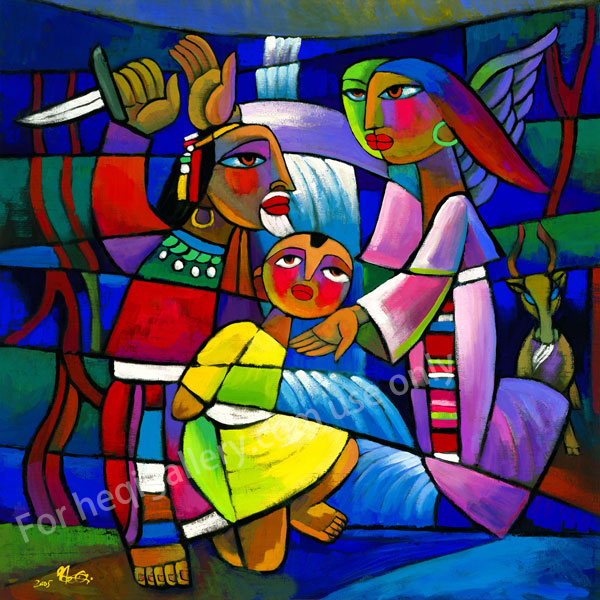
Sacrifice of Isaac

Image taken from an Armenian Gospel Book of 1455 in the Khizan style. (Source: Evans 2018, p. 206)

The following is a contemporary painting by He Qi:

He Qi © 2021 All Rights Reserved.

Image taken from He Qi Art . For purchasing prints of this and other artworks by He Qi go to heqiart.com . For other images of He Qi art works in TIPs, see here.

Following is an artwork by Sister Marie Claire , SMMI (1937–2018) from Bengaluru, India.

For more information about images by Sister Marie Claire and ways to purchase them as lithographs, see here . For other images of Sister Marie Claire paintings in TIPs, see here.

The following is a stained glass window from the Three choir windows in the Marienkirche, Frankfurt (Oder), Germany, of the 14th century:

Source: Der gläserne Schatz: Die Bilderbibel der St. Marienkirche in Frankfurt (Oder), Neuer Berlin Verlag, 2005, copyright for this image: Brandenburgisches Landesamt für Denkmalpflege und Archäologisches Landesmuseum

Stained glass is not just highly decorative, it’s a medium which has been used to express important religious messages for centuries. Literacy was not widespread in the medieval and Renaissance periods and the Church used stained glass and other artworks to teach the central beliefs of Christianity. In Gothic churches, the windows were filled with extensive narrative scenes in stained glass — like huge and colorful picture storybooks — in which worshipers could ‘read’ the stories of Christ and the saints and learn what was required for their religious salvation. (Source: Victoria and Albert Museum )

See also other stained glass windows from the Marienkirche in Frankfurt.

complete verse (Genesis 22:1)

Following are a number of back-translations as well as a sample translation for translators of Genesis 22:1:

  • Kankanaey: “When how many years had gone, God said/thought that he would test Abraham. So he called him saying, ‘Ay (vocative) Abraham.’ ‘Do you (sing.) have something to say, Sir/Lord?’ he said answering.” (Source: Kankanaey Back Translation)
  • Newari: “Some time later God summoned Abraham to test him — ‘Abraham!'” (Source: Newari Back Translation)
  • Hiligaynon: “Sometime later, God tested Abraham. He called Abraham, and Abraham answered him.” (Source: Hiligaynon Back Translation)
  • English: “Several years later, God tested Abraham to find out whether Abraham really trusted in him and would obey him. He called out to Abraham, and Abraham replied, ‘I’m here.'” (Source: Translation for Translators)

Translation commentary on Genesis 22:1

After these things: for discussion of this expression see 15.1. Translators may need to use a story opener here that will relate naturally to the events that closed the previous subdivision. We may say, for example, “After Abraham had been living some years in that land,” “A while after these things happened,” “Time passed, then God…,” “It was much later when God….”

God tested Abraham: tested here means took action to learn whether or not Abraham’s faith, trust in God, was genuine. By submitting Abraham to a difficult experience, God would test, try, examine Abraham’s faithfulness to him. The word for tested is used in the same way in Exo 16.4 (“prove”); Deut 8.2; Judges 2.22. In some languages it is more natural to talk about testing someone’s faith than about testing the person; for instance, “God tried out Abraham’s way of believing.”

In languages in which a word for “test” or “try” carries the meaning that the one tested is expected to fail, or is equivalent to “tempt” or “entice,” it may be necessary to adjust the expression by saying, for example, “God wanted to see if Abraham trusted him,” “God wanted to examine Abraham to see if he would obey him.”

And said to him, “Abraham!”: in some languages this expression may need to be introduced as a consequence of the desire to test Abraham. For example, “and so he said…,” “therefore he said….” Said may not be natural in this context. Note that Good News Translation uses “called.” Abraham! is here a form of address that often requires adjustments such as “You, Abraham.” Many languages in Papua New Guinea can use a form that calls a person from some distance away and say “Abraham-o.”

The Septuagint and Vulgate, as well as some modern translations, say “Abraham, Abraham!” The Hebrew text has the single “Abraham,” which Hebrew Old Testament Text Project rates as {A} and which is recommended to translators. Nevertheless, if a language requires the repeating of the name in calling out to a person, that natural form should be used. If it is optional, the single use of the name should be used.

And he said: he now refers to Abraham, which must be indicated in many languages. Abraham’s response should be appropriate to the verb used of God’s calling, speaking, saying.

Here am I: it is important that the translation of this response reflect, if possible, that Abraham expects to hear a further communication. This may be something equivalent to “Yes, I am waiting,” “At your service,” “I am ready,” “Yes, what is it?” Bible en français courant says “Yes, I hear you.”

Quoted with permission from Reyburn, William D. and Fry, Euan McG. A Handbook on Genesis. (UBS Helps for Translators). New York: UBS, 1997. For this and other handbooks for translators see here .