
The Greek and Hebrew that is translated as “early in the morning” or “daybreak” in English is translated in Low German as vür Dau un Daak or “before dew and day break” (translation by Johannes Jessen, publ. 1937, republ. 2006).
early morning
In Gbaya, the notion of early morning is emphasized with the ideophone sút as in the referenced verses.
Ideophones are a class of sound symbolic words expressing human sensation that are used as literary devices in many African languages. (Source: Philip Noss)
burnt-offering
The Hebrew olah (עֹלָה) originally means “that which goes up (in smoke).” English Bibles often translates it as “burnt-offering” or “whole burnt-offering,” focusing on the aspect of the complete burning of the offering.
The Greek Septuagint and the Latin Vulgate Bibles translate it as holokautōma / holocautōsis (ὁλοκαύτωμα / ὁλοκαύτωσις) and holocaustum, respectively, meaning “wholly burnt.” While a form of this term is widely used in many Romance languages (Spanish: holocaustos, French: holocaustes, Italian: olocausti, Portuguese: holocaustos) and originally also in the Catholic tradition of English Bible translations, it is largely not used in English anymore today (the preface of the revised edition of the Catholic New American Bible of 2011: “There have been changes in vocabulary; for example, the term ‘holocaust’ is now normally reserved for the sacrilegious attempt to destroy the Jewish people by the Third Reich.”)
Since translation into Georgian was traditionally done on the basis of the Greek Septuagint, a transliteration of holokautōma was used as well, which was changed to a translation with the meaning of “burnt offering” when the Old Testament was retranslated in the 1980’s on the basis of the Hebrew text.
In the Koongo (Ki-manianga) translation by the Alliance Biblique de la R.D. Congo (publ. in 2015) olah is translated as “kill and offer sacrifice” (source: Anicet Bassilua) and in Elhomwe as “fire offering.” (Source: project-specific translation notes in Paratext)
The English translation of Everett Fox uses offering-up (similarly, the German translation by Buber-Rosenzweig has Darhöhung and the French translation by Chouraqui montée).
See also offering (qorban).
offering / sacrifice (Luang)
The Greek terms that are translated uniformly as “sacrifice” or “offering” in English have the option of various terms in Luang with different shades of meaning.
For Acts 24:17, himima-rere’a (“holding two hands out”). “The focus of this term is on the gift being given by a person of lower position to a person of higher position.”
For Acts 21:26, hniurliwtu-nwali odawa (“pour out sweat [and] turn into sweaty smell”). “The focus is on the personal cost of the sacrifice.”
For Gen. 22:2-8 and Gen. 22:13, hopopa-hegeuru (“peace sign”). “The focus is on the animal or object being sacrificed, as in the story of the sacrifice of Isaac. This term was used throughout that whole chapter. This term is also used in verses that speak of Jesus as the sacrifice for our sins.”
For Acts 15:29, hoi-tani (“serve with right hand – serve with left”). “This term is used in referring to sacrifices or worship offered to idols or pagan gods.”
Source: Kathy Taber in Notes on Translation 1/1999, p. 9-16.
See also sacrifice.
Sacrifice of Isaac

Image taken from an Armenian Gospel Book of 1455 in the Khizan style. (Source: Evans 2018, p. 206)
The following is a contemporary painting by He Qi:
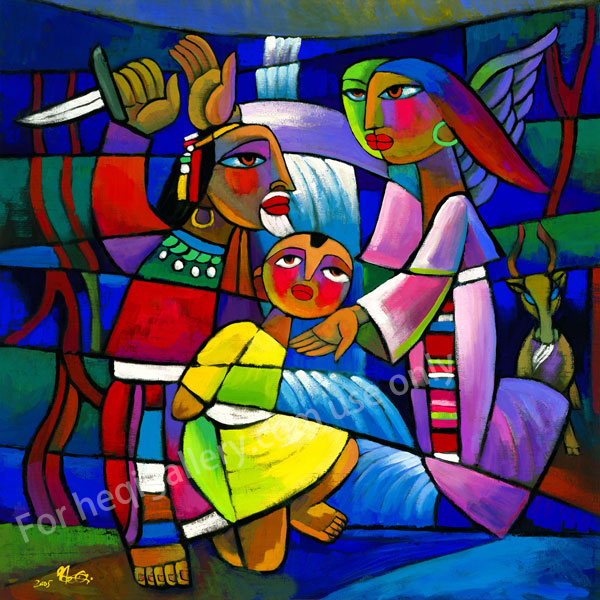
He Qi © 2021 All Rights Reserved.
Image taken from He Qi Art . For purchasing prints of this and other artworks by He Qi go to heqiart.com . For other images of He Qi art works in TIPs, see here.
Following is an artwork by Sister Marie Claire , SMMI (1937–2018) from Bengaluru, India.

For more information about images by Sister Marie Claire and ways to purchase them as lithographs, see here . For other images of Sister Marie Claire paintings in TIPs, see here.
The following is a stained glass window from the Three choir windows in the Marienkirche, Frankfurt (Oder), Germany, of the 14th century:


Source: Der gläserne Schatz: Die Bilderbibel der St. Marienkirche in Frankfurt (Oder), Neuer Berlin Verlag, 2005, copyright for this image: Brandenburgisches Landesamt für Denkmalpflege und Archäologisches Landesmuseum
Stained glass is not just highly decorative, it’s a medium which has been used to express important religious messages for centuries. Literacy was not widespread in the medieval and Renaissance periods and the Church used stained glass and other artworks to teach the central beliefs of Christianity. In Gothic churches, the windows were filled with extensive narrative scenes in stained glass — like huge and colorful picture storybooks — in which worshipers could ‘read’ the stories of Christ and the saints and learn what was required for their religious salvation. (Source: Victoria and Albert Museum )
See also other stained glass windows from the Marienkirche in Frankfurt.
complete verse (Genesis 22:3)
Following are a number of back-translations as well as a sample translation for translators of Genesis 22:3:
- Kankanaey: “When it-got-light then (i.e., next day), Abraham went-early to go get-firewood to use-for-burning and he loaded-it (lit. caused-it-to-be-carried) on his donkey. Then he called Isaac and two slaves and they set-off to go to the place that God had told him.” (Source: Kankanaey Back Translation)
- Newari: “Getting up early the next morning, Abraham split wood to light a fire, [and] tied a saddle on the body of a donkey. And taking his son Isaac and two servants he went toward the place God had told him about.” (Source: Newari Back Translation)
- Hiligaynon: “Therefore very early the next morning, Abraham chopped wood as firewood for the offering, and he loaded it on his donkey. He set-out with Isaac and his two male servants to the place that God had-said to him.” (Source: Hiligaynon Back Translation)
- English: “So Abraham got up early the next morning, put a saddle on his donkey, and took with him two of his servants along with his son, Isaac. He also chopped some wood to kindle a fire for a burnt offering. Then they started traveling to the place God told him about.” (Source: Translation for Translators)
- Language in the Caucasus (oral translation): “One day God wanted to check/test the prophet Ibrahim. He tells him, ‘You [should/must] completely-burn-as-sacrifice your only dear son Isaac for me on the mountain that I tell you in the land Moriah.” (“This particular story in Genesis does not call Abraham a prophet, but he is understood as such by Islam, which is the background for many OBS readers/listeners. The addition here is perfectly appropriate, since there already is prior Scripture where Abraham is called a prophet [Gen. 20:7, where God instructs Abimelech to return Sarah to Abraham.”]) (Source: Erwin R. Komen and Roman Kim in The Bible Translator 2023, p. 21ff.)
Abraham
The name that is transliterated as “Abraham” in English means “father of a multitude,” “father of mercy,” “father of many nations.” (Source: Cornwall / Smith 1997 )
In the vast majority of sign languages, including American Sign Language it is translated with the sign signifying “hold back arm” (referring to Genesis 22:12).
“Abraham” in American Sign Language (source )
In Vietnamese (Hanoi) Sign Language it is translated with a sign for that demonstrates his new destiny. Previously, he had been called to wander from his home, and the name “Abram” reflected this movement (see here). The new sign name is in one location and stays there, showing Abraham will be given a land to call his own. At this time, Abraham was in the southern part of Canaan, which is shown on the base arm by the location near the elbow. (Source: The Vietnamese Sign Language translation team, VSLBT)
“Abraham” in Vietnamese Sign Language, source: SooSL
For more information on translations of proper names with sign language see Sign Language Bible Translations Have Something to Say to Hearing Christians .
In Tira it is transliterated as Abaram. The choice of this, rather than the widely-known “Ibrahim,” as used in the Tira translation of the Qu’ran, was to offset it against the Muslim transliteration which originates from Arabic. (Source: J.A. Naudé, C.L. Miller Naudé, J.O. Obono in Acta Theologica 43/2, 2023, p. 129ff. )
Click or tap here to see two short video clips about Abraham (source: Bible Lands 2012)
See also our ancestor Abraham and Abram.
Learn more on Bible Odyssey: Abraham .
inform / tell (Japanese honorifics)
Click or tap here to see the rest of this insight.
Like a number of other East Asian languages, Japanese uses a complex system of honorifics, i.e. a system where a number of different levels of politeness are expressed in language via words, word forms or grammatical constructs. These can range from addressing someone or referring to someone with contempt (very informal) to expressing the highest level of reference (as used in addressing or referring to God) or any number of levels in-between. One way to do this is through the usage (or a lack) of an honorific prefix as shown here in the widely-used Japanese Shinkaiyaku (新改訳) Bible of 2017.
The concept of “informing” (“telling”) is translated in the Shinkaiyaku Bible as o-tsuge (お告げ), combining “inform / tell” (tsuge) with the respectful prefix o-. (Source: S. E. Doi, see also S. E. Doi in Journal of Translation, 18/2022, p. 37ff. )
See also informing (Japanese honorifics).
Leave a Reply
You must be logged in to post a comment.