6but I did not believe the reports until I came and my own eyes saw it. Not even half of the greatness of your wisdom had been told to me; you far surpass the report that I had heard.
Ixcatlán Mazatec: “with your best/biggest thinking” (source: Robert Bascom)
Noongar: dwangka-boola, lit. “ear much” (source: Portions of the Holy Bible in the Nyunga language of Australia, 2018 — see also remember)
Kwere “to know how to live well” (source: Pioneer Bible Translators, project-specific translation notes in Paratext)
Dobel: “their ear holes are long-lasting” (in Acts 6:3) (source: Jock Hughes)
Gbaya: iŋa-mgbara-mɔ or “knowing-about-things” (note that in comparison to that, “knowledge” is translated as iŋa-mɔ or “knowing things”) (source: Philip Noss in The Bible Translator 2001, p. 114ff. )
Chichewa: nzeru, meaning both “knowledge” and “wisdom” (source: Mawu a Mulungu mu Chichewa Chalero Back Translation)
Kako: “heart thinking” (source: Reyburn 2002, p. 190)
In Hungarian Sign Language it is translated with a hand gesture referring to God to indicate a human quality to communicate that wisdom does not originate from man but is linked to and connected with the fear of God (source: Jenjelvi Biblia and HSL Bible Translation Group):
In Malay, the pronoun beta for the royal “I” (or “my” or “me”) that is used by royals when speaking to people of lower rank, subordinates or commoners to refer to themselves in these verses. This reflects the “language of the court because the monarchy and sultanate in Malaysia are still alive and well. All oral and printed literature (including newspapers and magazines) preserve and glorify the language of the court. Considering that the language of the court is part of the Malaysian language, court language is used sparingly where appropriate, specifically with texts relating to palace life.” (Source: Daud Soesilo in The Bible Translator 2025, p. 263ff.)
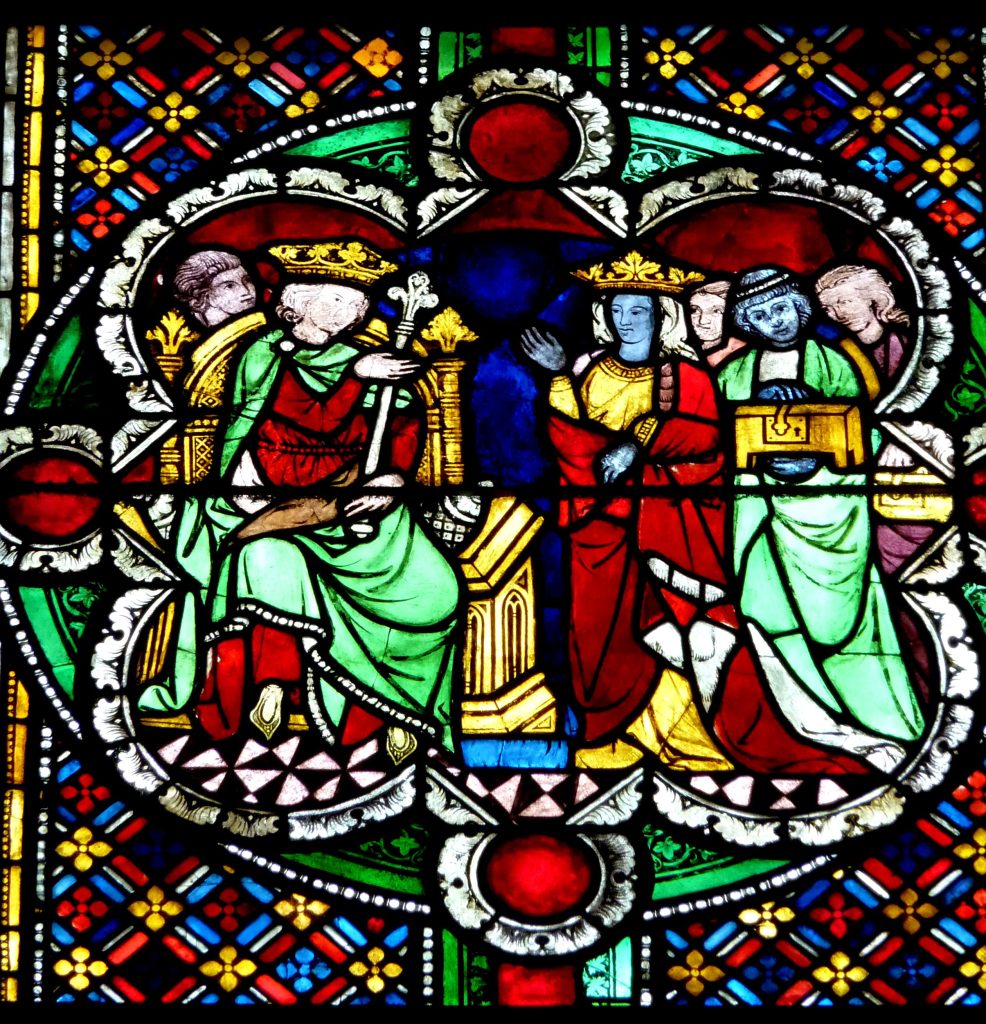
Stained glass is not just highly decorative, it’s a medium which has been used to express important religious messages for centuries. Literacy was not widespread in the medieval and Renaissance periods and the Church used stained glass and other artworks to teach the central beliefs of Christianity. In Gothic churches, the windows were filled with extensive narrative scenes in stained glass — like huge and colorful picture storybooks — in which worshipers could ‘read’ the stories of Christ and the saints and learn what was required for their religious salvation. (Source: Victoria and Albert Museum )
Following are a number of back-translations as well as a sample translation for translators of 2 Chronicles 9:6:
Kupsabiny: “But I could not at that time believe those words until I arrived to come and see (them) with my own eyes. Surely I was not told even a portion of all those words/things. Your wisdom goes beyond the matters/things I was told!” (Source: Kupsabiny Back Translation)
Newari: “But until I came and saw it with my own eyes, I did not believe what people said. As it turns out, I had not heard the half of your wisdom. As it turns out, you have much more wisdom than people say.” (Source: Newari Back Translation)
Hiligaynon: “I did- not -believe these-things until I came here and I saw it myself. The truth-is, what I have-heard about you is not even half-part of what I saw. Your wisdom is more than of what I have-heard.” (Source: Hiligaynon Back Translation)
English: “But I did not believe it was true until I came here and saw it myself. You are extremely wise and rich, more than what people told me.” (Source: Translation for Translators)
But: The common Hebrew conjunction here is translated by Revised Standard Version in such a way as to mark the contrast between the queen’s expectations and what she actually witnessed when she met Solomon. While her expectations were quite positive, she was overwhelmed by what she discovered when she saw Solomon in Jerusalem. Some other connectors used to mark this contrast are “Nevertheless” (NASB) and “Yet” (New American Bible).
I did not believe the reports … you surpass the report which I heard: Reports is literally “words,” and report is literally “what is heard.” Since these words are synonyms here, Revised Standard Version uses the noun report for both of them (also New Revised Standard Version). New Jewish Publication Society’s Tanakh translates the reports (literally “their words”) as “what they said.”
My own eyes had seen it: Instead of retaining the noun eyes as the subject of the verb had seen, it will be more natural in many languages to say “[I] saw with my own eyes” (New American Bible) or “[I] saw for myself” (Good News Translation, Revised English Bible, New Jerusalem Bible). Another possible rendering is “I myself saw.”
Behold, half the greatness of your wisdom was not told me: Good News Translation does not translate the Hebrew particle rendered behold. This particle calls attention to the statement that follows, and if the receptor language has such a particle or construction that serves the same function, it may be used here. The passive expression was not told me will have to be made active in some languages. It will be possible in certain cases to use the indefinite third person plural subject as follows: “they did not tell me….” But in other cases a more emphatic negative could be used, such as “no one told me….” Another way of saying this for some languages is “I did not learn about…” or “I did not hear about….”
An alternative model for this whole verse is:
• I did not believe what people said about you until I came and saw it for myself. In fact, I had not heard about even half of your great wisdom! You are even greater than what they told me.
Quoted with permission from Omanson, Roger L. and Ellington, John E. A Handbook on 1-2 Chronicles, Volume 1. (UBS Helps for Translators). Miami: UBS, 2014. For this and other handbooks for translators see here .
9:6a But I did not believe the reports until I came and saw with my own eyes.
But I did not believe what people said until I came here and my own eyes had seen it. -or-
Truly, when I heard what people said, I did not believe it. But now that I see it myself, I believe it.
9:6b Indeed, not half of the greatness of your wisdom was told to me.
Truly, they did not tell me the half of the immensity of your wisdom. -or-
You are very wise and what they told me was not even half of what I can see.
9:6c You have far exceeded the report I heard.
You are far greater than what I heard. -or-
I can even say that you are wiser than what people told me.


Leave a Reply
You must be logged in to post a comment.