The Hebrew, Aramaic, Ge’ez, and Greek that are translated as “wine” in English is translated into Pass Valley Yali as “grape juice pressed long ago (= fermented)” or “strong water” (source: Daud Soesilo). In Guhu-Samane it is also translated as “strong water” (source: Ernest L. Richert in The Bible Translator 1965, p. 198ff. ), in Noongar as “liquor” (verbatim: “strong water”) (source: Warda-Kwabba Luke-Ang), in Hausa as ruwan inabi or “water of grapes” (with no indication whether it’s alcoholic or not — source: Mark A. Gaddis), in sar as kasə nduú or “grape drink” (source: Andy Warren-Rothlin), or in Papantla Totonac and Coyutla Totonac as “a drink like Pulque” (for “Pulque,” see here ) (source: Jacob Loewen in The Bible Translator 1971, p. 169ff. ).
In Swahili, Bible translations try to avoid local words for alcoholic drinks, because “drinking of any alcohol at all was one of the sins most denounced by early missionaries. Hence translators are uncomfortable by the occurrences of wine in the Bible. Some of the established churches which use wine prefer to see church wine as holy, and would not refer to it by the local names used for alcoholic drinks. Instead church wine is often referred to by terms borrowed from other languages, divai (from German, der Wein) or vini/mvinyo (from ltalian/Latin vino/vinum). Several translations done by Protestants have adapted the Swahili divai for ‘wine,’ while those done by Catholics use vini or mvinyo.” (Source: Rachel Konyoro in The Bible Translator 1985, p. 221ff. )
The Swahili divai was in turn borrowed by Sabaot and was turned into tifaayiik and is used as such in the Bible. Kupsabiny, on the other hand, borrowed mvinyo from Swahili and turned it into Finyonik. (Source: Iver Larsen)
In Nyamwezi, two terms are used. Malwa ga muzabibu is a kind of alcohol that people specifically use to get drunk (such as in Genesis 9:21) and ki’neneko is used for a wine made from grapes (source: Pioneer Bible Translators, project-specific translation notes in Paratext).
In some Hindi translations (such as the Common Language version, publ. 2015 ), one term (dākharasa दाखरस — grape juice) is used when that particular drink is in the focus (such as in John 2) and another term (madirā मदिरा — “alcohol” or “liquor”) when drunkenness is in the focus (such as in Eph. 5:18).
In Mandarin Chinese, the generic term jiǔ (酒) or “alcohol(ic drink)” is typically used. Exceptions are Leviticus 10:9, Numbers 6:3, Deuteronomy 29:6, Judges 13:4 et al., 1 Samuel 1:15, and Luke 1:15 where a differentiation between weak and strong alcohol is needed. The Mandarin Chinese Union Version (2010) translates that as qīngjiǔ lièjiǔ (清酒烈酒) and dànjiǔ lièjiǔ (淡酒烈酒), both in the form of a Chinese proverb and meaning “light alcohol and strong drink.” (Source: Zetzsche)
Click or tap here to see a short video clip about wine in biblical times (source: Bible Lands 2012)
The name that is transliterated as “Eli” in English is translated means “YHWH is high,” “my God,” “adopted of the LORD,” “elevated.” (Source: Cornwall / Smith 1997 )
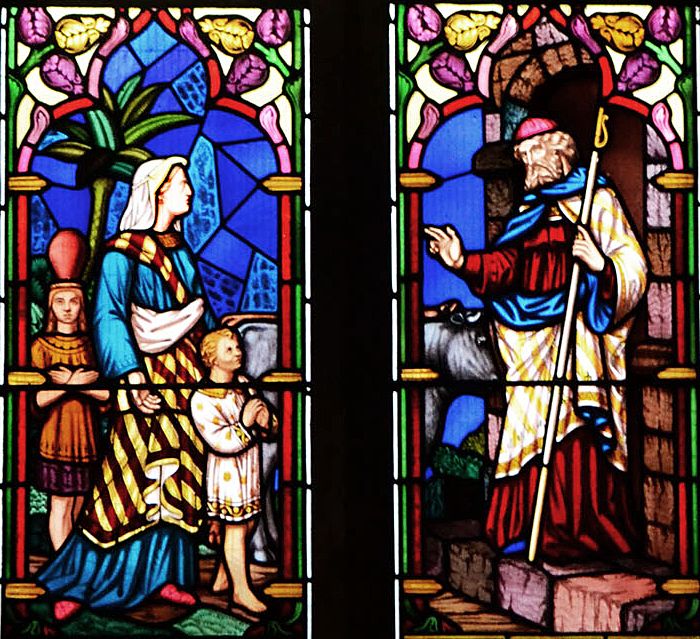
Stained glass is not just highly decorative, it’s a medium which has been used to express important religious messages for centuries. Literacy was not widespread in the medieval and Renaissance periods and the Church used stained glass and other artworks to teach the central beliefs of Christianity. In Gothic churches, the windows were filled with extensive narrative scenes in stained glass — like huge and colorful picture storybooks — in which worshipers could ‘read’ the stories of Christ and the saints and learn what was required for their religious salvation. (Source: Victoria and Albert Museum )
Following are a number of back-translations as well as a sample translation for translators of 1 Samuel 1:14:
Kupsabiny: “Eli said to Hannah that, ‘For how long will you drink? Refrain from this drinking!’” (Source: Kupsabiny Back Translation)
Newari: “So Eli said to her, "When will you desist from getting drunk? Give up your drinking!"” (Source: Newari Back Translation)
Hiligaynon: “Therefore he said to her, ‘Until when will- you (sing.) -cause- (yourself) -to-be-drunk? Please stop that now!’” (Source: Hiligaynon Back Translation)
English: “He said to her, ‘How long will you continue to get drunk ? Throw away your wine/Quit drinking wine!’” (Source: Translation for Translators)
And: in some languages the common Hebrew conjunction found here may be translated as a logical transition marker such as “Therefore” or “So” (New Revised Standard Version). Eli’s reaction was in direct response to what he had observed in the behavior of Hannah. But in several modern versions (New Jewish Publication Society’s Tanakh, Revised English Bible, New American Bible, New Jerusalem Bible) the conjunction is left untranslated.
Though the Hebrew is literally Eli said to her, Good News Translation substitutes the pronoun “he” in the interest of English style, rather than immediately repeating the noun (see verse 13). But in languages where “he” and “she” are translated by the same word, there may be good reason to retain the proper noun.
The question How long will you be drunken? is not to be taken in its literal sense, as if Eli were asking for information. Rather it is a plea for Hannah to stop the presumed bad habit that Eli thought was behind the behavior he had been observing. Like Good News Translation, several modern versions translate it as an exclamation: “Enough of this drunken behavior!” (Revised English Bible); “Stop getting drunk!” (New Century Version).
Put away your wine from you is a literal translation of the Hebrew. Many versions use a more natural expression in the receptor language, such as “go sleep it off” (Traduction œcuménique de la Bible), “Sober up from your wine!” (New American Bible), “Get rid of your wine!” (New International Version), or simply “Sober up!” (New Jewish Publication Society’s Tanakh, New American Bible).
Quoted with permission from Omanson, Roger L. and Ellington, John E. A Handbook on the First and Second Books of Samuel, Volume 1. (UBS Helps for Translators). New York: UBS, 2001. For this and other handbooks for translators see here .

Leave a Reply
You must be logged in to post a comment.