
The Greek in Luke 24:12 that is translated as “stooping and looking in” or similar in English is translated in the German New Testament translation by Berger / Nord (publ. 1999) with gebückt hineingehen or “stooped and went in.”
Peter got up and ran to the tomb𖺗 stooping and looking in he saw the linen cloths by themselves (image)

Illustration by Annie Vallotton, copyright by Donald and Patricia Griggs of Griggs Educational Service. More images can be viewed at rotation.org .
For other images by Annie Vallotton on Translation Insights & Perspectives, see here.
Women at the Tomb
The following is a stained glass window from the Chartres Cathedral in Chartres, France, ca. 1150:
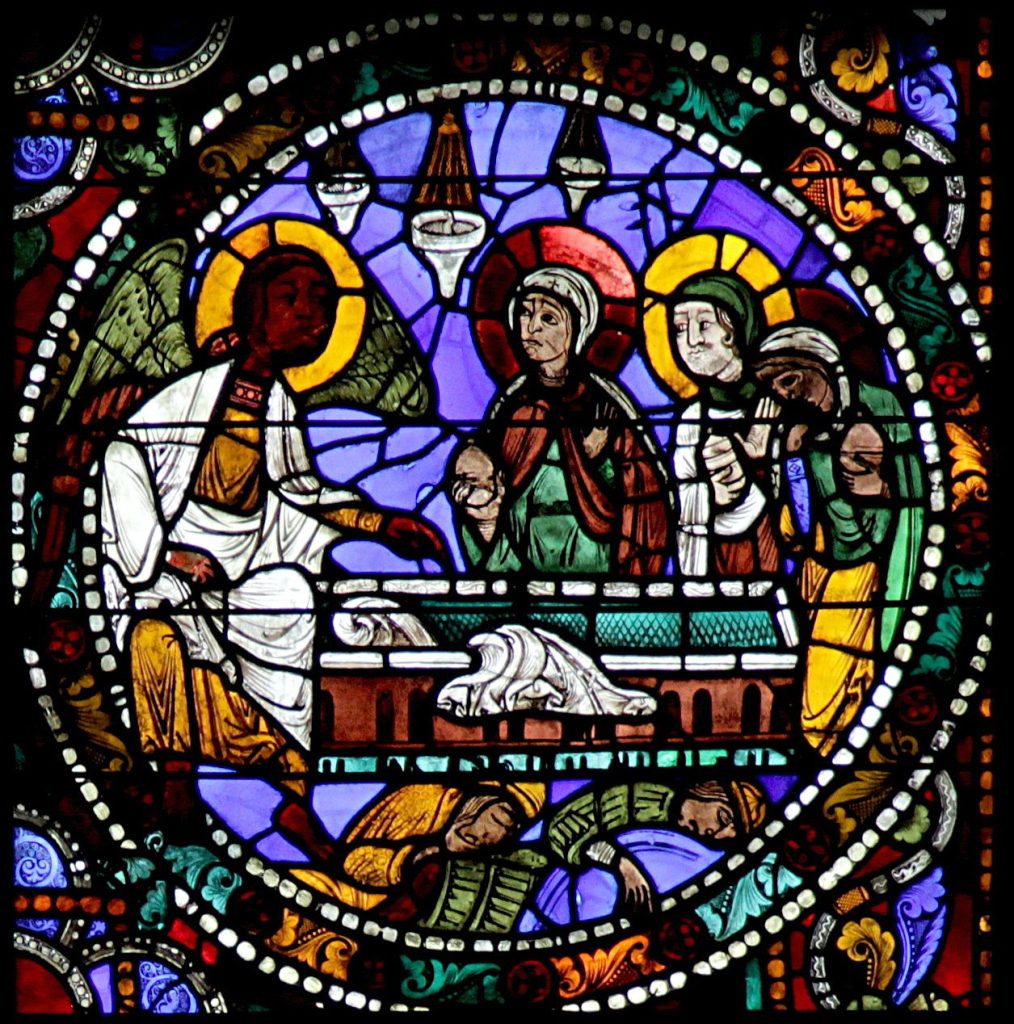
Source: Art in the Christian Tradition , a project of the Vanderbilt University Divinity Library, Nashville, TN. Original source: Wikimedia

Stained glass is not just highly decorative, it’s a medium which has been used to express important religious messages for centuries. Literacy was not widespread in the medieval and Renaissance periods and the Church used stained glass and other artworks to teach the central beliefs of Christianity. In Gothic churches, the windows were filled with extensive narrative scenes in stained glass — like huge and colorful picture storybooks — in which worshipers could ‘read’ the stories of Christ and the saints and learn what was required for their religious salvation. (Source: Victoria and Albert Museum )
complete verse (Luke 24:12)
Following are a number of back-translations of Luke 24:12:
- Noongar: “But Peter stood up and ran to the grave; he stooped and saw the grave clothes but not another thing. Then he went back , amazed because of everything which had happened.” (Source: Warda-Kwabba Luke-Ang)
- Uma: “But as for Petrus, he ran to the grave. He bent down to peer inside, he saw that only the burial-cloths were there. After that, he returned to his house, and he continually pondered thinking about what had happened.” (Source: Uma Back Translation)
- Yakan: “But Petros jumped up running to the grave. When he arrived there he bent down peeping into the cave. The only things he saw there were the shrouds. Then he left for home, he really wondered about the happenings.” (Source: Yakan Back Translation)
- Western Bukidnon Manobo: “But Peter, when he heard that news, he ran to the tomb and when he arrived, he peeked inside and the only thing he saw was the white cloth which had wrapped the body of Jesus. And he left there and went home, very surprised, wondering why the body of Jesus wasn’t there.” (Source: Western Bukidnon Manobo Back Translation)
- Kankanaey: “But Pedro however, he ran to go to the place of the cave. Arriving there, he bent-down to peer-in, but he saw nothing except the cloth that they-had-used-for-wrapping. Then he went-home searching-and-searching in his mind as to what had happened.” (Source: Kankanaey Back Translation)
- Tagbanwa: “But although they didn’t acknowledge it as true, Pedro ran going there to the grave. When he arrived, he bent down to peer inside. All he saw there were those cloths with which the body of Jesus had been wrapped. That’s why he went home amazed about that which had happened.” (Source: Tagbanwa Back Translation)
Peter
Following is a Armenian Orthodox icon of Peter (found in the Ghazanchetsots Cathedral in Shusha, Azerbaijan).


Orthodox Icons are not drawings or creations of imagination. They are in fact writings of things not of this world. Icons can represent our Lord Jesus Christ, the Virgin Mary, and the Saints. They can also represent the Holy Trinity, Angels, the Heavenly hosts, and even events. Orthodox icons, unlike Western pictures, change the perspective and form of the image so that it is not naturalistic. This is done so that we can look beyond appearances of the world, and instead look to the spiritual truth of the holy person or event. (Source )
Following is a hand colored stencil print on momigami of Peter by Sadao Watanabe (1970):

Image taken with permission from the SadaoHanga Catalogue where you can find many more images and information about Sadao Watanabe. For other images of Sadao Watanabe art works in TIPs, see here.
In Finnish Sign Language it is translated with the sign signifying “key” (referring to Matthew 16:19). (Source: Tarja Sandholm)
“Peter” or “Cephas” in Finnish Sign Language (source )
In Swiss-German Sign Language it is translated with the sign for “rock,” referring to the meaning of the Greek word for “Peter.”
“Peter” in Swiss-German Sign Language, source: DSGS-Lexikon biblischer Begriffe , © CGG Schweiz
For more information on translations of proper names with sign language see Sign Language Bible Translations Have Something to Say to Hearing Christians .
See also Peter – rock.
Learn more on Bible Odyssey: Peter .
flax / linen
Flax Linum usitatissimum, from which linen cloth is made, was cultivated in the Middle East, including Canaan, at least as early as 5000 B.C. A document from Gezer (in Israel) from around King Saul’s time (1000 B.C.) refers to the cultivation of flax and states that flax and wool were the main materials for making cloth. According to Joshua 2:6, the Israelite spies were hidden under flax stalks by Rahab. Flax was grown extensively in Egypt and made into cloth and mats.
Pesheth and pishtah are probably the original Hebrew words for flax, if indeed the plant was domesticated in the Holy Land, as Zohary (Plants of the Bible. Cambridge University Press, 1982) proposes. They may be related to the word pashat, meaning “to strip off” or “to flay,” or to the word pasas, meaning “to disintegrate.” Pesheth and pishtah are used twenty times in the Old Testament, twice referring clearly to the plant itself (Exodus 9:31; Joshua 2:6). Other references are to the processed flax (Judges 15:14 et al.). A few cases refer to finished products, namely wicks (Isaiah 42:3 et al.), cords (Ezekiel 40:3), and items of clothing (Jeremiah 13:1 et al.).
It is likely that the Hebrews acquired the word shesh from the Egyptians during their sojourn in Egypt, since flax was cultivated there also. The Egyptian word for flax was shent (via shen-suten). Shesh is used thirty-eight times in the Old Testament: for the material that Pharaoh put on Joseph, for the Tabernacle curtains and hangings in Exodus, for the ephod, and for the priests’ tunics. The wise woman of Proverbs 31:22 wears it. In Ezekiel 16:10 et al. it is paired with silk, and in Ezekiel 27:7 “shesh from Egypt” is spoken of as material for the sails of ships.
Several references to linen use the Hebrew word bad. In Exodus 28:42 the priests’ underwear are made from bad, and it is used thereafter in Leviticus to describe various items of clothing—coat, breeches, girdle, and turban. It turns up again in Samuel’s and King David’s “ephods” and then again in Ezekiel and Daniel, where we see visions of “a man clothed in bad.”
Linen is referred by the Hebrew word buts in 1‑2 Chronicles, Esther, and Ezekiel, where the robes of the Temple choir, kings, and rich men are described.
The Old Testament has some references to the Hebrew word sadin (“linen garment”): Judges 14:12 (Samson promises them to his opponents), Proverbs 31:24 (the wise woman makes them), and Isaiah 3:23 (the rich women of Jerusalem wear them). The Septuagint uses the Greek word bussos or sindōn in these passages.
The Hebrew word ’etun occurs only in Proverbs 7:16, where it refers to a linen bedspread from Egypt.
In the New Testament there are three primary Greek words for linen: linon/linous, sindōn, and othonē/othonion. Linon is used to refer to garments of the angels in Revelation 15:6 as well as to the “smoldering wick” in Matthew 12:20. The synoptic Gospel writers refer to the linen cloth that Joseph and Nicodemus used to wrap Jesus’ body as a sindōn. Mark uses the same word to refer to the cloth that was worn by the unidentified young man at the time of Jesus’ arrest (Mark 14:51f.). John uses a different Greek word for Jesus’ burial cloths: othonion.
The rich man referred to in the Lazarus story (Luke 16:19) is clothed in “fine linen” (bussos). The Greek word bussos is the root word for bussinos, which refers to tunics, robes and turbans made from linen fabric (Revelation 18:12 et al.).
Flax is a little taller than a sesame plant, about a meter (3 feet) tall. Its leaves are narrow and the flowers are bright blue with five petals. The seed capsule contains oil that is used for cooking and also for thinning paint. After flax ripens, the plants are uprooted and the stalks are left to dry for a while. The stalks are then soaked, dried, and beaten to separate the fibers, which are then combed and woven into cloth.
Linen cloth was relatively costly in Israel, and being light and easy to dye it was highly valued. Their priests wore linen garments to combat sweating (see Ezekiel 44:18). They had to remove these holy garments when they left the Temple, “lest they communicate holiness to the people” (Ezekiel 44:19). The high esteem given to linen by the Jews is shown also by the fact that they used it for burying the dead, and we are told that the Dead Sea Scrolls were wrapped in linen cloths. However, the flax plant was special in other ways. The crushed stalks of flax plants were also used for making rope and lamp wicks. The seed was used for oil.
Today flax is raised more for the oil that comes from the seeds (called linseed oil) than for the fibers, although flax stalks are also made into special kinds of paper.
Metaphorical uses of flax are relatively few in the Bible, and all suggest the weakness of the material. In Judges 15:14 flax fiber is used as a simile for Samson’s fetters (they snapped like linen thread). Isaiah 42:3 says the Messiah will be gentle with weak people (“a dimly burning wick [pishtah] he will not quench”), in contrast to the typical iron-fisted tyrants of the day. Isaiah 43:17 describes the fate of the Babylonian enemies: they will be snuffed out “like a wick [pishtah].”
Linen cloth (or other cloth with a similar name) is surprisingly widespread. Cloth merchants in the translators’ area may know it under a trade language name, and if so, that can be used.In some places it is used only for burying people. In that case, if it is used in translation at all, the difference in culture should be explained in a footnote. Since linen is bleached white, a generic phrase such as “beautiful white cloth” can be considered in many places. In the three metaphorical passages mentioned above, an appropriate cultural image may be substituted, or an adverb expressing weakness or fragility.


Source: Each According to its Kind: Plants and Trees in the Bible (UBS Helps for Translators)
Se also linen.
Scriptures Plain & Simple (Luke 24:1-12)
Barclay Newman, a translator on the teams for both the Good News Bible and the Contemporary English Version, translated passages of the New Testament into English and published them in 2014, “in a publication brief enough to be non-threatening, yet long enough to be taken seriously, and interesting enough to appeal to believers and un-believers alike.” The following is the translation of Luke 24:1-12:
Before Sunday dawned, the women rushed to the tomb,
carrying spices they had prepared.
The stone had been rolled away from the entrance,
and they rushed right in.
Where was the body of the Lord Jesus?
It was nowhere to be seen,
and they didn’t know what to think.
Two men there in shining white garments!
Where did they come from?
Shocked, the women fell to the ground, but the men said:
“The living don’t dwell in tombs of the dead!
Jesus has been raised to life,
and now he’s long gone.
While you were still in Galilee, don’t you remember
he told you he’d be arrested, then executed on a cross,
but three days later he’d rise to life?”
At that very moment, the women recalled
what Jesus had said to them.
Quite a crowd of women had gone to the tomb,
among them: Mary Magdalene, Joanna,
and Mary the mother of James.
They hurried off and informed others,
including the closest followers of Jesus,
who refused to believe such nonsense.
However, Peter raced to the tomb,
but after stooping and looking carefully inside,
he saw only burial clothes.
Still confused, he returned to the others.
Translation commentary on Luke 24:12
Exegesis:
parakupsas blepei ta othonia mona ‘stooping down he saw only the linen clothes.’ mona may be taken as predicate (cf. Revised Standard Version, Phillips) or as attributive to othonia, ‘the clothes alone,’ i.e. ‘only the clothes’ (cf. Translator’s New Testament, Good News Translation). The latter is preferable.
parakuptō ‘to stoop down,’ ‘to peer in.’
othonion ‘linen cloth,’ ‘bandage,’ used in preparing a corpse for burial.
pros heauton thaumazōn to gegonos ‘wondering in himself (at) that which had happened.’ pros heauton may go with apēlthen, or with thaumazōn, preferably the latter.
Translation:
Stooping and looking in, he saw, or, ‘when he stooped to look (or, when he peered in), he saw/noticed.’
The linen cloths by themselves, preferably, ‘only the linen cloths,’ “nothing but the linen wrappings/clothes” (The Four Gospels – a New Translation, Translator’s New Testament), ‘the linen bandages and nothing else.’ — The linen cloths refers to what in 23.53 is called “a linen shroud”.
He went home wondering, preferably, ‘he went away wondering in himself’ (Nieuwe Vertaling). The qualification ‘in himself’ is redundant; it should not be rendered where idiom is against it. For wondering see on 1.21.
Quoted with permission from Reiling, J. and Swellengrebel, J.L. A Handbook on the Gospel of Luke. (UBS Handbook Series). New York: UBS, 1971. For this and other handbooks for translators see here . Make sure to also consult the Handbook on the Gospel of Mark for parallel or similar verses.
Leave a Reply
You must be logged in to post a comment.