The Greek that is typically translated as “will” in English is translated in Warao as obojona, a term that “includes the concepts of consciousness, will, attitude, attention and a few other miscellaneous notions.” (Source: Henry Osborn in The Bible Translator 1969, p. 74ff. .) See other occurrences of Obojona in the Warao New Testament.
In Mairasi, it is translated with “throat.” (Source: Enggavoter 2004)
Following are a number of back-translations of John 4:34:
Uma: “That is why Yesus said to them: ‘My food is to follow the will of the Lord God who sent me, and to make-complete the work that he gave me.” (Source: Uma Back Translation)
Yakan: “Isa said to them, ‘That is what fills/satisfies me, when I do the wish of God, the one who sent me, and I have to finish the work he gave me to do.” (Source: Yakan Back Translation)
Western Bukidnon Manobo: “‘To fulfill the will of God who sent me and to finish that which he has given me to do is just like my food because it is that which gives me strength,’ said Jesus.” (Source: Western Bukidnon Manobo Back Translation)
Kankanaey: “Then Jesus said, ‘This is what I eat, my obeying what the one-who-sent-me wants in order that the work he gave-me -to-do will be finished.” (Source: Kankanaey Back Translation)
Tagbanwa: “When Jesus observed that, he said to them, ‘What I mean by my food is that I obey the will of the one who sent me to come here and fulfill what he is causing me to do.” (Source: Tagbanwa Back Translation)
Tenango Otomi: “Jesus said, ‘It is like eating to me when I do the will of him who sent me and I will complete the work he gave me to do.” (Source: Tenango Otomi Back Translation)
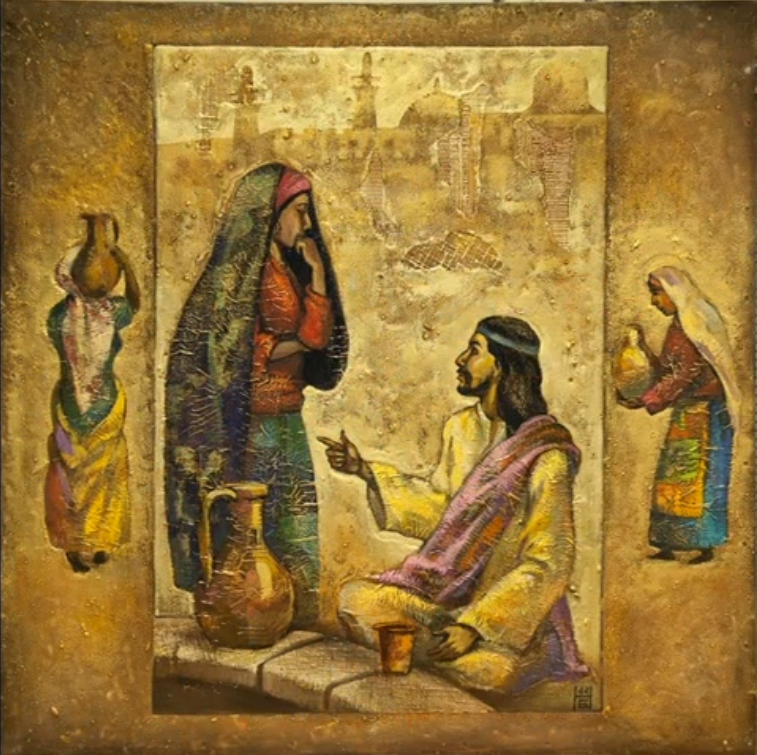
“Jesus is dressed in a different style of clothing than the style of the woman who is shown as a Lanna Thai northerner. It is unusual for him to talk to a person from a different region, especially a woman. The clothes, the roof of the house in the background, and the dipper for water all indicate that this is in northern Thailand.”
Ketut Lasia is one of the last traditional Balinese painters in the Ubud style. As an adult, Lasia converted from Hinduism to Christianity, and he paints primarily biblical scenes. You can find artwork from Ketut Lasia in a variety of formats for sale at Fine Art America .
In the Yatzachi Zapotec translation of the Gospel of John, any reference to the evangelist and presumed narrator is done in the first person.
The translator Inez Butler explains (in: Notes on Translation, September 1967, pp. 10ff.):
“In revising the Gospel of John in Yatzachi Zapotec we realized from the start that the third person references of Jesus to himself as Son of Man had to be converted into first person references, but only more recently have we decided that similar change is necessary in John’s references to himself as ‘the disciple whom Jesus loved.’ As I worked on those changes and questioned the informant about his understanding of other passages in the Gospel, I discovered that the reader misses the whole focus of the book as an eyewitness account unless every reference to the disciples indicates the writer’s membership in the group. In view of that we went back through the entire book looking for ways to cue in the reader to the fact that John was an eyewitness and a participant in a many of the events, as well as the historian.
“When the disciples were participants in events along with Jesus, it was necessary to make explicit the fact that they accompanied him, although in the source language that is left implicit, since otherwise our rendering would imply that they were not present.”
In this verse, the Yatzachi Zapotec says: “And Jesus said to us. . .”
Click or tap here to see the rest of this insight.
Like a number of other East Asian languages, Japanese uses a complex system of honorifics, i.e. a system where a number of different levels of politeness are expressed in language via words, word forms or grammatical constructs. These can range from addressing someone or referring to someone with contempt (very informal) to expressing the highest level of reference (as used in addressing or referring to God) or any number of levels in-between.
One way to do this is through the usage (or a lack) of an honorific prefix as shown here in the widely-used Japanese Shinkaiyaku (新改訳) Bible of 2017. When the referent is God, the “divine” honorific prefix mi- (御 or み) can be used, as in mi-kokoro (みこころ) or “will (of God)” in the referenced verses. Two verses (Ezra 10:11 and Ephesians 1:9) use mi-mune (みむね) with the same honorific prefix and meaning.
Click or tap here to see the rest of this insight.
Like a number of other East Asian languages, Japanese uses a complex system of honorifics, i.e. a system where a number of different levels of politeness are expressed in language via words, word forms or grammatical constructs. These can range from addressing someone or referring to someone with contempt (very informal) to expressing the highest level of reference (as used in addressing or referring to God) or any number of levels in-between.
One way Japanese shows different degree of politeness is through the choice of a first person singular and plural pronoun (“I” and “we” and its various forms) as shown here in the widely-used Japanese Shinkaiyaku (新改訳) Bible of 2017. The most commonly used watashi/watakushi (私) is typically used when the speaker is humble and asking for help. In these verses, where God / Jesus is referring to himself, watashi is also used but instead of the kanji writing system (私) the syllabary hiragana (わたし) is used to distinguish God from others.
Click or tap here to see the rest of this insight.
Like a number of other East Asian languages, Japanese uses a complex system of honorifics, i.e. a system where a number of different levels of politeness are expressed in language via words, word forms or grammatical constructs. These can range from addressing someone or referring to someone with contempt (very informal) to expressing the highest level of reference (as used in addressing or referring to God) or any number of levels in-between.
One way Japanese shows different degree of politeness is through the usage of an honorific construction where the morpheme are (され) is affixed on the verb as shown here in the widely-used Japanese Shinkaiyaku (新改訳) Bible of 2017. This is particularly done with verbs that have God as the agent to show a deep sense of reverence. Here, tsukawas-are-ru (遣わされる) or “send” is used.



Leave a Reply
You must be logged in to post a comment.