7Isaac said to his father Abraham, “Father!” And he said, “Here I am, my son.” He said, “The fire and the wood are here, but where is the lamb for a burnt offering?”
The Hebrew olah (עֹלָה) originally means “that which goes up (in smoke).” English Bibles often translates it as “burnt-offering” or “whole burnt-offering,” focusing on the aspect of the complete burning of the offering.
The GreekSeptuagint and the LatinVulgate Bibles translate it as holokautōma / holocautōsis (ὁλοκαύτωμα / ὁλοκαύτωσις) and holocaustum, respectively, meaning “wholly burnt.” While a form of this term is widely used in many Romance languages (Spanish: holocaustos, French: holocaustes, Italian: olocausti, Portuguese: holocaustos) and originally also in the Catholic tradition of English Bible translations, it is largely not used in English anymore today (the preface of the revised edition of the Catholic New American Bible of 2011: “There have been changes in vocabulary; for example, the term ‘holocaust’ is now normally reserved for the sacrilegious attempt to destroy the Jewish people by the Third Reich.”)
Since translation into Georgian was traditionally done on the basis of the Greek Septuagint, a transliteration of holokautōma was used as well, which was changed to a translation with the meaning of “burnt offering” when the Old Testament was retranslated in the 1980’s on the basis of the Hebrew text.
In the Koongo (Ki-manianga) translation by the Alliance Biblique de la R.D. Congo (publ. in 2015) olah is translated as “kill and offer sacrifice” (source: Anicet Bassilua) and in Elhomwe as “fire offering.” (Source: project-specific translation notes in Paratext)
The English translation of Everett Fox uses offering-up (similarly, the German translation by Buber-Rosenzweig has Darhöhung and the French translation by Chouraqui montée).
The Greek terms that are translated uniformly as “sacrifice” or “offering” in English have the option of various terms in Luang with different shades of meaning.
For Acts 24:17, himima-rere’a (“holding two hands out”). “The focus of this term is on the gift being given by a person of lower position to a person of higher position.”
For Acts 21:26, hniurliwtu-nwali odawa (“pour out sweat [and] turn into sweaty smell”). “The focus is on the personal cost of the sacrifice.”
For Gen. 22:2-8 and Gen. 22:13, hopopa-hegeuru (“peace sign”). “The focus is on the animal or object being sacrificed, as in the story of the sacrifice of Isaac. This term was used throughout that whole chapter. This term is also used in verses that speak of Jesus as the sacrifice for our sins.”
For Acts 15:29, hoi-tani (“serve with right hand – serve with left”). “This term is used in referring to sacrifices or worship offered to idols or pagan gods.”
Source: Kathy Taber in Notes on Translation 1/1999, p. 9-16.
The term that is translated as “lamb” in English is typically translated as “offspring of a sheep” in Ixcatlán Mazatec since there is no specific word for “lamb.” Since this could distract readers with thoughts of God being the sheep when the “lamb” refers to Jesus the translation into Ixcatlán Mazatec chose “little (individual) sheep” for those cases. (Source: Robert Bascom)
In Dëne Súline the native term for “lamb” directly translated as “the young one of an evil little caribou.” To avoid the negative connotation, a loan word from the neighboring South Slavey was used. (Source: NCEM, p. 70)
In Nenets it is translated as xu’ suyu or “young reindeer made of sheep.” Andrei S. Desnitsky explains (in: The Bible Translator 2018, p. 233ff. ): “For Arctic people, the usual sacrificial animal is a reindeer. Their whole life depends on breeding them, so they have many words for reindeer, depending on their age, gender, or function. For the Lamb, the Nenets translators (a Samoyed language spoken in northern Russia) have chosen the word suyu, which typically designates a young male reindeer, the most obvious choice for a sacrifice. Nevertheless, they did not want to break completely with the Russian tradition (Russian being the second if not the first language for most ethnic Nenets). So they added the word xu’, which normally qualifies sheep skin or some other product made from these animals. The expression xu’ suyu ‘young reindeer made of sheep’ looks biologically impossible, but it is quite plausible in the given context, since the first word indicates the exact species and the second one the age and the role of the animal. Thus it could be argued that ‘reindeer’ is not a necessary component of meaning for suyu, at least in this expression where it refers to a young animal suitable for a sacrifice.”
For the Kasua translation, it took a long process to find the right term. Rachel Greco (in The PNG Experience ) tells this story:
“To the Kasua people of Western Province, every four-legged animal is a pig. They call a horse a pig-horse, a cow, a pig-cow, and a sheep, a pig-sheep, because all of these animals have four legs, which is kopolo, or pig, in their language.
“When the translation team would translate the word, ‘sheep’ in the New Testament, they would translate it as ‘pig-sheep’. So when Jesus is referred to as the ‘Lamb,’ (John 1:29; Rev. 12:11; Rev. 17:14), they translated as ‘pig-sheep’ so that in John 1:29 it would read: ‘Behold, the pig-sheep of God.’
“When some members of the translation team attended the Translators Training Course, they had the opportunity to observe and study sheep for the first time. As they watched and learned more about the animals’ behavior, their understanding of these creatures—and God’s Word—rotated on its axis.
“Once during the course, Logan and Konni — the translation team’s helpers — were driving with the team to a Bible dedication when Amos, one of the team members, said passionately, ‘We can’t use the word kopolo in front of the word, ‘sheep’! Pigs know when they’re about to die and squeal and scream.’ The team had often watched villagers tie up pigs so they wouldn’t escape.
“’But,’ Amos said, ‘Jesus didn’t do that.’ The team had learned that sheep are quiet and still when death walks toward them. They had observed, as they translated the New Testament, the words of Isaiah 53 fulfilled: ‘Like a lamb led to the slaughter, he did not open his mouth.’ And now they understood what it meant. For this reason, the team decided not to put pig-sheep in the New Testament for the word ‘sheep,’ but used sheep-animal or, in their language, a:pele sipi.
“The Kasua translation team also chose to discard the word ‘pig’ before sheep because pigs are unclean animals to the Jews. The team knew that Jesus was called the ‘Lamb of God’ in the New Testament to show that he is unblemished and clean. Hopefully the Lord will open up the Kasua villagers’ eyes to these same truths about Jesus as they read of Him in their own language.”
The name that is transliterated as “Isaac” in English is signed in Spanish Sign Language and French Sign Language with a sign that is linked to his mother’s laughter when she hears that she will be pregnant with him (referring to Genesis 18:12 – 18:15) and also is the meaning of the Hebrew “Isaac” (Yitschaq — “he laughs”):
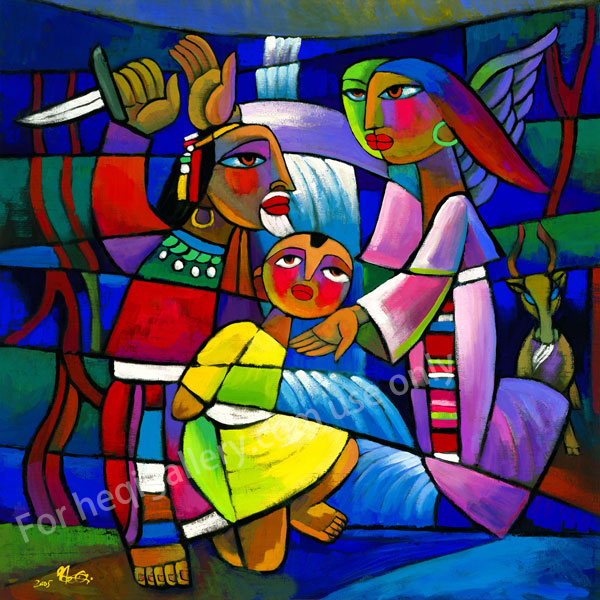
Image taken from He Qi Art . For purchasing prints of this and other artworks by He Qi go to heqiart.com . For other images of He Qi art works in TIPs, see here.
Following is an artwork by Sister Marie Claire , SMMI (1937–2018) from Bengaluru, India.
For more information about images by Sister Marie Claire and ways to purchase them as lithographs, see here . For other images of Sister Marie Claire paintings in TIPs, see here.
The following is a stained glass window from the Three choir windows in the Marienkirche, Frankfurt (Oder), Germany, of the 14th century:
Source: Der gläserne Schatz: Die Bilderbibel der St. Marienkirche in Frankfurt (Oder), Neuer Berlin Verlag, 2005, copyright for this image: Brandenburgisches Landesamt für Denkmalpflege und Archäologisches Landesmuseum
Stained glass is not just highly decorative, it’s a medium which has been used to express important religious messages for centuries. Literacy was not widespread in the medieval and Renaissance periods and the Church used stained glass and other artworks to teach the central beliefs of Christianity. In Gothic churches, the windows were filled with extensive narrative scenes in stained glass — like huge and colorful picture storybooks — in which worshipers could ‘read’ the stories of Christ and the saints and learn what was required for their religious salvation. (Source: Victoria and Albert Museum )
Click or tap here to see the rest of this insight.
Like a number of other East Asian languages, Japanese uses a complex system of honorifics, i.e. a system where a number of different levels of politeness are expressed in language via words, word forms or grammatical constructs. These can range from addressing someone or referring to someone with contempt (very informal) to expressing the highest level of reference (as used in addressing or referring to God) or any number of levels in-between. One important aspect of addressing someone else in one’s or someone else’s family is by selecting the correct word when referring to them.
One way to do this is through the usage of an appropriate title within a conversation. In the widely-used Japanese Shinkaiyaku (新改訳) Bible of 2017, the father is addressed with o-tō-san (お父さん), a form that expresses the intimate father-son relationship in the verses referenced here. (Source: S. E. Doi, see also S. E. Doi in Journal of Translation, 18/2022, p. 37ff. )
The name that is transliterated as “Abraham” in English means “father of a multitude,” “father of mercy,” “father of many nations.” (Source: Cornwall / Smith 1997 )
In the vast majority of sign languages, including American Sign Language it is translated with the sign signifying “hold back arm” (referring to Genesis 22:12).
In Vietnamese (Hanoi) Sign Language it is translated with a sign for that demonstrates his new destiny. Previously, he had been called to wander from his home, and the name “Abram” reflected this movement (see here). The new sign name is in one location and stays there, showing Abraham will be given a land to call his own. At this time, Abraham was in the southern part of Canaan, which is shown on the base arm by the location near the elbow. (Source: The Vietnamese Sign Language translation team, VSLBT)
“Abraham” in Vietnamese Sign Language, source: SooSL
In Tira it is transliterated as Abaram. The choice of this, rather than the widely-known “Ibrahim,” as used in the Tira translation of the Qu’ran, was to offset it against the Muslim transliteration which originates from Arabic. (Source: J.A. Naudé, C.L. Miller Naudé, J.O. Obono in Acta Theologica 43/2, 2023, p. 129ff. )
Click or tap here to see two short video clips about Abraham (source: Bible Lands 2012)
Following are a number of back-translations as well as a sample translation for translators of Genesis 22:7:
Kankanaey: “Isaac spoke and said ‘Ay (vocative) father!’ ‘What is that?’ said Abraham. ‘Here is what-to-use-for-starting fire and wood, but where (defensive explanatory particle) is the child of the sheep that we (dual) will offer?’ said Isaac.” (Source: Kankanaey Back Translation)
Newari: “Isaac said to his father, Abraham — ‘Father'” (Source: Newari Back Translation)
Hiligaynon: “While they were-walking, Isaac said, ‘Father!’ Abraham replied, ‘What, child?’ Isaac asked, ‘We (incl.) have brought something-to-start-up-the-flame/fire and firewood, but where is the sheep to-be-offered?'” (Source: Hiligaynon Back Translation)
English: “Then Isaac spoke to his father Abraham, saying, ‘My father!’ Abraham replied, ‘Yes, my son, I’m here!’ Isaac said, ‘Look, we have wood and coals to light a fire, but where is the lamb for the burnt offering?'” (Source: Translation for Translators)




Leave a Reply
You must be logged in to post a comment.