The Greek, Ge’ez, and Hebrew phrases that are often translated as “birds of the air” or similar in English “refer to the undomesticated song birds or wild birds, to be distinguished in a number of languages from domesticated fowl. In Tzeltal these former are ‘field birds’.” (source: Bratcher / Nida)
Q’anjob’al also uses an established term for non-domesticated birds. Newberry and Kittie Cox (in The Bible Translator 1950, p. 91ff. ) explain: “Qʼanjobʼal has two distinct terms, one to identify domesticated birds and the other non-domesticated birds. The additional descriptive phrase ‘of the air’ seemed entirely misleading, for Qʼanjobʼal speakers had never heard of such creatures. Actually, of course, all that was necessary was the term for non-domesticated birds, for that is precisely the meaning of the Biblical expression.”
In Elhomwe they are just translated as “birds” or “birds of the bush” (i.e., wild birds) to “not give the impression that these are special type of birds.” (Source: project-specific translation notes in Paratext)
The Greek that is translated as “four-footed creatures and reptiles” or similar in English is translated in Matumbi as “four-footed creatures and snakes,” since lizard-like creatures are already included in four-footed. (Source: Pioneer Bible Translators, project-specific notes in Paratext)
The Hebrew, Latin, Ge’ez, and Greek that is translated in English as “reptiles” or “creeping things” or similar is translated as “those which crawl along upon their stomach” in San Mateo del Mar Huave, “those that crawl the way they travel” in Chichimeca-Jonaz, and “animals that crawl on the ground” in Lalana Chinantec. (Source: Viola Waterhouse in Notes on Translation August 1966, p. 86ff.)
In Nyamwezi it is translated as as vitundwa vya ku’yu’mba or “creatures that move.” (Source: Pioneer Bible Translators, project-specific translation notes in Paratext)
The Hebrew words zachal and remes literally mean “creeping [things]” or “crawling [things]”, which is the Hebrew way of referring to small unclean creatures, reptiles in particular. The Greek word herpeton is also a general word for reptile; it includes snakes and lizards. All of the Hebrew, Greek, and Latin words usually exclude fish.
The Hebrew words carry the connotation of uncleanness.
In languages which have a word meaning “reptile”, this will fit most contexts. In languages which do not, phrases such as “snakes and lizards”, “wriggling things”, and so forth could be used.
Following are a number of back-translations of Acts 10:12:
Uma: “Inside the blanket being lowered, there were all kinds of animals: those with four feet, those that slithered, with birds also.” (Source: Uma Back Translation)
Yakan: “Inside that blanket there were various kinds of animals that walked, those that crawled and birds.” (Source: Yakan Back Translation)
Western Bukidnon Manobo: “And inside of that there were all kinds of legged creatures such as animals, and reptiles, and birds.” (Source: Western Bukidnon Manobo Back Translation)
Kankanaey: “Its contents were all that are seen of large-animals, crawling/slithering-things and flying-things, which are forbidden to the Jews to eat.” (Source: Kankanaey Back Translation)
Tagbanwa: “Its contents were all kinds of animals. Crawlers, walkers and fliers, they were there. There were many which the Jews didn’t eat for they tabooed them.” (Source: Tagbanwa Back Translation)
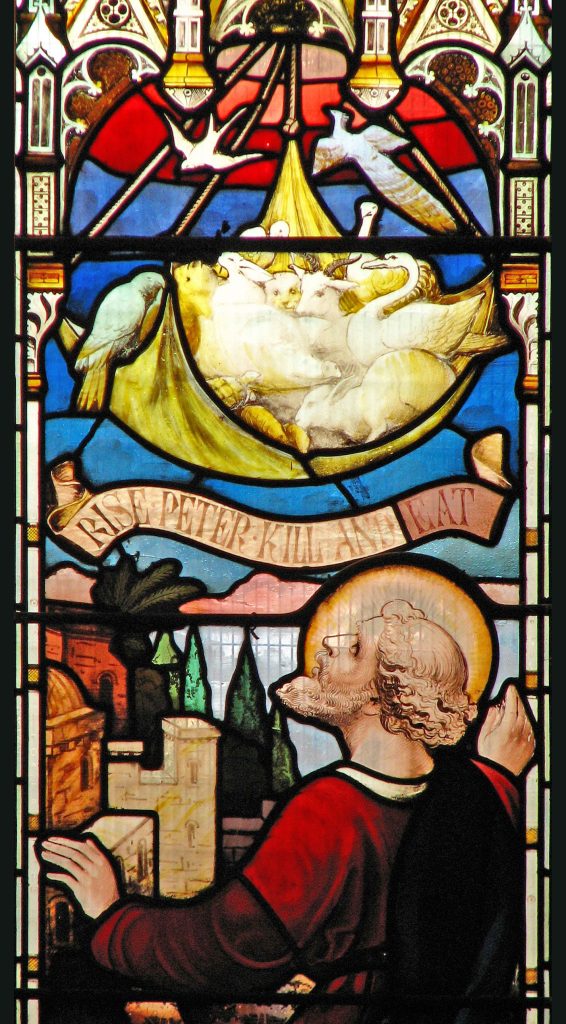
Stained glass is not just highly decorative, it’s a medium which has been used to express important religious messages for centuries. Literacy was not widespread in the medieval and Renaissance periods and the Church used stained glass and other artworks to teach the central beliefs of Christianity. In Gothic churches, the windows were filled with extensive narrative scenes in stained glass — like huge and colorful picture storybooks — in which worshipers could ‘read’ the stories of Christ and the saints and learn what was required for their religious salvation. (Source: Victoria and Albert Museum )
All kinds of must be taken in the sense of “some of every kind or species.” The threefold division of the animal world is based on Genesis 6.20 (see also Genesis 1.24). Animals includes all animals, both domesticated and wild; and wild birds (see An American Translation* and Moffatt) translates “birds of air,” in which “of the air” is taken as the equivalent of wild, as opposed to domesticated. These classifications of animals, reptiles and wild birds should not be understood in any special technical sense. The most general terms which correspond roughly to these three categories are fully satisfactory, and in most languages there are terms which more or less correspond.
Quoted with permission from Newman, Barclay M. and Nida, Eugene A. A Handbook on The Acts of the Apostles. (UBS Handbook Series). New York: UBS, 1972. For this and other handbooks for translators see here .
Living Water is produced for the Bible translation movement in association with Lutheran Bible Translators. Lyrics derived from the ESV® Bible (The Holy Bible, English Standard Version®).

Leave a Reply
You must be logged in to post a comment.