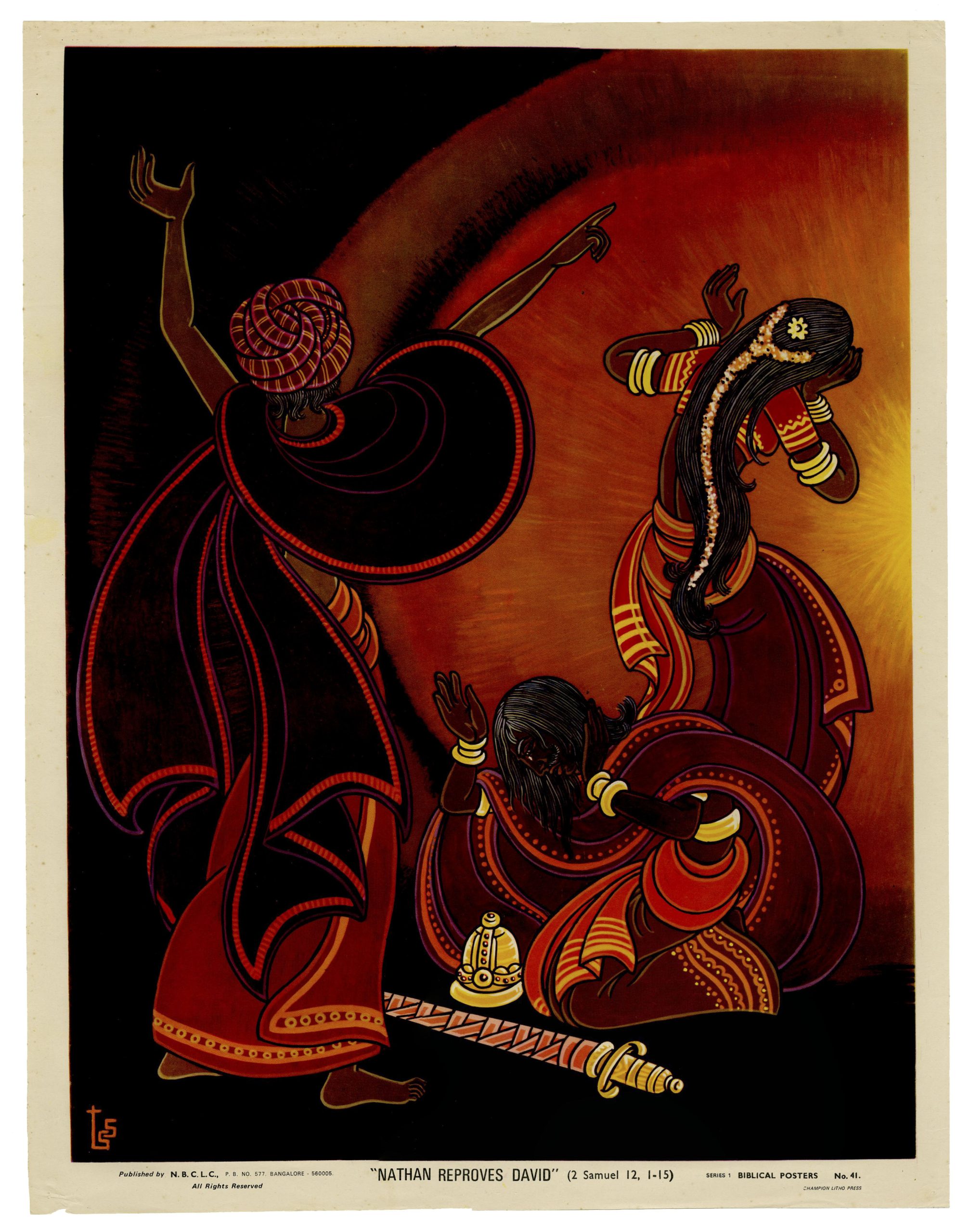
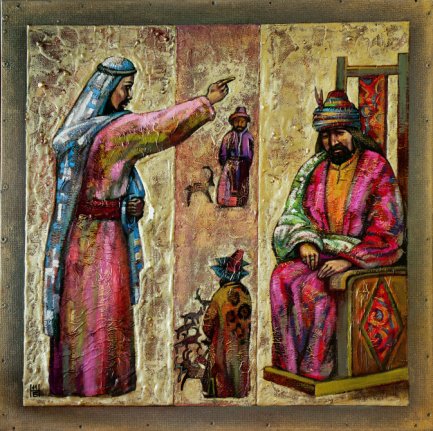
7Nathan said to David, “You are the man! Thus says the Lord, the God of Israel: I anointed you king over Israel, and I rescued you from the hand of Saul;
The different Hebrew, Ge’ez, and Greek terms that are translated as “(olive) oil” and “(animal) fat” in English are translated in Kwere with only one term: mavuta. (Pioneer Bible Translators, project-specific translation notes in Paratext)
Following are a number of back-translations as well as a sample translation for translators of 2 Samuel 12:7:
Kupsabiny: “Then Nathan replied David that, ‘That one is you. God says, ‘I have given you the rulership of Israel and have saved you from the hands of Saul.” (Source: Kupsabiny Back Translation)
Newari: “Then Nathan said to David, "You are that man! The LORD God of Israel says, ‘I anointed you king of Israel. I delivered you from the hand of Saul.” (Source: Newari Back Translation)
Hiligaynon: “Then Natan said to David, ‘You are that man! This is what the LORD says, the God of Israel: ‘I chose you king of Israel and I rescued you from Saul.” (Source: Hiligaynon Back Translation)
English: “Nathan said to David, ‘You are the man I have been talking about! And this is what Yahweh, the God we Israelis worship, says to you: ‘I appointed you to be king of Israel, after having rescued you from Saul.” (Source: Translation for Translators)
Click or tap here to see the rest of this insight.
Like a number of other East Asian languages, Japanese uses a complex system of honorifics, i.e. a system where a number of different levels of politeness are expressed in language via words, word forms or grammatical constructs. These can range from addressing someone or referring to someone with contempt (very informal) to expressing the highest level of reference (as used in addressing or referring to God) or any number of levels in-between.
One way Japanese shows different degree of politeness is through the choice of a first person singular and plural pronoun (“I” and “we” and its various forms) as shown here in the widely-used Japanese Shinkaiyaku (新改訳) Bible of 2017. The most commonly used watashi/watakushi (私) is typically used when the speaker is humble and asking for help. In these verses, where God / Jesus is referring to himself, watashi is also used but instead of the kanji writing system (私) the syllabary hiragana (わたし) is used to distinguish God from others.
Click or tap here to see the rest of this insight.
Like a number of other East Asian languages, Japanese uses a complex system of honorifics, i.e. a system where a number of different levels of politeness are expressed in language via words, word forms or grammatical constructs. These can range from addressing someone or referring to someone with contempt (very informal) to expressing the highest level of reference (as used in addressing or referring to God) or any number of levels in-between.
One way Japanese shows different degree of politeness is through the usage of an honorific construction where the morpheme are (され) is affixed on the verb as shown here in the widely-used Japanese Shinkaiyaku (新改訳) Bible of 2017. This is particularly done with verbs that have God as the agent to show a deep sense of reverence. Here, iw-are-ru (言われる) or “say” is used.
Some languages do not have a concept of kingship and therefore no immediate equivalent for the Greek, Hebrew, Ge’ez, Aramaic, and Latin that is translated as “king” in English. Here are some (back-) translations:
Ninia Yali: “big brother with the uplifted name” (source: Daud Soesilio in Noss 2007, p. 175)
Nyamwezi: mutemi: generic word for ruler, by specifying the city or nation it becomes clear what kind of ruler (source: Pioneer Bible Translators, project-specific translation notes in Paratext)
Ghomála’: Fo (“The word Fo refers to the paramount ruler in the kingdoms of West Cameroon. He holds administrative, political, and religious power over his own people, who are divided into two categories: princes (descendants of royalty) and servants (everyone else).” (Source: Michel Kenmogne in Theologizing in Context: An Example from the Study of a Ghomala’ Christian Hymn))
Faye Edgerton retells how the term in Navajo (Dinė) was determined:
“[This term was] easily expressed in the language of Biblical culture, which had kings and noblemen with their brilliant trappings and their position of honor and praise. But leadership among the Navajos is not accompanied by any such titles or distinctions of dress. Those most respected, especially in earlier days, were their headmen, who were the leaders in raids, and the shaman, who was able to serve the people by appealing for them to the gods, or by exorcising evil spirits. Neither of these made any outward show. Neither held his position by political intrigue or heredity. If the headman failed consistently in raids, he was superceded by a better warrior. If the shaman failed many times in his healing ceremonies, it was considered that he was making mistakes in the chants, or had lost favor with the gods, and another was sought. The term Navajos use for headman is derived from a verb meaning ‘to move the head from side to side as in making an oration.’ The headman must be a good orator, able to move the people to go to war, or to follow him in any important decision. This word is naat’áanii which now means ‘one who rules or bosses.’ It is employed now for a foreman or boss of any kind of labor, as well as for the chairman of the tribal council. So in order to show that the king is not just a common boss but the highest ruler, the word ‘aláahgo, which expresses the superlative degree, was put before naat’áanii, and so ‘aláahgo naat’áanii ‘anyone-more-than-being around-he-moves-his-head-the-one-who’ means ‘the highest ruler.’ Naat’áanii was used for governor as the context usually shows that the person was a ruler of a country or associated with kings.”
The translation of the tetragrammaton (YHWH or יהוה) is easily the most often discussed issue in Bible translation. This is exemplified by the fact that there is virtually no translation of the Bible — regardless of language — where the position of the respective translator or translation team on how to translate the name of God into the respective language is not clearly stated in the preface or introduction.
Click or tap here to read about the different ways the tetragrammaton is and has been translated
The literature on this topic is overwhelming, both as far as the meaning of YHWH and the translation of it by itself and in combination with other terms (including Elohim and Adonai). There is no reason or room to rehash those discussions. Aside from various insightful translations of YHWH into various languages (see below), what’s of interest in the context of this tool are official and semi-official statements regarding the translation by Bible translation agencies and churches. These include the 1992 statement by United Bible Societies’ “Names of God” Study Group (see The Bible Translator 1992, p. 403-407 ) or the “Letter to the Bishops’ Conference on ‘The Name of God'” by the Congregatio de Cultu Divino et Discriplina Sacramentorum of 2008 (see here et al.).
In summary, the UBS study group gives six different options on how to translate YHWH: 1) transliterate (some form of “Yahweh” or “Jehovah” if this is an already established term); 2) translate (along the lines of kurios — κύριος in the Septuagint); 3) translate the meaning of YHWH; 4) use a culture-specific name; 5) translate Elohim and YHWH in the same way; or 6) use a combination of any of these options.
The official Catholic directive states that for liturgical purposes YHWH is to be translated as an equivalent of Kurios (“Lord”) unless when appearing in combination with Elohim (“God”) or Adonai (“lord”), in which case it’s to be translated with “God.”
In the following collection of examples, any of the above-mentioned strategies are used.
Use of Typographical Means to Offset the Name of God
A large number of Bible translations in many Western European languages have used a similar strategy to translate YHWH as an equivalent of Kurios or Adonai (“lord” in Greek in Hebrew) but have used either small caps or all caps to denote these occurrences as an equivalent to a proper name. Here are some examples:
None of the European languages have found a “cultural-linguistic equivalent” with the possible exception of Eternal or l’Éternel (see below).
The rendering of the translation of YHWH in bold (and uppercase) characters is for instance used in Guhu-Samane: QOBEROBA (a term of address for a respected person and also connotes “forever”) (for “forever”, see below under Translations of the Name of God) and the upper-casing in Bible translations in several other languages in Papua New Guinea:
In Cebuano (Ang Pulong sa Dios edition, 2010) and Hiligaynon (all versions), Ginoo, a typographical variant of Ginoo (“Lord”) is used. Bible translation consultant Kermit Titrud (SIL): “‘Yahweh’ is too close to Yahwa, their word for ‘Satan.’ We were afraid that in the pulpits readers might misread ‘Yahweh’ and say ‘Yahwa.’ So we went with the tradition found in most English translations. Ginoo for ‘Yahweh’ and Ginoo for ‘adonai.'”
In languages where capitalization is not a typographical option, other options are available and used, such as in Japanese, where the generic term shu 主 for “Lord” is bolded in some translations to offset its meaning (Source: Omanson, p. 17).
In Pattani Malay, the word for “Lord” is underlined: ربي. (Source: Andy Warren-Rothlin)
A graphical way of representation beyond typography was used by André Chouraqui in his French La Bible hebraique et le Nouveau Testament (publ. 1974-1977) for which he superimposed adonai and Elohim over (the French rendition) of the tetragrammaton:
(Source: Andy Warren-Rothlin in Noss / Houser, p. 618ff.; see also tempt God / put God to the test)
Translations of the Name of God
A translation of YHWH with a rendering of the meaning of “Eternal” was done in English by James Moffatt (between 1926 and 1935) with Eternal, The Voice translation with Eternal One (2012), in French versions as L’ÉTERNEL by J. F. Ostervald in 1904 or l’Éternel by L. Segond (1910-1938, not in more recent revisions) and Zadoc Kahn (1964) (for the French translation, see also LORD of hosts), in Esperanto as “la Eternulo,” and in Obolo as Okumugwem: “The Ever-Living” (source: Enene Enene). In francophone Africa, translations of l’Éternel are widely used, due to the wide use of Segond’s early editions (see above). Examples include Nancere (Nandjéré) with Kumuekerteri, Ngambay (Ngambaï) with Njesigənea̰, Sar with Kɔ́ɔ̄ɓē, Mbay (Mbaï) with Bïraþe, Kim with Bage ɗiŋnedin, or Lélé uses Gojɛnɛkirɛkindiy (verbatim: “who remains for his eyes”). (Source: Andy Warren-Rothlin)
Similarly and at the same time expanding its meaning, the Nzima translation of 1998 translated YHWH as Ɛdεnkεma, the “Eternal All-Powerful Creator and Sustainer” (Source: David Ekem in The Bible Translator 2005, p. 72ff. ).
“Creator” is also used in Kazakh (Zharatkhan [Жаратқан]), Karakalpak (Zharatkhan [Жаратқан], sometimes in combination with Iyeg [Ийег] — “Master”), and Kirghiz (Zharatkhan [Жаратқан], likewise in combination with “Master” or Ege [Эге]). (Source: David Gray).
Nepali, Bengali, and Hindi are all derived from Sanskrit and have (eventually) all found similar translations of YHWH. In Bengali “God” is translated as Ishwar (ঈশ্বর) (widely used in Hindu scriptures, where it’s used as a title, usually associated with “Siva”) and YHWH as Shodaphrobhu (সদাপ্রভু) — “Eternal Lord”; in Nepali and NewariYHWH is translated as Paramaprabhu (परमप्रभु)– “Supreme Lord”; and Hindi translates YHWH as Phrabu (प्रभु) — “Lord.” In earlier translations all three languages used transliterations of Jehovah or Yahweh. (Source: B. Rai in The Bible Translator 1992, p. 443ff. and Barrick, p. 124).
The influential German Jewish translation of Martin Buber and Franz Rosenzweig (between 1925 and 1961) translates YHWH in Exodus 3:15 with “Ich bin da” (“I exist” or “I am”) and in all other instances with pronouns in small caps (Er, Ihm, Ihn, Ich — “he,” “him,” “his,” “I”).
The Jewish orthodox English ArtScroll Tanach translation (publ. 2011) uses Hashem or “The Name”
In the Bavarian translation by Sturmibund (publ. 1998), it is translated as Trechtein or “Sovereign, Lord.” “Trechtein” is related to the obsolete English “drighten.” (Source: Zetzsche)
In Ge’ez, Tigrinya, and Amharic it is translated with Igziabeher (እግዚአብሔር) or “Ruler/Lord of the Nations/Peoples.” In Ge’ez Igziabeher is used for “God” as well, whereas in Tigrinya and Amharic it is often, but not always used for “God.” In a recent revision by Biblica (see here ), an attempt was made to use Igziabeher exclusively for occurrences of the tetragrammaton in the Hebrew Bible, but after strong responses by the Christian community, a compromise was found by using Igziabeher in the first chapter of Genesis and changing it according to the Hebrew text elsewhere. (Source: Zetseat Fekadu)
Warlpiri uses Kaatu Jukurrarnu (Kaatu is a transcription of “God” and Jukurrarnu means “timelessness” and shares a root with jukurrpa — dreamings) (Source: Stephen Swartz, The Bible Translator 1985, p. 415ff. ).
The translation of YHWH into Weri with Aniak Tupup or “man of the holy house” intends “to maintain the Jewish practice of not uttering God’s name [with] the use of another vernacular phrase that signals that a ‘taboo’ name is being referred [which] could give a cue that would be recognizable in written or oral communication” (Source: P. King, The Bible Translator 2014, p. 195ff. ).
Aruamu translates it as Ikiavɨra Itir God or “Ever Present God” (source: Pioneer Bible Translators, project-specific translation notes in Paratext)
Idakho-Isukha-Tiriki: Nyasaye Wuvunyali Muno or “God powerful great” (source: Andy Warren-Rothlin)
Ruund uses Chinawej, a term that is otherwise used as a response of approval. Anna Lerbak (in The Bible Translator 1954, p. 84ff. ) tells the genesis of this term (click or tap to see an explanation):
“The name ‘Jehovah’ had been used in some contexts, but I had the feeling that it did not mean much to the people, and when I asked the pastors they all said it didn’t, and worse, it very often confused people, especially in the villages. During the conversation it was suggested that the name Chinawej be used in the place of ‘Jehovah’, and this met with immediate approval. A few days later I was working on a Psalm in which ‘Jehovah’ was used frequently, so I wrote Chinawej in its place and then read the Psalm to them. The response was about like this: “That is it, now people will understand, that is how Chinawej is. The Jews call God ‘Jehovah’, we call Him Chinawej, it is the same God. but we know Him as Chinawej as the Jews know Him as ‘Jehovah’ “. They often call God Chinawej in prayer, it seems to indicate warmth and intimacy.
The same word is used in two other ways. It is the name of a snake which never attacks human beings. And it is used as a response of approval. When told of something they are pleased to hear, something they find good, just, helpful, generous, they often respond by saying, Chinawej. When they call God Chinawej, it indicates that they think of Him as One Who is good and just and generous towards them. When it was suggested at the committee that we use Chinawej in place of ‘Jehovah’ it was accepted immediately and unanimously.
Ebira has Eneyimavara. Eneyimavara was created by merging a praise phrase that was only used for the traditional deity Ohomorihi (see here), that had become the word for the Christian God: ene e yi ma vara or “the one that never changes.” “The translators came to the agreement that this praise name that describes the unchangeableness of God is very close in meaning to the probable meaning of YHWH.” (Source: David O Moomo in Scriptura 88 (2005), p. 151ff. )
The Uzbek Bible uses the term Ega (Эга) — “master, owner” in various forms (including Egam / Эгам for “my Owner” or Egamiz / Эгамиз for “our Owner.” (Click or tap to see an explanation):
Jim Zvara (2019, p. 6) explains: “The Uzbek term ega means owner or master (‘master,’ in the historical context of an owner-slave relationship). By extension, it is natural for an Uzbek to speak to or refer to God as Egam (‘my owner’/’master’). In the Uzbek context to be God’s slave is a positive way of understanding one’s relation to him. It suggests that one is in a dependent and obedient relationship to God. The team felt that this relational connection and what it implies fits well with the concept of YHWH as the God who is in a covenant relationship with his people. In the Uzbek context, the choice of Ega was deemed to be the best balance of natural language with meaningful translation.”
The Seediq Bible translation team chose Utux Tmninun (“the weaving god”) for their translation of YHWH. (Click or tap to see a retelling of the process of how that decision was reached):
“(…) The Seediq team requested that we spend time with them on key terms. They had compiled a list of key terms that they wanted input on, and we went through the list item by item. The most important item was how to deal with the divine name. They had tentatively translated it as Yehoba, transliterated from Jehovah, but they were also aware that this transliteration may not be accurate, and they were keen to explore other options.
“We explored various alternatives. Were they interested in following the ancient Jewish practice of substituting ‘Lord’ for the divine name? Would capitalising the letters help? Would they be bold enough to use ‘Yahweh,’ following the opinion of most Old Testament scholars who regard this as the correct pronunciation? Was it feasible to adopt a mixed approach in dealing with the divine name (…)? Each option had its advantages as well as disadvantages.
“In the midst of the discussion, a participant said, ‘Our ancestors, as well as we today, always call God by the term Utux Tmninun. I suggest we use this term.’ The term Utux Tmninun in the Seediq culture means ‘the weaving God.’ In their culture, God is the weaver, the one who weaves life together. All the participants were excited about this proposal. They tried this term with all the composite terms that involve the divine name, and it seemed to work well, so they decided tentatively to adopt this term. After the workshop, the participants went back to their villages and sought feedback from the wider community, and eventually they confirmed the use of the term Utux Tmninun as the rendering of the divine name.
Translating the divine name as Utux Tmninun, the weaving God, is a creative solution. This term is viewed very positively in the Seediq community. It also correlates well with the concept of God as the creator (Gen. 1-2) and as the weaver who formed our inward parts and knit us together in our mothers’ wombs (Ps. 139:13). It also has the advantage of portraying God beyond the traditional masculine form.
“Some may argue that since names are usually transliterated, we should do the same with YHWH, most likely pronounced ‘Yahweh.’ Unfortunately, due to the influence of Chinese Union Version for almost one hundred years now, Chinese Christians only know God as Yehehua. Attempts to change the term Yehehua to Yahweh have not been successful. This is a reality that the Seediq Christians have to live with.
“Others may argue on theological grounds that YHWH is not only the creator, but also the God of the covenant, hence any attempt to substitute another term for YHWH will not do justice to the Hebrew text. In the case of the Seediq translation, there are significant similarities between Utux Tmninun and YHWH, though the terms are not identical. This is a reality translators often have to struggle with. Exact correspondence is hard to come by. Often it is a matter of approximation, give and take. Besides theological considerations, one has to deal with the constraints of past traditions (‘Jehovah,’ in this instance), the biblical cultures and one’s own culture, and audience acceptance. Hopefully, by using Utux Tmninun for YHWH, the Seediq term will be transformed and take on the aspect of the covenant God as well.” (Source: Yu Suee Yan, The Bible Translator 2015, p. 316ff. )
Nyankore: Nyakubaho or “the one who is from within itself” (source: Bühlmann 1950, p. 146)
‘One local dialect of Carpathian Romani: Drágon Dél or “Beloved/Dear God.” In most Romani dialects, the word Rai (Lord/Boss/landlord/shopkeeper) is sort-of acceptable, but in one particular subgroup of Carpathian Romani they said it only meant shopkeeper and ‘everyone knows that [majority term for YHWH] means God, and why can’t we translate it that way?’ We tried to explain, but they weren’t keen on anything but Dél (‘God’). We eventually compromised with Drágon Dél, a common expression for YHWH, and Dél for Elohim, but it took quite a lot of convincing them that there was any theological point there.
For the interconessional translation into Chichewa (publ. 1999) the term Chauta (“Great-One-of-the-Bow”) was chosen for YHWH (Click or tap to see the detailed story):
“The name Chauta, literally ‘Great-One-of-the-Bow’, i.e. [is] either the rainbow (descriptively termed uta-wa-Leza ‘the-bow-of-God’) or, less likely, the hunter’s bow. And yet Chauta was also distinct from Mulungu [“God”] in that it has reference to the specific tribal deity of the Chewa people — the God who ‘owns’ yet also ‘belongs to’ them — and hence it carries additional positive emotive overtones. Although research indicated that in an ancient traditional setting, Chauta too was probably associated with the indigenous ancestral rain cult, in the Christian era it has been progressively generalized to encompass virtually all religious contexts in which God may be either appealed to, proclaimed, or praised. After prolonged deliberation, therefore, the translation committee determined Chauta to be the closest functional equivalent to YHWH of the Hebrew Scriptures. The choice of this name is not without its difficulties, however, and these were carefully considered by the Chewa committee. For example, the use of a more specific local term, as opposed to the generic Mulungu, carries a greater likelihood of bringing along with it certain senses, connotations, and situations that were (and no doubt still are) associated with the indigenous, pre-Christian system of worship. If these happened to remain strong in any contemporary sacred setting, then of course the dangers connected with conceptual syncretism might well arise. In the case of Chauta, however, it appeared that the process of positive Christian contextualization had already reached an advanced stage, that is, judging from the widespread use of this name in all aspects of religious life and practice. A more scholarly argument against Chauta takes the position that there is too great a female component associated with this term because it was traditionally applied (by figurative metonymy) to refer also to the ritual ‘wife of God’, i.e. the chief officiant at a traditional rain shrine and worship sanctuary. However, this usage seems to be quite remote, and most people questioned do not even recognize the connection anymore. Besides, in a matrilineal society such as the Chewa, it does not seem inappropriate to have this aspect of meaning lying in the background, particularly since it is not completely foreign to the notion of God in the Bible (cf. Ps. 36:7; 73:15; Isa. 49:14-15; Mt. 23:37). In terms of ‘connotative fit’ or emotive identification and appeal, there can be little doubt that the name Chauta is by far the closest natural equivalent to YHWH in the contemporary Chewa cultural and religious environment. This aspect of meaning was probably also utmost from the ancient Jewish perspective as well; in other words, “for them the associated meaning of this special name [YHWH], in terms of their history and culture, far outweighed any meaning it may have suggested because of its form or derivation”. To be sure, this ‘new’ divine name — that is, new as far as the Scriptures are concerned — may take some getting used to, especially in the formal setting of public worship. But this is not a foreign god whom we are talking about; rather, he is certainly by now regarded as the national deity of the Chewa nation. Chauta is the great God who for one reason or another ‘did not make himself known to them by his holy name, the LORD’ (Exod. 6:3), that is, in the prior translations of his Word into Chewa. He is, however, and always has been “a God who saves … the LORD (Chauta), our Lord, who rescues us from death” (Ps. 68:20, Good News Bible)!” (Source: Wendland 1998, 120f.; see also The Bible Translator 1992, 430ff. )
Transliteration of YHWH
A 12th century reading of the Masoretic vowel points around יהוה (יְהֹוָה) was interpreted to be pronounced as Yehowah from which Iehouah and Jehovah were derived. This was reflected in the English versions of Tyndale (publ. 1530) and the Geneva Bible (significantly based on Tyndale and publ. in 1560) and again the King James Version (Authorized Version) (publ. 1611) which all used Iehouah or Jehovah in 7 different verses in the Old Testament. The translators and editors of the American Standard Version (publ. 1901), a review of the King James Version used Jehovah for all appearances of the tetragrammaton something that the Spanish Reina-Valera (publ. 1602) had already done as well.
In English versions, Yahweh as a transliteration of the tetragrammaton is used by the Catholic Jerusalem Bible (publ. 1966), the Protestant Holman Christian Standard Bible (publ. 2004) and the Legacy Standard Bible (publ. 2021). The Catholic translation by Knox (publ. 1949) occasionally uses Javé, “to make it a Latin name, to match all the other names in the Old Testament.” (Source Knox 1949, p. 80)
Mandinka for instance uses Yawe for YHWH. “The use of Yawe for YHWH is good and may be a trendsetter in this part of Africa.” (Source: Rob Koops)
In a group of related languages in another part of Africa an interesting development from a transliteration to a indigenous translation can be shown: In the Nandi Bible (1938) Jehovah was used as a translation for YHWH. Kamuktaindet (“The Powerful One”) was used as a translation for Elohim (“God”). This was taken over by a translation into the macrolanguage Kalenjin (1969) (intended to include the closely related Keiyo, Kipsigis, Markweeta, Nandi, Okiek, Sabaot, Terik, and Tugen). Sabaot, Markweeta, Tugen and Okiek later wanted there own translations. Both Sabaot and Markweeta use the indigenous word for “Creator” (Yēyiin in Sabaot and Iriin in Markweeta) to translate Elohim and YHWH of the Old Testament and Theos of the New Testament. The Kalenjin Bible has recently been revised to cater to Keiyo, Kipsigis, Nandi and Terik, and this revision has completely dropped Jehovah in favour of Kamuktaindet. (Source: Iver Larsen)
Early translations into Gilbertese faced a problem when transliterating “Jehovah” (a form of “Jehovah” was first used in Spanish Bible translations in 1569 and 1602): “There are only thirteen letters in the Kiribati alphabet: A, E, I, O, U, M, N, NG, B, K, R, T (pronounced [s] when followed by ‘i’), W For instance, ‘Jehovah’ is rendered Iehova, but Kiribati speakers can only pronounce it as ‘Iowa,’ since the phonemes [h] and [v] do not exist in Kiribati.” (source: Joseph Hong, The Bible Translator 1994, p. 329ff. .)
In a recent edition of a Thai translation (Thai Standard Version, publ. 2011) a combination of translation and transliteration is used: phra’ ya(h)we (h) (พระยาห์เวห์) (“Divine Yawe”). (Source: Stephen Pattemore)
In Nyarafolo Senoufo the transliteration is Yewe which also means “the being one” or “he that is.” David DeGraaf (in: Notes on Translation 3/1999, p. 34ff.) explains: “Since it is widely recognized that the vowels of the name are uncertain, another possible transliteration is Yewe. This proposal is in accord with the Nyarafolo rules of vowel harmony and is thus open to being understood as a normal nominalization in the language. Second, Yewe is exactly the word that would be formed by nominalizing the verb ‘to be’ in the class that includes sentient beings. Thus, Yewe can be understood as ‘the being one’ or ‘he that is’. This solution accords well with YHWH’s self-revelation to Moses in Exodus 3:14, ‘I am who I am.'”
In the Literary and Mandarin Chinese (Protestant) tradition the transliteration of “Jehovah” is historically deeply rooted, even though there are also some historical burdens (Click or tap to see more details):
“YHWH” is rendered in the Chinese Union Version — the most widely used Bible translation in China—as well as most other Chinese Bible translations as yehehua 耶和華. According to Chinese naming conventions, yehehua could be interpreted as Ye Hehua, in which Ye would be the family name and Hehua — “harmonic and radiant” — the given name. In the same manner, Ye would be the family name of Jesus (transliterated as yesu 耶穌) and Su would be the given name. Because in China the children inherit the family name from the father, the sonship of Jesus to God the Father, yehehua, would be illustrated through this. Though this line of argumentation sounds theologically unsound, it is indeed used effectively in the Chinese church.” (see Wright 1953, p. 298, see also Jesus).
“Ye 耶, an interrogative particle in classical Chinese, is part of the same phonetic series as ye 爺, which gives it a certain exchangeability. Ye 爺 carries the meaning “father” or is used as an honorable form of address. The choice of the first Bible translators to use the transliteration yehehua 爺火華 for Jehovah had a remarkable and sobering influence on the history of the 19th century in China by possibly helping to shape the fatal Taiping ideology, a rebellion that ended up costing an estimated 20 million lives.
“The founder of the Taiping rebellion, Hong Xiuquan, was given a tract (…) [that he used to] interpret a nervous breakdown he had had in 1837 as his “call” to be the “Messiah.” This “vision” that Hong experienced is likely to have had a direct correlation with the name of “God” in that tract. Shen yehuohua 神爺火華 (directly translated: ‘God (or: spirit); old man (or: father); fire; bright)” was the term that was used in that tract for ‘God Jehovah,’ but this was not indicated as a (in its second part) transliteration of a proper name. In his vision, Hong saw ‘a man venerable in years (corresponding with ye), with golden (corresponding with huo and hua) beard and dressed in a black robe,’ an image likely to have been inspired by a direct translation from that name for ‘God,’ especially as it appeared at the beginning of the tract. That this term was considered to be a term of some relevance to the Taiping ideology is demonstrated by the fact that both yehuohua 爺火華 as the personal name of God and ye 爺 as “God the Father” later appeared in Taiping writings.” (Source: Zetzsche in Malek 2002, p. 141ff.)
In American Sign Language it is translated with a sign that combines the letter Y and a sign that points up and is similar to the sign for “God.” (Source: Ruth Anna Spooner, Ron Lawer)
“YHWH” in American Sign Language, source: Deaf Harbor
In British Sign Language is is translated with a sign that combines the signs for “God” and “name” and the finger-spelling of Y-H-W-H. (Source: Anna Smith)
“YHWH” in British Sign Language (source: Christian BSL, used with permission)
Japanese Sign Language combines the sign for “Lord” with “exist” to make a name sign that technically means “the existent one,” but is close enough to “Lord” that it isn’t too jarring for people in the church who expect to see “Lord” in certain contexts (source: Mark Penner). For a Japanese Sign Language explanation, see here.
“YHWH” in Japanese Sign Language, source: 日本手話訳聖書を
For further reading on the translation of YHWH, see Rosin 1956, p. 89-125 and Andy Warren-Rothlin in Noss / Houser, p. 618ff.