The Hebrew and Greek that is translated as “eunuch” in English is translated in Low German as “man (or: person) who does not have male strength” (Minsch, de ehr Mannskraft nicht hebt) (translation by Johannes Jessen, publ. 1933, republ. 2006). Similarly, in the German Luther Bible it is translated as Entmannter or “de-masculated.” (Source: Jost Zetzsche)
When the mentioning of “eunuch” does not play an important part of the story, such as in Esther 2:3 or Esther 1:15, the Elhomwe translation uses “servant or “someone working at the palace” “because otherwise element of being castrated too much emphasis.” (Source: project-specific translation notes in Paratext)
The Greek in Philippians 3:14 that is often translated in English with “press on toward the goal” is translated into Avaric with an existing expression: ch’alde shshveze: “to race for the finish,” taken from the language of horse racing.
The Greek in Romans 2:11 that is translated as “God shows no partiality” or similar in English is translated in Waiwai as “God never says concerning us, ‘He is a very important person” (Noro yipu mikha kopi, kahraro maki nay Kan kpokoso). (Source: Robert Hawkins in The Bible Translator 1962, pp. 164ff. )
The Greek, Latin and Hebrew that is translated in English as “painful” or “sorrow” is translated in Huba as “cut the insides.” David Frank explains: “Huba has just one expression that covers both ‘angry’ and ‘sad.’ They don’t make a distinction in their language. I suppose you could say that the term they use means more generically, ‘strong emotional reaction’ (source: David Frank in this blog post ). Similarly, in Bariai it is “the interior is severed/cut” (source: Bariai Back Translation).
In Noongar it is translated as koort-warra or “heart bad.” (Source: Bardip Ruth-Ang 2020)
In Enlhet it is translated as “going aside of the innermost.” “Innermost” or valhoc is a term that is frequently used in Enlhet to describe a large variety of emotions or states of mind (for other examples see here). (Source: Jacob Loewen in The Bible Translator 1969, p. 24ff. )
The Greek and Hebrew that is translated in English as “encourage” or “comfort” is translated in Enlhet as “become calm of the innermost.” “Innermost” or valhoc is a term that is frequently used in Enlhet to describe a large variety of emotions or states of mind (for other examples see here). (Source: Jacob Loewen in The Bible Translator 1969, p. 24ff. )
In Bacama it is translated as “(to) cool stomach” (source: David Frank in this blog post ), in Yatzachi Zapotec as “cause hearts to mature,” in Isthmus Zapotec “hearts may lie quiet” (source: Waterhouse / Parrott in Notes on Translation October 1967, p. 1ff.) and in Thai “give heart power to” (source: Bratcher / Hatton 2000).
The Greek in 1 Corinthians 3:22 that is typically translated as “life” in English is translated in Warao as “your obojona must come out new.” Obojona is a term that “includes the concepts of consciousness, will, attitude, attention and a few other miscellaneous notions.” (Source: Henry Osborn in The Bible Translator 1969, p. 74ff. )
There is no disagreement about the meaning of these words. The Hebrew ‘orev and the two Greek words are general names given to any member of the crow family. This includes any of the three types of raven, two types of crow, and the rook, which are found in Israel. Of these the Brown-necked Raven Corvus ruficolllis, the Fan-tailed Raven Corvus rhipidurus, and the Hooded Crow Corvus corone cornix are common residents. The Common Raven Corvus corax is resident but not as common in modern Israel as it must have been in ancient times. The remaining types of crow found in Israel are visiting migrants that do not stay long.
Crows and ravens are large black birds with thick strong beaks, and fairly short legs. They are highly intelligent and seem to enjoy flying. Often if there is a good thermal current of air, they will soar around in circles, riding the thermal and calling. Some varieties will congregate in great numbers in these thermals and circle around together. On sunny windy days they will sometimes spread their wings and ride the wind, not going anywhere, sometimes even anchoring themselves by hanging on to the end of a branch with one foot. They eat almost anything, including grain, fruit, insects, lizards, frogs, eggs, nestlings, and the meat of dead animals. When the raven released by Noah failed to return to the ark, this was a sign that some land had emerged from the flood and that the raven had found food, probably the carcasses of the people and creatures drowned in the flood.
Crows and ravens build their nests out of twigs and grass in the forks of trees or on ledges on cliffs. The nests are quite large and untidy. Ravens tend to keep to the rocky hills and are found near Galilee, the Judean Desert, the Dead Sea coast, the Negev, and the escarpment bordering the Aravah Rift Valley.
Ravens are unclean birds and are associated in biblical culture with death. They are thus symbols of the devastation resulting from war. They are also singled out as fed by God (Job 38:41). Even though they are unclean and have some horrible habits, they are not forgotten by God. Thus they are also a symbol of God’s kindness. Finally, for the inhabitants of Israel there was nothing blacker than the raven, which in fact is usually glossy as well as black.
Crows and ravens are very widespread around the world. Some types are not all black, but black and white, black and gray, or black and brown. In all there over one hundred species distributed throughout the world. They are usually found in mountainous areas or near towns, but seldom in dense rain forest. In Africa south of the Sahara, the Pied Crow Corvus albus is the most common, but in the mountains of eastern and southern Africa the larger White-necked Raven Corvus albicollis is also found. A relative of the Middle Eastern hooded crow, called the Australian Raven Corvus coronoides, is found in most parts of Australia. The House Crow Corvus splendens, which was originally indigenous to India, has now spread to countries as far away as Australia and South Africa.
In most parts of the world, therefore, except in those rain forest areas that have no towns, there will be local crows or ravens.
In Lingala it is translated in all cases as “pied crow” (see here ) because ravens are unknown in the area where Lingala speakers traditionally live. (Source: Sigurd F. Westberg in The Bible Translator 1956, p. 117ff. )
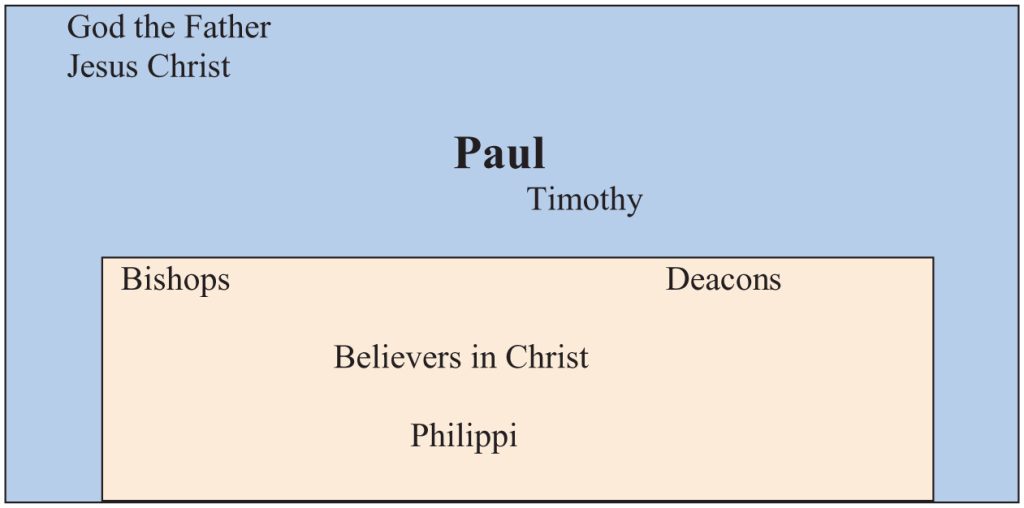
Isela Trujillo (in The Bible Translator 2026, p. 118ff.) explains: “In the opening greeting (Philippians 1:1-2), the Deaf signer makes clear what kind of genre the audience will look at (a letter) and establishes the main stage for the entire letter, clearly locating the primary audience (the Philippians). This stage is depicted in [the figure below]. The apostle Paul, represented by the signer, occupies the center of the stage. From the signer’s perspective, the community of believers in Philippi, including the bishops and deacons, has been placed in front of him. God the Father is above him and to the right. Jesus Christ is on Paul’s right side and Timothy is on his left. It is important that in the distribution of space not one character should overlap the space of another one. This strategy is not different from the one used in narrative texts.”