
love (by God)

Translator Lee Bramlett submitted this on the translation of the Greek word that is translated into English as “love” (referring to God’s love). This letter was then reposted by Wycliffe Bible Translators (see here ):

“Translator Lee Bramlett was confident that God had left His mark on the Hdi culture somewhere, but though he searched, he could not find it. Where was the footprint of God in the history or daily life of these Cameroonian people? What clue had He planted to let the Hdi know who He was and how He wanted to relate to them?

“Then one night in a dream, God prompted Lee to look again at the Hdi word for ‘love.’ Lee and his wife, Tammi, had learned that verbs in Hdi consistently end in one of three vowels. For almost every verb, they could find forms ending in i, a, and u. But when it came to the word for love, they could only find i and a. Why no u?

“Lee asked the Hdi translation committee, which included the most influential leaders in the community, ‘Could you ‘ɗvi’ your wife?’ ‘Yes,’ they said. That would mean that the wife had been loved but the love was gone.

“‘Could you ‘ɗva’ your wife?’ ‘Yes,’ they said. That kind of love depended on the wife’s actions. She would be loved as long as she remained faithful and cared for her husband well.

“‘Could you ‘ɗvu’ your wife?’ Everyone laughed. ‘Of course not! If you said that, you would have to keep loving your wife no matter what she did, even if she never got you water, never made you meals. Even if she committed adultery, you would be compelled to just keep on loving her. No, we would never say ‘ɗvu.’ It just doesn’t exist.’

“Lee sat quietly for a while, thinking about John 3:16, and then he asked, ‘Could God ‘ɗvu’ people?’

“There was complete silence for three or four minutes; then tears started to trickle down the weathered faces of these elderly men. Finally they responded. ‘Do you know what this would mean? This would mean that God kept loving us over and over, millennia after millennia, while all that time we rejected His great love. He is compelled to love us, even though we have sinned more than any people.’

“One simple vowel and the meaning was changed from ‘I love you based on what you do and who you are,’ to ‘I love you, based on Who I am. I love you because of Me and NOT because of you.’

“God had encoded the story of His unconditional love right into their language. For centuries, the little word was there — unused but available, grammatically correct and quite understandable. When the word was finally spoken, it called into question their entire belief system. If God was like that, did they need the spirits of the ancestors to intercede for them? Did they need sorcery to relate to the spirits? Many decided the answer was no, and the number of Christ-followers quickly grew from a few hundred to several thousand.

“The New Testament in Hdi is ready to be printed now, and 29,000 speakers will soon be able to feel the impact of passages like Ephesians 5:25: ‘Husbands, ‘ɗvu’ your wives, just as Christ ‘ɗvu’-d the church…'”

In Hawai’i Creole English the love that God has is often translated as love an aloha. Aloha has a variety of meanings, including “hello,” “goodbye,” “love,” “thank you,” etc.

The Philippine languages of Cebuano, Tagalog, and Pampanga use a word (gugma, pag-ibig, and lugud respectively) that is also used for a “noble, refined love of people for each other,” distinct from romantic love. (Source: G. Henry Waterman in The Bible Translator 1960, p. 24ff. )

In Mairasi, the term that is used for love by God, for God and for people is the same: “desire one’s face.” (source: Enggavoter 2004)

Joseph Hong (in The Bible Translator 1996, p. 233ff. ) explains the translation of this kind of love into Khmer: “Expressing the idea of God’s love has also caused some problems. Since the Khmer knows only about the Buddha as compassionate, the translation team was at a loss to find an adequate term to express God’s love for humankind which is so great that God even allowed himself to become a human being. A solution was found which says that God “relates himself” to (that is, “interacts with”) human beings, srolanh (ស្រលាញ់).”

See also love (Jesus for young, rich man), God is love, Honorary “are” construct denoting God (“love”), and this devotion on YouVersion .
Hosea

The Hebrew, Latin, and Greek that is transliterated as “Hosea” in English means “Jehovah is help or salvation,” “salvation.” (Source: Cornwall / Smith 1997 )

In Spanish Sign Language it is translated with the sign for “repent,” particularly referring to Hosea 6:1Hosea 6:3. (Source: Steve Parkhurst)


“Hosea” in Spanish Sign Language, source: Sociedad Bíblica de España

In Swiss-German Sign Language it is translated with a sign that depicts going away and returning, referring to Hosea going away and finding the prostitute Gomer to marry and then returning home with her (see Hosea 1:2 and Hosea 1:3).


“Hosea” in Swiss-German Sign Language, source: DSGS-Lexikon biblischer Begriffe , © CGG Schweiz

In Hungarian Sign Language it is translated with a sign thatrefers to the faithful acceptance of God’s inexplicable command (as one who is able, as it were, to swallow the evil—that is, to endure his wife’s infidelity — see Hosea 3:1). (Source: Jenjelvi Biblia and HSL Bible Translation Group)


“Hosea” in Hungarian Sign Language — note that only the first part refers to “Hosea,” the second and third parts refer to “prophet” and “book” (source )

For more information on translations of proper names with sign language see Sign Language Bible Translations Have Something to Say to Hearing Christians .

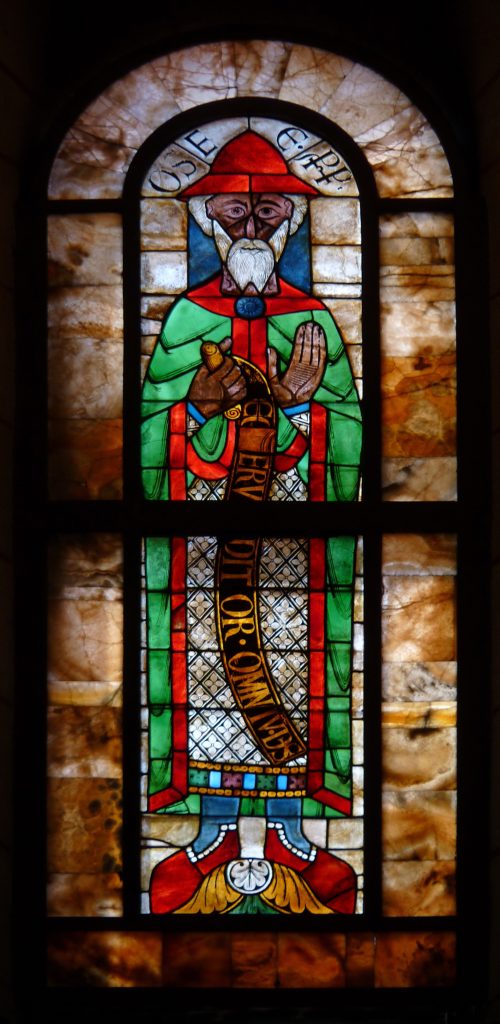
The following is a stained glass window of Hosea in the Augsburg Cathedral in Germany. It is part of the “Prophet windows of Augsburg ” from the 12th century which is assumed to be the oldest remaining set of church windows:

Photo by Hans Bernhard, hosted by Wikimedia Common under the GFDL-CC-BY-SA-all license

Stained glass is not just highly decorative, it’s a medium which has been used to express important religious messages for centuries. Literacy was not widespread in the medieval and Renaissance periods and the Church used stained glass and other artworks to teach the central beliefs of Christianity. In Gothic churches, the windows were filled with extensive narrative scenes in stained glass — like huge and colorful picture storybooks — in which worshipers could ‘read’ the stories of Christ and the saints and learn what was required for their religious salvation. (Source: Victoria and Albert Museum )

More information on Hosea .

complete verse (Romans 9:25)

Following are a number of back-translations of Romans 9:25:

  • Uma: “In the letter of the prophet Hosea God says like this: ‘People who are not my followers and who do not know my love, I will call them to become my followers and I will show them my love.'” (Source: Uma Back Translation)
  • Yakan: “God caused Nabi Hosea to write abut this. He said, ‘The ones who were not my people at the beginning, they will be the ones I call/name my people. The nation which was not my loved one they will be the ones I call/name my loved one.” (Source: Yakan Back Translation)
  • Western Bukidnon Manobo: “For in the book written by Hosea, there is a word of God where He says, ‘As for the people who are not my subjects, I will make them my subjects. And as for those people who were not precious long ago here in my breath, I will make them precious today.'” (Source: Western Bukidnon Manobo Back Translation)
  • Kankanaey: “This very-thing is what God said in the book that he caused-Hosea -to-write. He said, ‘Those who are not my people, I will count them as my people, and the collective-people whom I did not love, I will love them.” (Source: Kankanaey Back Translation)
  • Tenango Otomi: “It happened like it says in the Book written by the prophet Hosea, that God said: ‘Those people who were not my people I now say that they are my people. These are the people whom I did not love, but now I love them’ he said.” (Source: Tenango Otomi Back Translation)

Honorary "rare" construct denoting God ("saying")

Click or tap here to see the rest of this insight.

Like a number of other East Asian languages, Japanese uses a complex system of honorifics, i.e. a system where a number of different levels of politeness are expressed in language via words, word forms or grammatical constructs. These can range from addressing someone or referring to someone with contempt (very informal) to expressing the highest level of reference (as used in addressing or referring to God) or any number of levels in-between.

One way Japanese shows different degree of politeness is through the usage of an honorific construction where the morpheme rare (られ) is affixed on the verb as shown here in the widely-used Japanese Shinkaiyaku (新改訳) Bible of 2017. This is particularly done with verbs that have God as the agent to show a deep sense of reverence. Here, itteo-rare-ru (言っておられる) or “saying” is used.

(Source: S. E. Doi, see also S. E. Doi in Journal of Translation, 18/2022, p. 37ff. )

1st person pronoun referring to God (Japanese)

Click or tap here to see the rest of this insight.

Like a number of other East Asian languages, Japanese uses a complex system of honorifics, i.e. a system where a number of different levels of politeness are expressed in language via words, word forms or grammatical constructs. These can range from addressing someone or referring to someone with contempt (very informal) to expressing the highest level of reference (as used in addressing or referring to God) or any number of levels in-between.

One way Japanese shows different degree of politeness is through the choice of a first person singular and plural pronoun (“I” and “we” and its various forms) as shown here in the widely-used Japanese Shinkaiyaku (新改訳) Bible of 2017. The most commonly used watashi/watakushi (私) is typically used when the speaker is humble and asking for help. In these verses, where God / Jesus is referring to himself, watashi is also used but instead of the kanji writing system (私) the syllabary hiragana (わたし) is used to distinguish God from others.

(Source: S. E. Doi, see also S. E. Doi in Journal of Translation, 18/2022, p. 37ff. )

See also pronoun for “God”.

Translation commentary on Romans 9:25

Beginning with this verse and going through verse 29, Paul introduces a series of Old Testament passages to validate what he has said in verse 24. That is, that God’s call extends both to the Jews and to the Gentiles, though neither all of the Jews nor all of the Gentiles have responded to this call.

Paul says, literally, “in Hosea,” but this is merely a Semitic way of saying in the book of Hosea. The quotation comes from the Septuagint of Hosea 2.23 with a few minor alterations. In the original context Hosea is addressing himself to the northern kingdom of Israel. Hosea has named his daughter “Without Mercy” and his son “Not-my-People” (Hosea 1.6, 9) to indicate the fallen condition of the northern tribes of Israel. Now Hosea is saying that God will show mercy to Israel and restore them, so that they will once again be his people. However, it is clear that Paul is applying this verse to the Gentiles.

In the introductory statement of verse 25 (This is what he says …), it may be necessary to specify that it is God who is speaking—for example, “this is what God says, as written in the book of Hosea” or “… as Hosea wrote.”

It is not easy to translate idiomatically an expression such as The people who were not mine, I will call “My People.” In some languages the closest equivalent may be “I will use the words My-People when I speak of people who are really not mine” or “I will give the name of My-People to those people who are not mine.”

“Her” of the Revised Standard Version is actually a feminine article in Greek; it is translated by the Good News Translation and others (New English Bible, Jerusalem Bible) as the nation. The Good News Translation also transforms a passive construction in Greek (“the [nation] that was not loved”) to an active construction: the nation that I did not love (see also Jerusalem Bible). As in the case of the first line of the quoted passage, one may also employ for this second line some such translation as “I will use the words My-Beloved when I talk about the nation that I did not love,” or “I will use the words I-Love-You when I talk about the nation that I did not love.”

Quoted with permission from Newman, Barclay M. and Nida, Eugene A. A Handbook on Paul’s Letter to the Romans. (UBS Handbook Series). New York: UBS, 1973. For this and other handbooks for translators see here .

SIL Translator’s Notes on Romans 9:25

9:25a

As: This word introduces support for what Paul said in 9:24. Some languages must use a full clause here. For example:

It is⌋ as/like
-or-

That talk is⌋ like

The Greek has a word that is usually translated as “indeed” here. It probably emphasizes what follows. Here are other ways to translate this word:

in fact
-or-
certainly

But some English versions, such as the Berean Standard Bible, do not translate this word.

He says: The Greek and the Berean Standard Bible use the present tense here, as in 9:15. Greek scholars call it the historical present. In many languages the normal way of referring to a past event must be used. For example:

he said

He: Here this word refers to God.

in Hosea: Here the name Hosea refers to the Old Testament book of Hosea. In some languages all or some of that information will need to be made clear. For example:

in ⌊the book of⌋ Hosea
-or-
in ⌊the book of⌋ Hosea ⌊in Scripture

Hosea: The prophet Hosea lived about eight hundred years before Paul. In some languages a literal translation would imply that Hosea wrote about the same time as Paul. If that is true in your language, indicate that it was many years before Paul. For example:

Hosea ⌊long ago

9:25b–c

These words are from Hosea 2:23, but it is not an exact quote. However, God spoke in 9:25b–c, so quote marks are needed in English. If you indicate the location of quotes from the Old Testament with cross-references, you may want to do so here.

Paul used these words in Hosea to imply a promise for the Gentiles. In the context of the book of Hosea, these words refer to the ten clans of Israel who had rebelled against God. You should not add the word “Gentiles” in this quote.

9:25b

I will call them ‘My People’: Here God promised to begin or restart a relationship with the people who he formerly said were not his people. Here are other ways to translate this clause:

I will call them my people
-or-
I will now call my people
-or-
I will count them as my people

who are not My people: This refers to people whom God did not consider to be his people. They did not have a relationship with him or that relationship was completely broken. Here are other ways to translate this phrase:

The people who were not mine (Good News Translation)
-or-
People who were formerly not my people

9:25c

I will call her ‘My Beloved’ who is not My beloved: In Hosea 2:23, the word her refers to Hosea’s wife. Here it is used poetically to refer to the same group as “those who were not my people” in 9:25b. In some languages a literal translation would not refer to the same group of people. If that is true in your language, you may want to explain the meaning in a footnote. Here is an example footnote:

Here, Paul used “her” to refer to the same group of people as “those who were not my people.”

I will call her ‘My Beloved’: Here God promised to love the people who he formerly did not love as his people.

who is not My beloved: The word beloved refers to someone who is loved. Here are other ways to translate this word:

who was unloved (NET Bible)
-or-
whom I did not love before (New Living Translation (2004))

© 2020 by SIL International®
Made available under the terms of a Creative Commons Attribution-ShareAlike 4.0 License (CC BY-SA) creativecommons.org/licenses/by-sa/4.0.
All Scripture quotations in this publication, unless otherwise indicated, are from The Holy Bible, Berean Standard Bible.
BSB is produced in cooperation with Bible Hub, Discovery Bible, OpenBible.com, and the Berean Bible Translation Committee.