14But the seventh day is a Sabbath to the Lord your God; you shall not do any work—you, or your son or your daughter, or your male or female slave, or your ox or your donkey, or any of your livestock, or the resident alien in your towns, so that your male and female slave may rest as well as you.
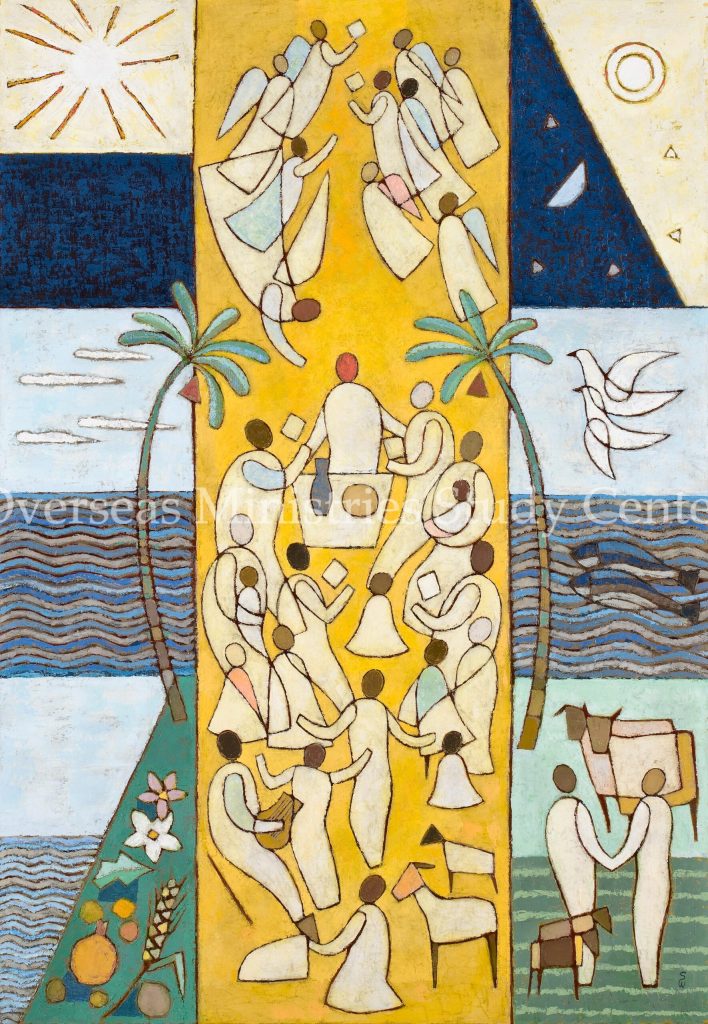
Painting by Soichi Watanabe, used with permission by the Overseas Ministries Study Center (OMSC) at Princeton Theological Seminary. You can purchase this and many other artworks by artists in residence at the OSMC in high resolution and without a watermark via the OSMC website .
“A resident of Koshigaya City, Saitama, Japan, Soichi Watanabe was the 2008-09 OMSC artist in residence. Watanabe graduated in 1982 from the Ochanomizu Art School in Tokyo after having earned, a decade earlier, an economics degree from Tohoku Gakuin University in Sendai. He teaches at a private art school that he started in 1982. Following his 1982 graduation, Soichi founded a private art school where he and his wife work together to help others experience the joy of art.
“Soichi was drawn to God as an undergraduate student during a home Bible study when he encountered Mark 8:35: ‘Whoever wants to save his life will lose it, but whoever loses his life for me and for the gospel will save it.’ Further study of the New Testament led him to realize that he was both ‘stubborn and self-centered.’ He recalls that ‘the richness of the biblical world overwhelmed me and at the same time tortured me.’
“Shortly thereafter he chose to submit his life to God at an evening worship service. ‘I really heard a voice telling me to accept the salvation of Jesus on the cross and to follow him,’ remembers Soichi. From that point on he has been determined to serve God through his abilities. As a follower of Jesus, Soichi points to his faith as the foundation from which he works as an artist. In his art book Jesus Walking With Us (2004), he writes, ‘I realize that [my works] are my own humble responses to God’s calling in my life… . The images are often given to me through the words of God at worship services on Sundays and during my daily devotion. I have the earnest hope that I will go on painting to praise the Lord.'” (Source )
About this image, Watanabe says: “This passage in Exodus [and Deuteronomy] speaks of the six days God spent working on the creation. The daily work we do is to be done through God’s leading. The seventh day, the Sabbath day, is the day when we give thanks with joy and praise for the work of God and for what Jesus has done. This painting reflects some of the things I learned in seminars at OMSC, such as the worship dancing of African believers. It also reflects some of the worship experience I enjoyed with little children at the First Presbyterian Church in New Haven. (Source: OMSC 2010, p. 34)
The Hebrew and Ge’ez that is translated in English as “livestock” (or “cattle”) is translated in Newari as “living beings brought up in a house” or “living beings cared for in a house” (source: Newari Back Translation). Specifically “cattle” is “cows and oxen.”
In Kwere it is “animals that are being kept.” (Source: Pioneer Bible Translators, project-specific translation notes in Paratext)
The Hebrew, Ge’ez, and Greek that is translated as “Sabbath” in English is rendered as “day we rest” in Tzotzil, in Mairasi as “Jew’s Rest Day,” in Quiotepec Chinantec as “day when people of Israel rested,” in Shilluk as “day of God,” in Obolo as Usen Mbuban or “Holy Day,” and in Mandarin Chinese as ānxírì (安息日) or “rest day” (literally: “peace – rest – day”). (Sources: Tzotzil: Marion Cowan in Notes on Translation with Drill, p. 169ff; Mairasi: Enggavoter 2004; Quiotepec Chinantec: B. Moore / G. Turner in Notes on Translation 1967, p. 1ff.; Shilluk: Nida 1964, p. 237; Obolo: Enene Enene; Chinese: Jost Zetzsche)
In Matumbi it is translated as Sabato ya Ayahudi or “Sabbath of the Jews,” to distinguish it from the Islamic Sabbath (which is Friday) or the Christian Sabbath (which is Sunday). (Source: Pioneer Bible Translators, project-specific notes in Paratext)
In the old Khmer version as well as in the first new translation this term was rendered as “day of rest” (Thngai Chhup Somrak / ថ្ងៃឈប់សំរាក). Considered inadequate to convey its religious meaning (not only about cessation of work, but also in honor of Yahweh as the Creator), the committee for the Today’s Khmer Version (publ. 2005) decided to keep the Hebrew word and use its transliterated form Thgnai Sabath (ថ្ងៃសប្ប័ទ). “The Buddhist word Thngai Seil ‘day of merits’ used by some Catholics was once under consideration but was rejected because it did not receive unanimous support.” (Source: Joseph Hong in The Bible Translator 1996, p. 233ff. )
In Spanish, the translation is either día de reposo (“day of rest”) or sábado (usually: “Saturday,” derived from the Greek and Hebrew original). Nida (1947, p. 239f.) explains that problem for Spanish and other languages in its sphere of influence: “In translation ‘Sabbath’ into various aboriginal languages of Latin America, a considerable number of translators have used the Spanish sábado, ‘Saturday,’ because it is derived from the Hebrew sabbath and seems to correspond to English usage as well. The difficulty is that sábado means only ‘Saturday’ for most people. There is no religious significance about this word as the is with ‘Sabbath’ in English. Accordingly the [readers] cannot understand the significance of the persecution of Jesus because he worked on ‘Saturday.’ It has been found quite advantageous to use the translation ‘day of rest,’ for this accurately translated the Hebrew meaning of the term and resolves the problem in connection with the prohibitions placed upon some types of activities.”
In the Nueva traducción viviente translation (2010) it día de descanso al mantenerlo santo (“day of rest to keep it holy”). (Source: Lénart de Regt in The Bible Translator 2017, p. 131ff. )
In French Sign Language it is translated with a sign that depicts closing of the blinds of a store:
While the Greek term doulos in the New Testament and ‘ebed in the Old Testament refer to slightly different concepts (unlike in New Testament Judea in Old Testament Israel and Judah, Hebrew servants/slaves were required to be released after six years of labor and, regardless of when they started their servitude, all Hebrew servants were to be automatically freed during the year of Jubilee), translation issues are somewhat similar.
Joel Baden (2025, p. 65ff.) says this about the Hebrew term used in the Old Testament / Hebrew Bible:
“The English words ‘servant’ and ‘slave’ have decidedly different connotations. ‘Servant’ has the sense of ‘employee.’ ‘Slave,’ by contrast, carries with it the ideas of an owned and controlled body, of violence and dishonor. The connotation of ‘servant’ can verge on the positive; ‘slave’ is predominantly negative. How a reader of the Bible understands the identity of a character or the relationship between one character and another or the world of ancient Israel depends significantly on whether the word ‘servant’ or ‘slave’ is used. In Hebrew, however, there is but one word underlying every occurrence of ‘servant’ and ‘slave’ in our modern translations. The distinction between the two exists only on the level of interpretation.
“It is not a matter of mere nomenclature. Take the story of Genesis 24, in which Abraham sends his servant off to find a wife for Isaac. The servant — though the main character of the passage — has no name and is identified only by his title, which he even uses to introduce himself: ‘I am Abraham’s servant,’ he says (Genesis 24:34, Jewish Publication Society). This is often read as a warm story about a devoted servant — usually imagined to be relatively old — who carries out the elderly patriarch’s final wishes. How does it change, how do we reimagine it, when we read all thirteen mentions of Abraham’s servant as, in fact, Abraham’s slave? We know Abraham has slaves: His ‘servant’ even says so in this very chapter in the very next verse: ‘The Lord has greatly blessed my master, and he has become rich: he has given him sheep and cattle, silver and gold, male and female slaves, camels and asses’ (24:35, JPS). Yet generations of translators, interpreters, and readers have failed to connect the slaves (the property with which God has blessed Abraham) and the servant — the slave who is the protagonist of this same story.
“When slaves are turned into servants, the Bible itself is changed. Our revulsion at the institution of slavery is kept at a distance from the biblical text that stands as our religious heritage. The Bible is protected, albeit from itself. Slavery is minimized, or worse: The King James Version, notably, does not translate ‘ebed as ‘slave’ a single time. The result? Some KJV readers have denied that there is any slavery in the Bible whatsoever. Yet the word ‘ebed appears around 800 times in the Bible. That’s 800 moments when a slave, and the existence of slavery in ancient Israel and the biblical text, has been erased.
“The social role that we associate with the term ‘servant’ didn’t exist in ancient Israel. Slaves, however, did. Israel knew what it was to be a slave, and Israel knew, too, what it was to own a slave. And thus Israel uses the language and metaphor of slavery again and again to express the basic notions of obedience, of power disparity, of bodily control and the absence of agency. Samuel says to Yahweh upon being called, ‘Speak, Lord, for your servant is listening’ (1 Samuel 3:9, JPS). ‘Let my lord go ahead of his servant,’ Jacob says to Esau in Genesis 33:14 (JPS). Rendered as ‘servant’ in every translation, this is a sort of formally obsequious, self-abnegating speech. While literal slavery is not at stake in these sorts of expressions, the metaphorical reference to the relative status of slave and master is lost when it is translated as ‘servant.’
“So, too, when those figures who are the ‘ebed to a king are referred to as ‘courtiers,’ ‘officials,’ ‘attendants,’ ‘soldiers,’ ‘subjects,’ ‘envoys,’ ‘ministers,’ or even sometimes simply ‘men,’ of the king. These are all translations of the same word, and the instinct to specify their distinctive roles in the royal court is understandable. Yet in doing so, translations obscure the actual language with the connotations that it presents: subordination, threat of violence to one’s person, absolute control over will and agency. And so, too, when it is not a human king but God to whom one is said to be ‘ebed. In the book of Joshua, God states, ‘My servant Moses is dead’ (1:2, JPS) — we are relatively comfortable with the idea of serving God but perhaps less so with the idea of being God’s slave. Yet the qualities of obedience, subservience, and loyalty — and the implicit threat of punishment for the lack thereof — are part of this picture as well. One might point to the way this language is picked up in the New Testament in the phrase ‘slave of Christ’ in 1 Corinthians 7:22.
“If ‘servants’ and ‘slaves’ are not understood to be equivalent — and in modern English it is safe to say that they are not — then every time that the word ‘ebed appears, a choice has to be made by the translator. The diminishment of the very word ‘slave’ in English translations of the Hebrew Bible results in the diminishment of the idea and reality of slavery in the Bible and in the world that produced it. Though there is no debate to be had about whether there was slavery in the Bible and in ancient Israel, a lay reader of the text in translation might well wonder.
“Our ears, and eyes, have become accustomed to seeing the word ‘servant’ in the Bible. ‘Slave’ often sounds wrong, inapt, almost harsh. Yet it is just this discomfort that signals how important the change is. Whenever we encounter the word ‘servant’ in our English translations, we should be obliged to ask why it says ‘servant’ and not ‘slave’ — and what difference it would make to our reading of the text as an individual, as a community, and as a culture if we were instead to read ‘slave.’”
Ruden (2021, p. lviii) says this about the Greek term in the New Testament:
“In Judea, servitude was sui generis and could be complicated, and accordingly the Greek vocabulary in scripture is varied. But there appears to be no basis for sugarcoating the word meaning a chattel slave in nearly all Greek literature, doulos. It is unlikely that the internationally oriented authors of the Gospels didn’t mean what their peers meant by the word — ‘slave.’ Also, the English word ‘servant’ is too vague for the array of servitors (including trusted house slaves and personal attendants), military and administrative subordinates, and ritual helpers the Greek of the Gospels distinguishes.”
Some English New Testament translations (Ruden 2021, Hart 2017, The Orthodox New Testament 2004) have consistently used slave for the Greek doulos but no Old Testament translation consistently translates ‘ebed with only one term.
In a number of leading German translations, including the Catholic Einheitsübersetzung (1980 / 2016) and the Protestant Elberfelder Bibel (1871 / 2006), BasisBibel (2021), as well as the translation by Luther (all editions) use the term Knecht throughout. Knecht is an old-fashioned term for a low-class, often agricultural servant with little or no social mobility, a position that is somewhat located between Diener (“servant”) and Sklave (“slave”). The only times these versions specifically don’t use Knecht is where slavery is specifically in the focus (such as Leviticus 25:44 or Philemon 1:16).
Following are a number of back-translations as well as a sample translation for translators of Deuteronomy 5:14:
Kupsabiny: “and then on the seventh rest because that day is set aside to be mine. No person is allowed to do any work including his children, his slaves, his oxen, his donkeys, any other of his animal or/and foreigners who are in his home. Make sure that his slaves rest like him.” (Source: Kupsabiny Back Translation)
Newari: “The seventh day, however, is the Sabbath of LORD your God. On that day, you, your sons and daughters, your male and female servants, your ox or donkey, and also any animal of your and even any foreign person who has come into your towns are not to do any work. Your servants and maid servants must also rest like you do.” (Source: Newari Back Translation)
Hiligaynon: “but the seventh day is the Day For-Resting which you (plur.) will-set-aside for me, the LORD your (plur.) God. You (plur.) do- not -work on that day including your (plur.) children, slaves, cows, donkeys, and your (plur.) other animals, or the non-Israelinhon who live in your (plur.) towns. In this way your (plur.) slaves can also rest as you (plur.) do.” (Source: Hiligaynon Back Translation)
English: “but the seventh day is a rest day, a day dedicated to me, Yahweh your God. On that day you must not do any work. You and your sons and daughters and your male and female slaves must not work. You must not even force your livestock to work, and you must not tell foreigners to work, those who are living in your country. You must allow your slaves to rest on that day just like you do.” (Source: Translation for Translators)
The translation of the tetragrammaton (YHWH or יהוה) is easily the most often discussed issue in Bible translation. This is exemplified by the fact that there is virtually no translation of the Bible — regardless of language — where the position of the respective translator or translation team on how to translate the name of God into the respective language is not clearly stated in the preface or introduction.
Click or tap here to read about the different ways the tetragrammaton is and has been translated
The literature on this topic is overwhelming, both as far as the meaning of YHWH and the translation of it by itself and in combination with other terms (including Elohim and Adonai). There is no reason or room to rehash those discussions. Aside from various insightful translations of YHWH into various languages (see below), what’s of interest in the context of this tool are official and semi-official statements regarding the translation by Bible translation agencies and churches. These include the 1992 statement by United Bible Societies’ “Names of God” Study Group (see The Bible Translator 1992, p. 403-407 ) or the “Letter to the Bishops’ Conference on ‘The Name of God'” by the Congregatio de Cultu Divino et Discriplina Sacramentorum of 2008 (see here et al.).
In summary, the UBS study group gives six different options on how to translate YHWH: 1) transliterate (some form of “Yahweh” or “Jehovah” if this is an already established term); 2) translate (along the lines of kurios — κύριος in the Septuagint); 3) translate the meaning of YHWH; 4) use a culture-specific name; 5) translate Elohim and YHWH in the same way; or 6) use a combination of any of these options.
The official Catholic directive states that for liturgical purposes YHWH is to be translated as an equivalent of Kurios (“Lord”) unless when appearing in combination with Elohim (“God”) or Adonai (“lord”), in which case it’s to be translated with “God.”
In the following collection of examples, any of the above-mentioned strategies are used.
Use of Typographical Means to Offset the Name of God
A large number of Bible translations in many Western European languages have used a similar strategy to translate YHWH as an equivalent of Kurios or Adonai (“lord” in Greek in Hebrew) but have used either small caps or all caps to denote these occurrences as an equivalent to a proper name. Here are some examples:
None of the European languages have found a “cultural-linguistic equivalent” with the possible exception of Eternal or l’Éternel (see below).
The rendering of the translation of YHWH in bold (and uppercase) characters is for instance used in Guhu-Samane: QOBEROBA (a term of address for a respected person and also connotes “forever”) (for “forever”, see below under Translations of the Name of God) and the upper-casing in Bible translations in several other languages in Papua New Guinea:
In Cebuano (Ang Pulong sa Dios edition, 2010) and Hiligaynon (all versions), Ginoo, a typographical variant of Ginoo (“Lord”) is used. Bible translation consultant Kermit Titrud (SIL): “‘Yahweh’ is too close to Yahwa, their word for ‘Satan.’ We were afraid that in the pulpits readers might misread ‘Yahweh’ and say ‘Yahwa.’ So we went with the tradition found in most English translations. Ginoo for ‘Yahweh’ and Ginoo for ‘adonai.'”
In languages where capitalization is not a typographical option, other options are available and used, such as in Japanese, where the generic term shu 主 for “Lord” is bolded in some translations to offset its meaning (Source: Omanson, p. 17).
In Pattani Malay, the word for “Lord” is underlined: ربي. (Source: Andy Warren-Rothlin)
A graphical way of representation beyond typography was used by André Chouraqui in his French La Bible hebraique et le Nouveau Testament (publ. 1974-1977) for which he superimposed adonai and Elohim over (the French rendition) of the tetragrammaton:
(Source: Andy Warren-Rothlin in Noss / Houser, p. 618ff.; see also tempt God / put God to the test)
Translations of the Name of God
A translation of YHWH with a rendering of the meaning of “Eternal” was done in English by James Moffatt (between 1926 and 1935) with Eternal, The Voice translation with Eternal One (2012), in French versions as L’ÉTERNEL by J. F. Ostervald in 1904 or l’Éternel by L. Segond (1910-1938, not in more recent revisions) and Zadoc Kahn (1964) (for the French translation, see also LORD of hosts), in Esperanto as “la Eternulo,” and in Obolo as Okumugwem: “The Ever-Living” (source: Enene Enene). In francophone Africa, translations of l’Éternel are widely used, due to the wide use of Segond’s early editions (see above). Examples include Nancere (Nandjéré) with Kumuekerteri, Ngambay (Ngambaï) with Njesigənea̰, Sar with Kɔ́ɔ̄ɓē, Mbay (Mbaï) with Bïraþe, Kim with Bage ɗiŋnedin, or Lélé uses Gojɛnɛkirɛkindiy (verbatim: “who remains for his eyes”). (Source: Andy Warren-Rothlin)
Similarly and at the same time expanding its meaning, the Nzima translation of 1998 translated YHWH as Ɛdεnkεma, the “Eternal All-Powerful Creator and Sustainer” (Source: David Ekem in The Bible Translator 2005, p. 72ff. ).
“Creator” is also used in Kazakh (Zharatkhan [Жаратқан]), Karakalpak (Zharatkhan [Жаратқан], sometimes in combination with Iyeg [Ийег] — “Master”), and Kirghiz (Zharatkhan [Жаратқан], likewise in combination with “Master” or Ege [Эге]). (Source: David Gray).
Nepali, Bengali, and Hindi are all derived from Sanskrit and have (eventually) all found similar translations of YHWH. In Bengali “God” is translated as Ishwar (ঈশ্বর) (widely used in Hindu scriptures, where it’s used as a title, usually associated with “Siva”) and YHWH as Shodaphrobhu (সদাপ্রভু) — “Eternal Lord”; in Nepali and NewariYHWH is translated as Paramaprabhu (परमप्रभु)– “Supreme Lord”; and Hindi translates YHWH as Phrabu (प्रभु) — “Lord.” In earlier translations all three languages used transliterations of Jehovah or Yahweh. (Source: B. Rai in The Bible Translator 1992, p. 443ff. and Barrick, p. 124).
The influential German Jewish translation of Martin Buber and Franz Rosenzweig (between 1925 and 1961) translates YHWH in Exodus 3:15 with “Ich bin da” (“I exist” or “I am”) and in all other instances with pronouns in small caps (Er, Ihm, Ihn, Ich — “he,” “him,” “his,” “I”).
The Jewish orthodox English ArtScroll Tanach translation (publ. 2011) uses Hashem or “The Name”
In the Bavarian translation by Sturmibund (publ. 1998), it is translated as Trechtein or “Sovereign, Lord.” “Trechtein” is related to the obsolete English “drighten.” (Source: Zetzsche)
In Ge’ez, Tigrinya, and Amharic it is translated with Igziabeher (እግዚአብሔር) or “Ruler/Lord of the Nations/Peoples.” In Ge’ez Igziabeher is used for “God” as well, whereas in Tigrinya and Amharic it is often, but not always used for “God.” In a recent revision by Biblica (see here ), an attempt was made to use Igziabeher exclusively for occurrences of the tetragrammaton in the Hebrew Bible, but after strong responses by the Christian community, a compromise was found by using Igziabeher in the first chapter of Genesis and changing it according to the Hebrew text elsewhere. (Source: Zetseat Fekadu)
Warlpiri uses Kaatu Jukurrarnu (Kaatu is a transcription of “God” and Jukurrarnu means “timelessness” and shares a root with jukurrpa — dreamings) (Source: Stephen Swartz, The Bible Translator 1985, p. 415ff. ).
The translation of YHWH into Weri with Aniak Tupup or “man of the holy house” intends “to maintain the Jewish practice of not uttering God’s name [with] the use of another vernacular phrase that signals that a ‘taboo’ name is being referred [which] could give a cue that would be recognizable in written or oral communication” (Source: P. King, The Bible Translator 2014, p. 195ff. ).
Aruamu translates it as Ikiavɨra Itir God or “Ever Present God” (source: Pioneer Bible Translators, project-specific translation notes in Paratext)
Idakho-Isukha-Tiriki: Nyasaye Wuvunyali Muno or “God powerful great” (source: Andy Warren-Rothlin)
Ruund uses Chinawej, a term that is otherwise used as a response of approval. Anna Lerbak (in The Bible Translator 1954, p. 84ff. ) tells the genesis of this term (click or tap to see an explanation):
“The name ‘Jehovah’ had been used in some contexts, but I had the feeling that it did not mean much to the people, and when I asked the pastors they all said it didn’t, and worse, it very often confused people, especially in the villages. During the conversation it was suggested that the name Chinawej be used in the place of ‘Jehovah’, and this met with immediate approval. A few days later I was working on a Psalm in which ‘Jehovah’ was used frequently, so I wrote Chinawej in its place and then read the Psalm to them. The response was about like this: “That is it, now people will understand, that is how Chinawej is. The Jews call God ‘Jehovah’, we call Him Chinawej, it is the same God. but we know Him as Chinawej as the Jews know Him as ‘Jehovah’ “. They often call God Chinawej in prayer, it seems to indicate warmth and intimacy.
The same word is used in two other ways. It is the name of a snake which never attacks human beings. And it is used as a response of approval. When told of something they are pleased to hear, something they find good, just, helpful, generous, they often respond by saying, Chinawej. When they call God Chinawej, it indicates that they think of Him as One Who is good and just and generous towards them. When it was suggested at the committee that we use Chinawej in place of ‘Jehovah’ it was accepted immediately and unanimously.
Ebira has Eneyimavara. Eneyimavara was created by merging a praise phrase that was only used for the traditional deity Ohomorihi (see here), that had become the word for the Christian God: ene e yi ma vara or “the one that never changes.” “The translators came to the agreement that this praise name that describes the unchangeableness of God is very close in meaning to the probable meaning of YHWH.” (Source: David O Moomo in Scriptura 88 (2005), p. 151ff. )
The Uzbek Bible uses the term Ega (Эга) — “master, owner” in various forms (including Egam / Эгам for “my Owner” or Egamiz / Эгамиз for “our Owner.” (Click or tap to see an explanation):
Jim Zvara (2019, p. 6) explains: “The Uzbek term ega means owner or master (‘master,’ in the historical context of an owner-slave relationship). By extension, it is natural for an Uzbek to speak to or refer to God as Egam (‘my owner’/’master’). In the Uzbek context to be God’s slave is a positive way of understanding one’s relation to him. It suggests that one is in a dependent and obedient relationship to God. The team felt that this relational connection and what it implies fits well with the concept of YHWH as the God who is in a covenant relationship with his people. In the Uzbek context, the choice of Ega was deemed to be the best balance of natural language with meaningful translation.”
The Seediq Bible translation team chose Utux Tmninun (“the weaving god”) for their translation of YHWH. (Click or tap to see a retelling of the process of how that decision was reached):
“(…) The Seediq team requested that we spend time with them on key terms. They had compiled a list of key terms that they wanted input on, and we went through the list item by item. The most important item was how to deal with the divine name. They had tentatively translated it as Yehoba, transliterated from Jehovah, but they were also aware that this transliteration may not be accurate, and they were keen to explore other options.
“We explored various alternatives. Were they interested in following the ancient Jewish practice of substituting ‘Lord’ for the divine name? Would capitalising the letters help? Would they be bold enough to use ‘Yahweh,’ following the opinion of most Old Testament scholars who regard this as the correct pronunciation? Was it feasible to adopt a mixed approach in dealing with the divine name (…)? Each option had its advantages as well as disadvantages.
“In the midst of the discussion, a participant said, ‘Our ancestors, as well as we today, always call God by the term Utux Tmninun. I suggest we use this term.’ The term Utux Tmninun in the Seediq culture means ‘the weaving God.’ In their culture, God is the weaver, the one who weaves life together. All the participants were excited about this proposal. They tried this term with all the composite terms that involve the divine name, and it seemed to work well, so they decided tentatively to adopt this term. After the workshop, the participants went back to their villages and sought feedback from the wider community, and eventually they confirmed the use of the term Utux Tmninun as the rendering of the divine name.
Translating the divine name as Utux Tmninun, the weaving God, is a creative solution. This term is viewed very positively in the Seediq community. It also correlates well with the concept of God as the creator (Gen. 1-2) and as the weaver who formed our inward parts and knit us together in our mothers’ wombs (Ps. 139:13). It also has the advantage of portraying God beyond the traditional masculine form.
“Some may argue that since names are usually transliterated, we should do the same with YHWH, most likely pronounced ‘Yahweh.’ Unfortunately, due to the influence of Chinese Union Version for almost one hundred years now, Chinese Christians only know God as Yehehua. Attempts to change the term Yehehua to Yahweh have not been successful. This is a reality that the Seediq Christians have to live with.
“Others may argue on theological grounds that YHWH is not only the creator, but also the God of the covenant, hence any attempt to substitute another term for YHWH will not do justice to the Hebrew text. In the case of the Seediq translation, there are significant similarities between Utux Tmninun and YHWH, though the terms are not identical. This is a reality translators often have to struggle with. Exact correspondence is hard to come by. Often it is a matter of approximation, give and take. Besides theological considerations, one has to deal with the constraints of past traditions (‘Jehovah,’ in this instance), the biblical cultures and one’s own culture, and audience acceptance. Hopefully, by using Utux Tmninun for YHWH, the Seediq term will be transformed and take on the aspect of the covenant God as well.” (Source: Yu Suee Yan, The Bible Translator 2015, p. 316ff. )
Nyankore: Nyakubaho or “the one who is from within itself” (source: Bühlmann 1950, p. 146)
‘One local dialect of Carpathian Romani: Drágon Dél or “Beloved/Dear God.” In most Romani dialects, the word Rai (Lord/Boss/landlord/shopkeeper) is sort-of acceptable, but in one particular subgroup of Carpathian Romani they said it only meant shopkeeper and ‘everyone knows that [majority term for YHWH] means God, and why can’t we translate it that way?’ We tried to explain, but they weren’t keen on anything but Dél (‘God’). We eventually compromised with Drágon Dél, a common expression for YHWH, and Dél for Elohim, but it took quite a lot of convincing them that there was any theological point there.
For the interconessional translation into Chichewa (publ. 1999) the term Chauta (“Great-One-of-the-Bow”) was chosen for YHWH (Click or tap to see the detailed story):
“The name Chauta, literally ‘Great-One-of-the-Bow’, i.e. [is] either the rainbow (descriptively termed uta-wa-Leza ‘the-bow-of-God’) or, less likely, the hunter’s bow. And yet Chauta was also distinct from Mulungu [“God”] in that it has reference to the specific tribal deity of the Chewa people — the God who ‘owns’ yet also ‘belongs to’ them — and hence it carries additional positive emotive overtones. Although research indicated that in an ancient traditional setting, Chauta too was probably associated with the indigenous ancestral rain cult, in the Christian era it has been progressively generalized to encompass virtually all religious contexts in which God may be either appealed to, proclaimed, or praised. After prolonged deliberation, therefore, the translation committee determined Chauta to be the closest functional equivalent to YHWH of the Hebrew Scriptures. The choice of this name is not without its difficulties, however, and these were carefully considered by the Chewa committee. For example, the use of a more specific local term, as opposed to the generic Mulungu, carries a greater likelihood of bringing along with it certain senses, connotations, and situations that were (and no doubt still are) associated with the indigenous, pre-Christian system of worship. If these happened to remain strong in any contemporary sacred setting, then of course the dangers connected with conceptual syncretism might well arise. In the case of Chauta, however, it appeared that the process of positive Christian contextualization had already reached an advanced stage, that is, judging from the widespread use of this name in all aspects of religious life and practice. A more scholarly argument against Chauta takes the position that there is too great a female component associated with this term because it was traditionally applied (by figurative metonymy) to refer also to the ritual ‘wife of God’, i.e. the chief officiant at a traditional rain shrine and worship sanctuary. However, this usage seems to be quite remote, and most people questioned do not even recognize the connection anymore. Besides, in a matrilineal society such as the Chewa, it does not seem inappropriate to have this aspect of meaning lying in the background, particularly since it is not completely foreign to the notion of God in the Bible (cf. Ps. 36:7; 73:15; Isa. 49:14-15; Mt. 23:37). In terms of ‘connotative fit’ or emotive identification and appeal, there can be little doubt that the name Chauta is by far the closest natural equivalent to YHWH in the contemporary Chewa cultural and religious environment. This aspect of meaning was probably also utmost from the ancient Jewish perspective as well; in other words, “for them the associated meaning of this special name [YHWH], in terms of their history and culture, far outweighed any meaning it may have suggested because of its form or derivation”. To be sure, this ‘new’ divine name — that is, new as far as the Scriptures are concerned — may take some getting used to, especially in the formal setting of public worship. But this is not a foreign god whom we are talking about; rather, he is certainly by now regarded as the national deity of the Chewa nation. Chauta is the great God who for one reason or another ‘did not make himself known to them by his holy name, the LORD’ (Exod. 6:3), that is, in the prior translations of his Word into Chewa. He is, however, and always has been “a God who saves … the LORD (Chauta), our Lord, who rescues us from death” (Ps. 68:20, Good News Bible)!” (Source: Wendland 1998, 120f.; see also The Bible Translator 1992, 430ff. )
Transliteration of YHWH
A 12th century reading of the Masoretic vowel points around יהוה (יְהֹוָה) was interpreted to be pronounced as Yehowah from which Iehouah and Jehovah were derived. This was reflected in the English versions of Tyndale (publ. 1530) and the Geneva Bible (significantly based on Tyndale and publ. in 1560) and again the King James Version (Authorized Version) (publ. 1611) which all used Iehouah or Jehovah in 7 different verses in the Old Testament. The translators and editors of the American Standard Version (publ. 1901), a review of the King James Version used Jehovah for all appearances of the tetragrammaton something that the Spanish Reina-Valera (publ. 1602) had already done as well.
In English versions, Yahweh as a transliteration of the tetragrammaton is used by the Catholic Jerusalem Bible (publ. 1966), the Protestant Holman Christian Standard Bible (publ. 2004) and the Legacy Standard Bible (publ. 2021). The Catholic translation by Knox (publ. 1949) occasionally uses Javé, “to make it a Latin name, to match all the other names in the Old Testament.” (Source Knox 1949, p. 80)
Mandinka for instance uses Yawe for YHWH. “The use of Yawe for YHWH is good and may be a trendsetter in this part of Africa.” (Source: Rob Koops)
In a group of related languages in another part of Africa an interesting development from a transliteration to a indigenous translation can be shown: In the Nandi Bible (1938) Jehovah was used as a translation for YHWH. Kamuktaindet (“The Powerful One”) was used as a translation for Elohim (“God”). This was taken over by a translation into the macrolanguage Kalenjin (1969) (intended to include the closely related Keiyo, Kipsigis, Markweeta, Nandi, Okiek, Sabaot, Terik, and Tugen). Sabaot, Markweeta, Tugen and Okiek later wanted there own translations. Both Sabaot and Markweeta use the indigenous word for “Creator” (Yēyiin in Sabaot and Iriin in Markweeta) to translate Elohim and YHWH of the Old Testament and Theos of the New Testament. The Kalenjin Bible has recently been revised to cater to Keiyo, Kipsigis, Nandi and Terik, and this revision has completely dropped Jehovah in favour of Kamuktaindet. (Source: Iver Larsen)
Early translations into Gilbertese faced a problem when transliterating “Jehovah” (a form of “Jehovah” was first used in Spanish Bible translations in 1569 and 1602): “There are only thirteen letters in the Kiribati alphabet: A, E, I, O, U, M, N, NG, B, K, R, T (pronounced [s] when followed by ‘i’), W For instance, ‘Jehovah’ is rendered Iehova, but Kiribati speakers can only pronounce it as ‘Iowa,’ since the phonemes [h] and [v] do not exist in Kiribati.” (source: Joseph Hong, The Bible Translator 1994, p. 329ff. .)
In a recent edition of a Thai translation (Thai Standard Version, publ. 2011) a combination of translation and transliteration is used: phra’ ya(h)we (h) (พระยาห์เวห์) (“Divine Yawe”). (Source: Stephen Pattemore)
In Nyarafolo Senoufo the transliteration is Yewe which also means “the being one” or “he that is.” David DeGraaf (in: Notes on Translation 3/1999, p. 34ff.) explains: “Since it is widely recognized that the vowels of the name are uncertain, another possible transliteration is Yewe. This proposal is in accord with the Nyarafolo rules of vowel harmony and is thus open to being understood as a normal nominalization in the language. Second, Yewe is exactly the word that would be formed by nominalizing the verb ‘to be’ in the class that includes sentient beings. Thus, Yewe can be understood as ‘the being one’ or ‘he that is’. This solution accords well with YHWH’s self-revelation to Moses in Exodus 3:14, ‘I am who I am.'”
In the Literary and Mandarin Chinese (Protestant) tradition the transliteration of “Jehovah” is historically deeply rooted, even though there are also some historical burdens (Click or tap to see more details):
“YHWH” is rendered in the Chinese Union Version — the most widely used Bible translation in China—as well as most other Chinese Bible translations as yehehua 耶和華. According to Chinese naming conventions, yehehua could be interpreted as Ye Hehua, in which Ye would be the family name and Hehua — “harmonic and radiant” — the given name. In the same manner, Ye would be the family name of Jesus (transliterated as yesu 耶穌) and Su would be the given name. Because in China the children inherit the family name from the father, the sonship of Jesus to God the Father, yehehua, would be illustrated through this. Though this line of argumentation sounds theologically unsound, it is indeed used effectively in the Chinese church.” (see Wright 1953, p. 298, see also Jesus).
“Ye 耶, an interrogative particle in classical Chinese, is part of the same phonetic series as ye 爺, which gives it a certain exchangeability. Ye 爺 carries the meaning “father” or is used as an honorable form of address. The choice of the first Bible translators to use the transliteration yehehua 爺火華 for Jehovah had a remarkable and sobering influence on the history of the 19th century in China by possibly helping to shape the fatal Taiping ideology, a rebellion that ended up costing an estimated 20 million lives.
“The founder of the Taiping rebellion, Hong Xiuquan, was given a tract (…) [that he used to] interpret a nervous breakdown he had had in 1837 as his “call” to be the “Messiah.” This “vision” that Hong experienced is likely to have had a direct correlation with the name of “God” in that tract. Shen yehuohua 神爺火華 (directly translated: ‘God (or: spirit); old man (or: father); fire; bright)” was the term that was used in that tract for ‘God Jehovah,’ but this was not indicated as a (in its second part) transliteration of a proper name. In his vision, Hong saw ‘a man venerable in years (corresponding with ye), with golden (corresponding with huo and hua) beard and dressed in a black robe,’ an image likely to have been inspired by a direct translation from that name for ‘God,’ especially as it appeared at the beginning of the tract. That this term was considered to be a term of some relevance to the Taiping ideology is demonstrated by the fact that both yehuohua 爺火華 as the personal name of God and ye 爺 as “God the Father” later appeared in Taiping writings.” (Source: Zetzsche in Malek 2002, p. 141ff.)
In American Sign Language it is translated with a sign that combines the letter Y and a sign that points up and is similar to the sign for “God.” (Source: Ruth Anna Spooner, Ron Lawer)
“YHWH” in American Sign Language, source: Deaf Harbor
In British Sign Language is is translated with a sign that combines the signs for “God” and “name” and the finger-spelling of Y-H-W-H. (Source: Anna Smith)
“YHWH” in British Sign Language (source: Christian BSL, used with permission)
Japanese Sign Language combines the sign for “Lord” with “exist” to make a name sign that technically means “the existent one,” but is close enough to “Lord” that it isn’t too jarring for people in the church who expect to see “Lord” in certain contexts (source: Mark Penner). For a Japanese Sign Language explanation, see here.
“YHWH” in Japanese Sign Language, source: 日本手話訳聖書を
For further reading on the translation of YHWH, see Rosin 1956, p. 89-125 and Andy Warren-Rothlin in Noss / Houser, p. 618ff.