
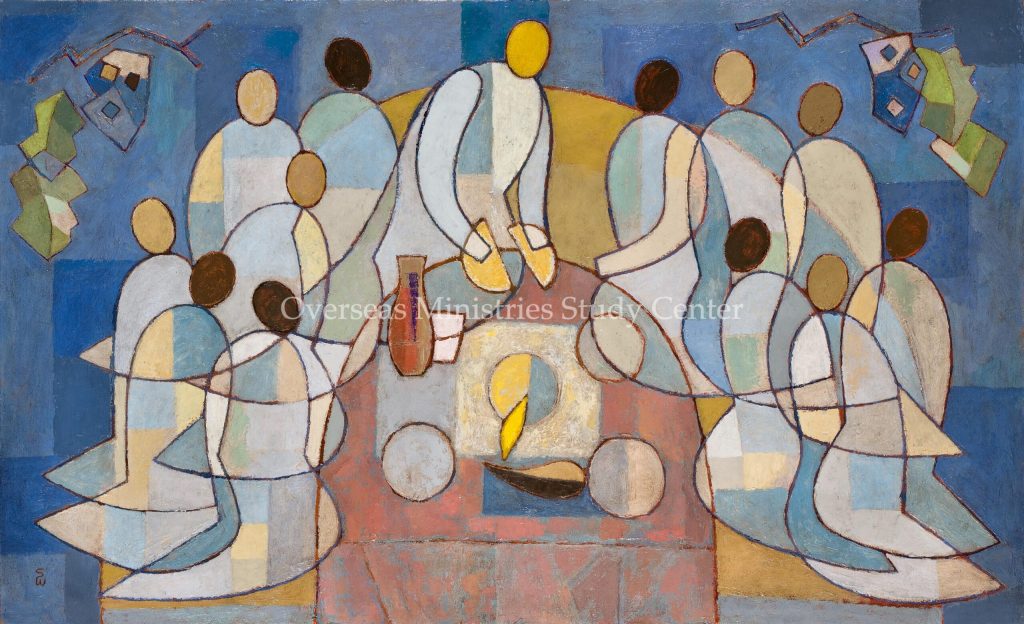
We All are One in Christ

Painting by Soichi Watanabe, used with permission by the Overseas Ministries Study Center (OMSC) at Princeton Theological Seminary. You can purchase this and many other artworks by artists in residence at the OSMC in high resolution and without a watermark via the OSMC website .

“A resident of Koshigaya City, Saitama, Japan, Soichi Watanabe was the 2008-09 OMSC artist in residence. Watanabe graduated in 1982 from the Ochanomizu Art School in Tokyo after having earned, a decade earlier, an economics degree from Tohoku Gakuin University in Sendai. He teaches at a private art school that he started in 1982. Following his 1982 graduation, Soichi founded a private art school where he and his wife work together to help others experience the joy of art.

“Soichi was drawn to God as an undergraduate student during a home Bible study when he encountered Mark 8:35: ‘Whoever wants to save his life will lose it, but whoever loses his life for me and for the gospel will save it.’ Further study of the New Testament led him to realize that he was both ‘stubborn and self-centered.’ He recalls that ‘the richness of the biblical world overwhelmed me and at the same time tortured me.’

“Shortly thereafter he chose to submit his life to God at an evening worship service. ‘I really heard a voice telling me to accept the salvation of Jesus on the cross and to follow him,’ remembers Soichi. From that point on he has been determined to serve God through his abilities. As a follower of Jesus, Soichi points to his faith as the foundation from which he works as an artist. In his art book Jesus Walking With Us (2004), he writes, ‘I realize that [my works] are my own humble responses to God’s calling in my life… . The images are often given to me through the words of God at worship services on Sundays and during my daily devotion. I have the earnest hope that I will go on painting to praise the Lord.'” (Source )

About this image, Watanabe says: “I have painted this subject twice. My first experience of this was being able to participate in the Nagel Institute Traveling Seminar in Indonesia, in June 2008, which had ‘Christianity, Contextualization, and the Visual Arts’ as its theme. I enjoyed fellowship there with Christian artists from different countries. My second experience was of being impressed with the Christian unity that exists in the OMSC community. In both cases, I experienced the unity that Christians have in Jesus.” (Source: OMSC 2010, p. 34)

Thomas Hastings, former director of the OMSC comments on this painting: “All One in Jesus. There are separate bodies, but they look so similar and they overlap. There are faces, and, differences exist between them, notably the faces are different colors, but they are also so similar in their lack of features.

“Counting the number of figures, it could be Jesus and the disciples. It could be the Last Supper and this could be Jesus. Looking at it that way we realize we all look like Jesus, or Jesus looks like each of us.

“One observation is that Watanabe minimized the particulars that can separate us from others to show we are all one people, regardless of where we come from. There is a sameness here, there is a union. We are one because all are all part of a common humanity. We are also one because we are at the table together, and the table encompasses us all. We are the body of Christ and members of one another.

“At the same time that we are one, there is also a differentiation. These are individual bodies, and faces. There is some specificity, not an undifferentiated mass. There is a spiritual reality here, of a one-ness that exists. There is a material specificity here, that individual bodies exist and the two can’t be separated.” (Source )

See other images of Soichi Watanabe.

the last supper (image).

complete verse (1 Corinthians 12:27)

Following are a number of back-translations of 1 Corinthians 12:27:

  • Uma: “Just as God made our body from many kinds of parts, so also you [emphatic] who are many he made like one-body in your connection with Kristus. We can say that each and every one of you is a part of the body of Kristus.” (Source: Uma Back Translation)
  • Yakan: “This is the meaning of what I said there: you the ones trusting in Isa Almasi are figuratively the body of Isa Almasi, and each one of you is a part of his body.” (Source: Yakan Back Translation)
  • Western Bukidnon Manobo: “And this is the meaning of all of this: as for us (incl.) believers, we are all part of the body of Christ, which is to say, it’s made up of all believers.” (Source: Western Bukidnon Manobo Back Translation)
  • Kankanaey: “The interpretation of what I’ve-been-saying is that we who believe can-be-compared to Cristo’s body, and each one of us is one part of it.” (Source: Kankanaey Back Translation)
  • Tagbanwa: “Well as for you, you are included in the body of Cristo, in which what each one of us believers is like is its parts.” (Source: Tagbanwa Back Translation)
  • Tenango Otomi: “Now concerning us, we are like Christ’s body. Each of us are the parts which make up his body.” (Source: Tenango Otomi Back Translation)

Christ, Messiah

The Greek Christos (Χρηστός) is typically transliterated when it appears together with Iésous (Ἰησοῦς) (Jesus). In English the transliteration is the Anglicized “Christ,” whereas in many other languages it is based on the Greek or Latin as “Kristus,” “Cristo,” or similar.

When used as a descriptive term in the New Testament — as it’s typically done in the gospels (with the possible exceptions of for instance John 1:17 and 17:3) — Christos is seen as the Greek translation of the Hebrew mashiaḥ (המשיח‎) (“anointed”). Accordingly, a transliteration of mashiaḥ is used, either as “Messiah” or based on the Greek or Latin as a form of “Messias.”

This transliteration is also used in the two instances where the Greek term Μεσσίας (Messias) is used in John 1:41 and 4:25.

In some languages and some translations, the term “Messiah” is supplemented with an explanation. Such as in the German Gute Nachricht with “the Messiah, the promised savior” (Wir haben den Messias gefunden, den versprochenen Retter) or in Muna with “Messiah, the Saving King” (Mesias, Omputo Fosalamatino) (source: René van den Berg).

In predominantly Muslim areas or for Bible translations for a Muslim target group, Christos is usually transliterated from the Arabic al-Masih (ٱلْمَسِيحِ) — “Messiah.” In most cases, this practice corresponds with languages that also use a form of the Arabic Isa (عيسى) for Jesus (see Jesus). There are some exceptions, though, including modern translations in Arabic which use Yasua (يَسُوعَ) (coming from the Aramaic Yēšūa’) alongside a transliteration of al-Masih, Hausa which uses Yesu but Almahisu, and some Fula languages (Adamawa Fulfulde, Nigerian Fulfulde, and Central-Eastern Niger Fulfulde) which also use a form of Iésous (Yeesu) but Almasiihu (or Almasiifu) for Christos.

In Indonesian, while most Bible translations had already used Yesus Kristus rather than Isa al Masih, three public holidays used to be described using the term Isa Al Masih. From 2024 on, the government is using Yesus Kristus in those holiday names instead (see this article in Christianity Today ).

Other solutions that are used by a number of languages include these:

  • Dobel: “The important one that God had appointed to come” (source: Jock Hughes)
  • Noongar: Keny Mammarap or “The One Man” (source: Warda-Kwabba Luke-Ang)
  • Mairasi: “King of not dying for life all mashed out infinitely” (for “mashed out,” see salvation; source: Lloyd Peckham)
  • Western Bukidnon Manobo: “One chosen by God to rule mankind” (source: Western Bukidnon Manobo Back Translation)
  • Bacama: Ma Pwa a Ngɨltən: “The one God has chosen” (source: David Frank in this blog post )
  • Binumarien: Anutuna: originally a term that was used for a man that was blessed by elders for a task by the laying on of hands (source: Desmond Oatridges, Holzhausen 1991, p. 49f.)
  • Noongar: Keny Boolanga-Yira Waangki-Koorliny: “One God is Sending” (source: Warda-Kwabba Luke-Ang)
  • Uab Meto: Neno Anan: “Son of heaven” P. Middelkoop explains: “The idea of heavenly power bestowed on a Timorese king is rendered in the title Neno Anan. It is based on the historical fact that chiefs in general came from overseas and they who come thence are believed to have come down from heaven, from the land beyond the sea, that means the sphere of God and the ghosts of the dead. The symbolical act of anointing has been made subservient to the revelation of an eternal truth and when the term Neno Anan is used as a translation thereof, it also is made subservient to a new revelation of God in Jesus Christ. The very fact that Jesus came from heaven makes this translation hit the mark.” (Source: P. Middelkoop in The Bible Translator 1953, p. 183ff. )

In Finnish Sign Language both “Christ” and “Messiah” are translated with a sign signifying “king.” (Source: Tarja Sandholm)


“Christ / Messiah” in Finnish Sign Language (source )

Law (2013, p. 97) writes about how the Ancient Greek Septuagint‘s translation of the Hebrew mashiah was used by the New Testament writers as a bridge between the Old and New Testaments (click or tap here to read more):

“Another important word in the New Testament that comes from the Septuagint is christos, ‘Christ.’ Christ is not part of the name of the man from Nazareth, as if ‘the Christs’ were written above the door of his family home. Rather, ‘Christ’ is an explicitly messianic title used by the writers of the New Testament who have learned this word from the Septuagint’s translation of the Hebrew mashiach, ‘anointed,’ which itself is often rendered in English as ‘Messiah.’ To be sure, one detects a messianic intent on the part of the Septuagint translator in some places. Amos 4:13 may have been one of these. In the Hebrew Bible, God ‘reveals his thoughts to mortals,’ but the Septuagint has ‘announcing his anointed to humans.’ A fine distinction must be made, however, between theology that was intended by the Septuagint translators and that developed by later Christian writers. In Amos 4:13 it is merely possible we have a messianic reading, but it is unquestionably the case that the New Testament writers exploit the Septuagint’s use of christos, in Amos and elsewhere, to messianic ends.”

Learn more on Bible Odyssey: Christ .

formal 2nd person plural pronoun (Japanese)

Click or tap here to see the rest of this insight.

Like a number of other East Asian languages, Japanese uses a complex system of honorifics, i.e. a system where a number of different levels of politeness are expressed in language via words, word forms or grammatical constructs. These can range from addressing someone or referring to someone with contempt (very informal) to expressing the highest level of reference (as used in addressing or referring to God) or any number of levels in-between.

One way Japanese shows different degree of politeness is through the choice of a formal plural suffix to the second person pronoun (“you” and its various forms) as shown here in the widely-used Japanese Shinkaiyaku (新改訳) Bible of 2017. In these verses, anata-gata (あなたがた) is used, combining the second person pronoun anata and the plural suffix -gata to create a formal plural pronoun (“you” [plural] in English).

(Source: S. E. Doi, see also S. E. Doi in Journal of Translation, 18/2022, p. 37ff. )

Translation commentary on 1 Corinthians 12:27

From this point on Paul explains the image of the body as referring to the church, the body of Christ. This verse takes up the thought of verse 12. For this reason and in order to make the contrast between verses 27a and 27b clearer, several translations agree with Good News Bible in expanding you to “all of you.” For example, Jerusalem Bible has “Now you together are Christ’s body…”; New Jerusalem Bible “Now Christ’s body is yourselves, each of you with a part to play in the whole.”

Are the body of Christ may be expressed as “make up Christ’s body.” The body of Christ means not “the body which is Christ” but “the body which belongs to Christ.”

An alternative translation model for this verse is:
• All of you are the body which belongs to Christ, and each one of you is a part of it.

Quoted with permission from Ellingworth, Paul and Hatton, Howard A. A Handbook on Paul’s First Letter to the Corinthians, 2nd edition. (UBS Handbook Series). New York: UBS, 1985/1994. For this and other handbooks for translators see here .

SIL Translator’s Notes on 1 Corinthians 12:27

12:27a Now you are the body of Christ,

As for you (plur.), you ⌊together⌋ form the body of Christ,
-or-
You are ⌊like⌋ the body of Christ,

12:27b and each of you is a member of it.

and every one of you (plur.) is a part of the body.
-or-
and individually you are ⌊like⌋ its limbs and organs.

© 1998, 2019, 2020, 2022, 2023 by SIL International®
Made available under the terms of a Creative Commons Attribution-ShareAlike 4.0 License (CC BY-SA) creativecommons.org/licenses/by-sa/4.0.
All Scripture quotations in this publication, unless otherwise indicated, are from The Holy Bible, Berean Standard Bible.
BSB is produced in cooperation with Bible Hub, Discovery Bible, OpenBible.com, and the Berean Bible Translation Committee.