In Gbaya, the notion sweeping something away is emphasized in Psalm 58:9 with hótóŋ, an ideophone that expresses the idea of emptying something completely.
Ideophones are a class of sound symbolic words expressing human sensation that are used as literary devices in many African languages. (Source: Philip Noss)
In the fable of the trees in Judges 9:14, all the trees come to ‘atad (in English Bible translations: thornbush or bramble) and ask it to become their king. Most scholars have generally agreed that this is probably a reference to the Boxthorn Lycium europaeum. Zohary (Plants of the Bible, Cambridge University Press, 1982) holds that it is more likely the Christ Thorn Ziziphus spina-christi. Both are thorny trees that are plentiful in the Near East, especially near Samaria in northern Israel, where Jotham, the teller of the fable, lived. The name “Christ thorn” (French couronne-du-Christ) reflects the tradition that this tree must also have been the source of the thorns that are referred to in the account of Christ’s crucifixion. The topic is widely debated, and there is little to confirm whether the “crown of thorns” came from this tree, or from one of many other prickly plants such as the thorny burnet, which is more common in the Jerusalem area. We advocate the majority opinion here, which is boxthorn (French lycie d’Europe).
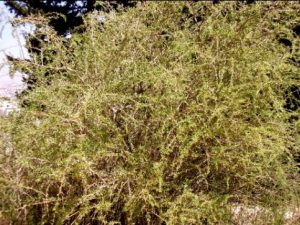
The boxthorn tree grows to 5 meters (17 feet) tall, has small leaves forming an oval crown, and has very sharp thorns. The yellowish green flowers give way to edible fruits about the size of grapes or cherries.
The word associations in Jotham’s fable are by no means clear, but he appears to use the ’atad as a tree that is neither attractive nor very useful. Indeed, its fruit is barely edible, and it does not produce usable wood, or even effective shade, since the leaves are fairly small and sparse. The ’atad is thorny, but whether that is significant in the fable is not clear. If the tree represents Abimelech (see Abimelech’s downfall), most readers would probably agree that he was a thorny character.
Jotham’s fable, being an allegory, allows the option for translators to substitute rhetorically equivalent species for the olive, fig, grapevine, and boxthorn. However, there may be no single word for “boxthorn” in the receptor language, so translators will end up using a generic phrase like “thorn tree” or substituting a thorny local tree or shrub, probably the most common one in their area. A common problem is that languages often do not have names for plants that are not useful. If transliterations are needed, ‘atad can be used from Hebrew, or translators can use a transliteration from a major language for a related type of tree.
Boxthorn, photo by Ray PritzBoxthorn branch, photo by Ray Pritz
Following are a number of back-translations as well as a sample translation for translators of Psalm 58:9:
Chichewa Contempary Chichewa translation, 2002/2016:
“Before your pots catch fire of the bramble thorns,
whether it is green or dry, the wicked will be removed.” (Source: Mawu a Mulungu mu Chichewa Chalero Back Translation)
Newari:
“Before a pot put on a fire of thorns to cook becomes hot
He will blow the wicked away, whether they be green or dry.” (Source: Newari Back Translation)
Hiligaynon:
“Destroy them, young or old. Destroy them who (are) swifter than the heating of a clay-pot which is-set-ablaze with bush-branches.” (Source: Hiligaynon Back Translation)
Laarim:
“God will sweep all of them outside.
quickly like pot which is boil in a big fire.” (Source: Laarim Back Translation)
Nyakyusa-Ngonde (back-translation into Swahili):
“Vyungu vyenu wakati havijaungua katika moto wa miiba,
watenda dhambi watafagiliwa mbali.
vijana na wazee wote kwa pamoja.” (Source: Nyakyusa Back Translation)
English:
“Get rid of them
as fast as thornbushes are blown away after they are cut (OR, as fast as a fire heats a pot over burning thorns).” (Source: Translation for Translators)
Translators of different languages have found different ways with what kind of formality God is addressed.
Like many languages (but unlike Greek or Hebrew or modern English), Tuvan uses a formal vs. informal 2nd person pronoun (a familiar vs. a respectful “you”). Unlike other languages that have this feature, however, the translators of the Tuvan Bible have attempted to be very consistent in using the different forms of address in every case a 2nd person pronoun has to be used in the translation of the biblical text.
As Voinov shows in Pronominal Theology in Translating the Gospels (in: The Bible Translator2002, p. 210ff. ), the choice to use either of the pronouns many times involved theological judgment. While the formal pronoun can signal personal distance or a social/power distance between the speaker and addressee, the informal pronoun can indicate familiarity or social/power equality between speaker and addressee.
In these verses, in which humans address God, the informal, familiar pronoun is used that communicates closeness.
Voinov notes that “in the Tuvan Bible, God is only addressed with the informal pronoun. No exceptions. An interesting thing about this is that I’ve heard new Tuvan believers praying with the formal form to God until they are corrected by other Christians who tell them that God is close to us so we should address him with the informal pronoun. As a result, the informal pronoun is the only one that is used in praying to God among the Tuvan church.”
In Gbaya, “a superior, whether father, uncle, or older brother, mother, aunt, or older sister, president, governor, or chief, is never addressed in the singular unless the speaker intends a deliberate insult. When addressing the superior face to face, the second person plural pronoun ɛ́nɛ́ or ‘you (pl.)’ is used, similar to the French usage of vous.
Accordingly, the translators of the current version of the Gbaya Bible chose to use the plural ɛ́nɛ́ to address God. There are a few exceptions. In Psalms 86:8, 97:9, and 138:1, God is addressed alongside other “gods,” and here the third person pronoun o is used to avoid confusion about who is being addressed. In several New Testament passages (Matthew 21:23, 26:68, 27:40, Mark 11:28, Luke 20:2, 23:37, as well as in Jesus’ interaction with Pilate and Jesus’ interaction with the Samaritan woman at the well) the less courteous form for Jesus is used to indicate ignorance of his position or mocking.” (Source Philip Noss)
In the most recent Manchu translation of 1835 (a revision of an earlier edition from 1822), God is never addressed with a pronoun but with “father” (ama /ᠠᠮᠠ) instead. Chengcheng Liu (in this post on the Cambridge Centre for Chinese Theology blog ) explains: “In Manchu tradition, as in Chinese etiquette, second-person pronouns could be considered disrespectful when speaking to superiors or spiritual beings. Manchu Shamanist prayers avoided si [‘you’] and sini [‘your’] for this very reason. To use them for God would be, in Lipovzoff’s [one of the two translators] words, ‘the most uncouth and indecent way to speak to the Almighty — as if He were a servant or slave.’ There was also a grammatical problem. In Manchu, si and sini could refer to both singular and plural subjects. For a faith that insisted on the singularity of God, this was potentially confusing. By contrast, repeating ama removed any ambiguity.”
Click or tap here to see the rest of this insight.
Like a number of other East Asian languages, Japanese uses a complex system of honorifics, i.e. a system where a number of different levels of politeness are expressed in language via words, word forms or grammatical constructs. These can range from addressing someone or referring to someone with contempt (very informal) to expressing the highest level of reference (as used in addressing or referring to God) or any number of levels in-between. One way Japanese shows different degree of politeness is through the choice of a second person pronoun (“you” and its various forms) as shown here in the widely-used Japanese Shinkaiyaku (新改訳) Bible of 2017. The most commonly used anata (あなた) is typically used when the speaker is humbly addressing another person.
In these verses, however, omae (おまえ) is used, a cruder second person pronoun, that Jesus for instance chooses when chiding his disciples. (Source: S. E. Doi, see also S. E. Doi in Journal of Translation, 18/2022, p. 37ff. )
Click or tap here to see the rest of this insight.
Like a number of other East Asian languages, Japanese uses a complex system of honorifics, i.e. a system where a number of different levels of politeness are expressed in language via words, word forms or grammatical constructs. These can range from addressing someone or referring to someone with contempt (very informal) to expressing the highest level of reference (as used in addressing or referring to God) or any number of levels in-between.
One way Japanese shows different degree of politeness is through the usage of an honorific construction where the morpheme are (され) is affixed on the verb as shown here in the widely-used Japanese Shinkaiyaku (新改訳) Bible of 2017. This is particularly done with verbs that have God as the agent to show a deep sense of reverence. Here, fukiharaw-are-ru (吹き払われる) or “blow away” is used.
The two similes in verse 8 are also reasonably clear, but it should be noted: (1) Snail translates a word found only here in the Old Testament; some take it to mean “beeswax,” and others “worm.” G. R. Driver takes the word to be synonymous with “abortion” in line b (see New English Bible “like an abortive birth which melts away”); most translate as do Good News Translation and Revised Standard Version. It seems that it was thought, from the trail of slime left by a snail, that the snail gradually dissolves, and finally there is nothing left but the empty snail shell. (2) The verb translated dissolves also occurs only here in the Old Testament, but its meaning is reasonably certain.
The simile in verse 8b is clear enough; see Job 3.16; Ecclesiastes 6.3 for the same figure. The untimely birth: a more normal way in English to say this would be either “a stillborn child” or “an aborted fetus.”
The difficulty, not to say the impossibility, of translating verse 9 can be demonstrated by the fact that Dahood does not provide a translation of it and confesses: “The Hebrew of this verse is unintelligible to me.” He rightly scores Revised Standard Version for not giving any indication of the impossibility of making sense of the Masoretic text. It would be of little practical use to list the many ways in which the text has been handled. No two translations agree completely, and all (including even New International Version) have textual footnotes. Whatever course a translator takes, a note should indicate that the Hebrew makes little sense. Notice how two translations in English have rendered the same Hebrew text: New Jerusalem Bible “Before the thorns grow into a bramble, may He whirl them away alive in fury”; New English Bible “All unawares, may they be rooted up like a thorn-bush, like weeds which a man angrily clears away!”; and one other suggested version, “Before their pots feel the heat of the thorns, whether green or dry, may God sweep them away.”8-9 Hebrew Old Testament Text Project (“A” decision) says the Masoretic text is difficult and can be interpreted in two ways: (1) “before your kettles were aware of the thorn, the stormwind wipes away, be it green or dry!”; (2) “before your thorns rise to a bush: while it is (still) green, the stormwind wipes it away (as if it were) dried!”
Good News Translation translates an emended text which mostly follows G. R. Driver’s reconstruction in “Studies in the Vocabulary of the O.T. V,” Journal of Theological Studies 34 (1933), page 44; see also Anderson.
Quoted with permission from Bratcher, Robert G. and Reyburn, William D. A Handbook on the Book of Psalms. (UBS Helps for Translators). New York: UBS, 1991. For this and other handbooks for translators see here .


Leave a Reply
You must be logged in to post a comment.