
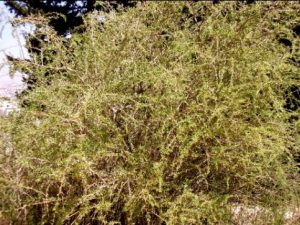
In the fable of the trees in Judges 9:14, all the trees come to ‘atad (in English Bible translations: thornbush or bramble) and ask it to become their king. Most scholars have generally agreed that this is probably a reference to the Boxthorn Lycium europaeum. Zohary (Plants of the Bible, Cambridge University Press, 1982) holds that it is more likely the Christ Thorn Ziziphus spina-christi. Both are thorny trees that are plentiful in the Near East, especially near Samaria in northern Israel, where Jotham, the teller of the fable, lived. The name “Christ thorn” (French couronne-du-Christ) reflects the tradition that this tree must also have been the source of the thorns that are referred to in the account of Christ’s crucifixion. The topic is widely debated, and there is little to confirm whether the “crown of thorns” came from this tree, or from one of many other prickly plants such as the thorny burnet, which is more common in the Jerusalem area. We advocate the majority opinion here, which is boxthorn (French lycie d’Europe).
The boxthorn tree grows to 5 meters (17 feet) tall, has small leaves forming an oval crown, and has very sharp thorns. The yellowish green flowers give way to edible fruits about the size of grapes or cherries.
The word associations in Jotham’s fable are by no means clear, but he appears to use the ’atad as a tree that is neither attractive nor very useful. Indeed, its fruit is barely edible, and it does not produce usable wood, or even effective shade, since the leaves are fairly small and sparse. The ’atad is thorny, but whether that is significant in the fable is not clear. If the tree represents Abimelech (see Abimelech’s downfall), most readers would probably agree that he was a thorny character.
Jotham’s fable, being an allegory, allows the option for translators to substitute rhetorically equivalent species for the olive, fig, grapevine, and boxthorn. However, there may be no single word for “boxthorn” in the receptor language, so translators will end up using a generic phrase like “thorn tree” or substituting a thorny local tree or shrub, probably the most common one in their area. A common problem is that languages often do not have names for plants that are not useful. If transliterations are needed, ‘atad can be used from Hebrew, or translators can use a transliteration from a major language for a related type of tree.

Source: Each According to its Kind: Plants and Trees in the Bible (UBS Helps for Translators)