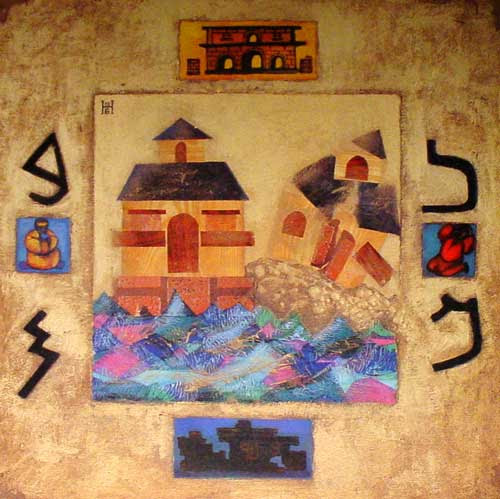
The now commonly-used German idiom auf Sand gebaut (literally “built on sand”), meaning “built on shifting sand” or “make bricks without straw,” was first coined in 1522 in the German New Testament translation by Martin Luther.
The French expression “bâtir sur le sable” with the same meaning is also commonly-used today and originates in French Bible translation. (Source: Günther 2017, p. 104)
For other idioms or terms in German that were coined by Bible translation, see here.
Fuyug houses are built with poles which cannot be put into rock, so in this passage the Fuyug translation for the term that is “rock” in English becomes “firm ground” and “sand” becomes “soft ground.” (Source: David Clark)
Likewise, and for the same reason, the wise man builds his house in Manam on “firm ground” as well. (Source: Blaine Turner in Holzhausen 1991, p. 47)
Since speakers of Karakalpak do indeed build their houses on sand, the translators had to find a slightly different solution to not imply that the Karakalpaks themselves are foolish. They ended up choosing shege qum, the term for loose yellow sand along river banks, since this indeed is a kind of sand Karakalpaks would not build their houses on. (Source: Holzhausen / Riderer 2010, p. 57)
The parable of the wise builder is translated in Yaosakor Asmat as “the wise builder is like the person who builds a house on stilts made of iron wood which last a long time, while the foolish builder is the one who builds a house on stilts made of white wood which will rot quickly.”
Daud Soesilio (in Noss 2007, p. 175) explains: “In Pirimapun, a swampy area on the southern coast of Indonesian Papua, the parable of the wise builder who builds on stone foundation and the foolish builder who builds on sand was rendered into the Asmat language as ‘the wise builder is like the person who builds a house on stilts made of iron wood which last a long time, while the foolish builder is the one who builds a house on stilts made of white wood which will rot quickly.’ This adaptation is necessary since one cannot find a single stone in this swampy area, and all houses are built on stilts. They use iron wood stilts for their more permanent houses, and they only use white wood stilts for the temporary houses that they use when they go hunting. White wood will not last. It is also interesting to point out that they use sand from the beach to make their walking paths firm.”
Following are a number of back-translations of Matthew 7:26:
Uma: “‘But the person who hears my words and does not follow them, that person is like the foolish person who builds his house on top of sand.” (Source: Uma Back Translation)
Yakan: “And whoever hears those my words but does not follow/obey them, he is like a stupid man who built his house on sand.” (Source: Yakan Back Translation)
Western Bukidnon Manobo: “And whoever hears these advices of mine and he doesn’t carry them out, he is like a stupid person. This stupid person, he built on a sandy bank.” (Source: Western Bukidnon Manobo Back Translation)
Kankanaey: “But the person who has been hearing what I am saying but he doesn’t believe/obey it, he can-be-illustrated by a foolish person who built his house on the sand/gravel.” (Source: Kankanaey Back Translation)
Tagbanwa: “But the person who, although he hears this teaching of mine, doesn’t obey it, he is like a stupid/simple-minded person, who jerry-built his house on the sand and didn’t put-posts-down-deep.” (Source: Tagbanwa Back Translation)
Tenango Otomi: “But concerning the person who hears all that I speak and does not do what I say, such a one is to be compared with a man who didn’t have any sense. He built a house on where it was sandy.” (Source: Tenango Otomi Back Translation)
Click or tap here to see the rest of this insight.
Like a number of other East Asian languages, Japanese uses a complex system of honorifics, i.e. a system where a number of different levels of politeness are expressed in language via words, word forms or grammatical constructs. These can range from addressing someone or referring to someone with contempt (very informal) to expressing the highest level of reference (as used in addressing or referring to God) or any number of levels in-between.
One way Japanese shows different degree of politeness is through the choice of a first person singular and plural pronoun (“I” and “we” and its various forms) as shown here in the widely-used Japanese Shinkaiyaku (新改訳) Bible of 2017. The most commonly used watashi/watakushi (私) is typically used when the speaker is humble and asking for help. In these verses, where God / Jesus is referring to himself, watashi is also used but instead of the kanji writing system (私) the syllabary hiragana (わたし) is used to distinguish God from others.
Barclay Newman, a translator on the teams for both the Good News Bible and the Contemporary English Version, translated passages of the New Testament into English and published them in 2014, “in a publication brief enough to be non-threatening, yet long enough to be taken seriously, and interesting enough to appeal to believers and un-believers alike.” The following is the translation of Matthew 7:24-29:
If you obey my teachings, you’re wise —
you’ve built your house on solid rock.
Neither drenching rains, nor floods, nor hurricanes
can shake that house from its solid foundation.
If you disobey my teachings, you’re foolish —
you’ve built your house on shifting sands.
Drenching rains, floods, or hurricanes can shake that house,
and it will collapse with a loud crash.
Jesus surprised everyone by teaching with such authority
as they had never witnessed before —
not even from the most renowned biblical scholars!
Every one can be rendered “anyone,” “whoever,” or “those people who.”
The phrase hears these words of mine and does not do them will be like is similar to verse 24 except for the negative does not do them.
The Greek word translated foolish man was first used in 5.22. It is also used in 23.17 and in 25.2, 3, 8. See 5.22 for a discussion of the word. Here it can be “stupid person” or “person who has no sense.”
Upon the sand would be more natural for English speakers without the use of the definite article the, which is found in Greek. Good News Translation, New Jerusalem Bible, and New English Bible omit the article, and New American Bible has “on sandy ground.” See comment on “the rock” in verse 24.
As with “on the rock,” upon the sand will pose a problem for people who do in fact build houses on sand. They may have to say “on top of sand so it was not strong” or “on sand with the result that nothing could give it strength.”
Quoted with permission from Newman, Barclay M. and Stine, Philip C. A Handbook on the Gospel of Matthew. (UBS Handbook Series). New York: UBS, 1988. For this and other handbooks for translators see here .

Leave a Reply
You must be logged in to post a comment.