
“Wind” is translated in Mekeo as the local northwest wind that blows between Christmas and Easter.
parable of the wise builder
The parable of the wise builder is translated in Yaosakor Asmat as “the wise builder is like the person who builds a house on stilts made of iron wood which last a long time, while the foolish builder is the one who builds a house on stilts made of white wood which will rot quickly.”
Daud Soesilio (in Noss 2007, p. 175) explains: “In Pirimapun, a swampy area on the southern coast of Indonesian Papua, the parable of the wise builder who builds on stone foundation and the foolish builder who builds on sand was rendered into the Asmat language as ‘the wise builder is like the person who builds a house on stilts made of iron wood which last a long time, while the foolish builder is the one who builds a house on stilts made of white wood which will rot quickly.’ This adaptation is necessary since one cannot find a single stone in this swampy area, and all houses are built on stilts. They use iron wood stilts for their more permanent houses, and they only use white wood stilts for the temporary houses that they use when they go hunting. White wood will not last. It is also interesting to point out that they use sand from the beach to make their walking paths firm.”
The Two House Builders
The following artwork is part of a series of 56 paintings on biblical themes by Kazakh artist Nelly Bube (born 1949):
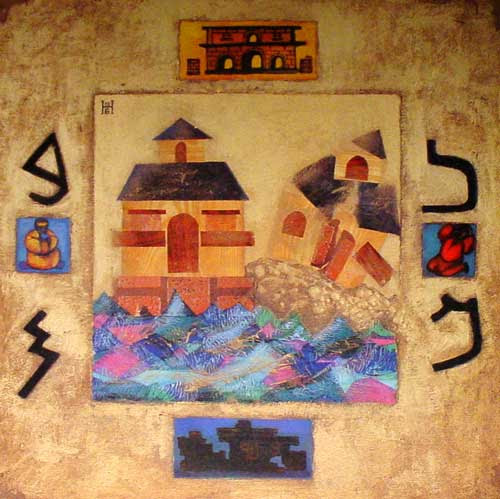
Copyright by Norwegian Bible Society , used with permission.
For other images of Nelly Bube in TIPs, see here.
complete verse (Matthew 7:25)
Following are a number of back-translations of Matthew 7:25:
- Uma: “When rain came, it flooded and wind struck that house, but it did not fall, because it was build on top of strong stones.” (Source: Uma Back Translation)
- Yakan: “So-then the rain came and the river flooded and the house was hit by a very strong wind. But the house did not fall because it was built on stone/rock.” (Source: Yakan Back Translation)
- Western Bukidnon Manobo: “And there was a typhoon. It rained hard; the rivers got deep, and the wind blew hard. But that house didn’t fall down because it was placed on a large stone.” (Source: Western Bukidnon Manobo Back Translation)
- Kankanaey: “Then it rained-hard and the water in the river increased. The wind that struck-against the house was also strong, but (reassurance-particle) it didn’t fall-over, because its foundation was constructed on the rock.” (Source: Kankanaey Back Translation)
- Tagbanwa: “When bad weather came, that there was really big flooding, and a strong wind blew right by the house, no harm came to it, because he had put the posts down deep there where there were rocks.” (Source: Tagbanwa Back Translation)
- Tenango Otomi: “Then when there was the rain, the river rose, the wind pushed against the house. Yet it didn’t fall down because it was on rock that the house was guilt.” (Source: Tenango Otomi Back Translation)
Scriptures Plain & Simple (Matthew 7:24-29)
Barclay Newman, a translator on the teams for both the Good News Bible and the Contemporary English Version, translated passages of the New Testament into English and published them in 2014, “in a publication brief enough to be non-threatening, yet long enough to be taken seriously, and interesting enough to appeal to believers and un-believers alike.” The following is the translation of Matthew 7:24-29:
If you obey my teachings, you’re wise —
you’ve built your house on solid rock.
Neither drenching rains, nor floods, nor hurricanes
can shake that house from its solid foundation.
If you disobey my teachings, you’re foolish —
you’ve built your house on shifting sands.
Drenching rains, floods, or hurricanes can shake that house,
and it will collapse with a loud crash.
Jesus surprised everyone by teaching with such authority
as they had never witnessed before —
not even from the most renowned biblical scholars!
Sung version of Matthew 7
Translation commentary on Matthew 7:25
Some languages would not say that the rain fell, but rather “it rained” or “the rain came.”
As for floods, it is often necessary to specify what was flooding, as in “the rivers flooded over.” Other translations can say “the flood waters rose up.”
The Greek verb rendered beat upon is different from the one translated “beat against” in verse 27. The verb used here literally means “fall against,” while the one in verse 27 literally means “strike against.” It is difficult to tell which, if either, of the two verbs is intended to be stronger than the other. Commentators do not agree, and no clues are given in the lexicons. Some translations do not distinguish between the two renderings, while others do. New Jerusalem Bible reads “gales blew and hurled themselves against that house … gales blew and struck that house.” Barclay translates “and the winds blew and battered that house … and the winds blew and buffeted that house.” New American Bible renders the verb in verse 27 “the winds blew and lashed against his house,” while translating the first part of verse 25 “When the rainy season set in, the torrents came and the winds blew and buffeted his house.” Die Bibel im heutigen Deutsch, which gives the same rendering in each verse, has “Then, when there is a cloudburst, rivers overflow their banks, and the storm rages and shakes the house….”
The phrase the winds blew and beat upon that house can be expressed “there were strong winds that blew against the house” or “strong winds came against that house.”
But it did not fall, except for the negative, appears in the same form in verse 27. The normal word that is used for a building collapsing should be used here.
The translation of founded on the rock will depend on how verse 24 was handled. It may be necessary to say “because the rock on which it was built gave it strength (or, made it strong).”
Quoted with permission from Newman, Barclay M. and Stine, Philip C. A Handbook on the Gospel of Matthew. (UBS Handbook Series). New York: UBS, 1988. For this and other handbooks for translators see here .
SIL Translator’s Notes on Matthew 7:25
7:25a
The rain fell: In this context, the clause The rain fell refers to a heavy rain. It is the type of rain that could damage a house.
the torrents raged: The expression the torrents raged refers to so much water in the rivers that the water overflows the banks of the rivers.
Here are some other ways to translate this clause:
the streams rose (New International Version)
-or-
the rivers flooded over (Good News Translation)
7:25b
the winds blew: The phrase the winds blew means that they blew strongly. They were the type of winds that could damage a house.
The word for winds is plural in Greek. But in some languages, it is more natural to translate this as a singular noun and verb. For example:
the wind blew
-or-
a strong wind came
beat against that house: The words beat against that house refer to another thing that the winds did.
In some languages, the verb “beat” is something that only a human, animal, or supernatural spirit could do. If that is true in your language, then you may want to use a different word. For example:
the wind blew hard against that house (Good News Translation)
7:25c
yet it did not fall: The verb fall here means “fall down,” or “collapse.” In spite of the rain, flood, and wind, the house was not ruined.
Here are some other ways to translate this verb:
did not fall down/over
-or-
did not collapse
-or-
was not destroyed
because its foundation was on the rock: The Greek verb that the Berean Standard Bible translates as was on the rock means “was firmly established” or “was built.” This verb refers to the base or lowest part of the house being placed on bedrock. So the house’s foundation was strong.
The clause is passive. Here are some other ways to translate this:
• Use a passive verb. For example:
it was built on solid rock (Contemporary English Version)
-or-
it was built strongly
• Use an active verb. It was the wise man who built his house on the rock. For example:
he built it on the rock
-or-
he built it strongly
• Change the verb to a noun. For example:
it had its foundation on the rock (New International Version)
rock: The Greek word that the Berean Standard Bible translates as rock means “bedrock.” It does not refer to loose stones on top of the ground. It refers to a solid rock mass or layer under the surface of the ground.
© 2023 by SIL International®
Made available under the terms of a Creative Commons Attribution-ShareAlike 4.0 License (CC BY-SA) creativecommons.org/licenses/by-sa/4.0.
All Scripture quotations in this publication, unless otherwise indicated, are from The Holy Bible, Berean Standard Bible.
BSB is produced in cooperation with Bible Hub, Discovery Bible, OpenBible.com, and the Berean Bible Translation Committee.
Leave a Reply
You must be logged in to post a comment.