
The Greek in Matthew 2:12 that is translated as “warned in a dream” or similar in English is translated in the German New Testament translation by Berger / Nord (publ. 1999) with im Traum eine himmlische Weisung erhielt or “received a heavenly directive in a dream.”
formal pronoun: Jesus addressing his disciples and common people
Like many languages (but unlike Greek or Hebrew or English), Tuvan uses a formal vs. informal 2nd person pronoun (a familiar vs. a respectful “you”). Unlike other languages that have this feature, however, the translators of the Tuvan Bible have attempted to be very consistent in using the different forms of address in every case a 2nd person pronoun has to be used in the translation of the biblical text.
As Voinov shows in Pronominal Theology in Translating the Gospels (in: The Bible Translator 2002, p. 210ff. ), the choice to use either of the pronouns many times involved theological judgment. While the formal pronoun can signal personal distance or a social/power distance between the speaker and addressee, the informal pronoun can indicate familiarity or social/power equality between speaker and addressee.
Here, Jesus is addressing his disciples, individuals and/or crowds with the formal pronoun, showing respect.
In Nepali translations, Jesus addresses his disciples and other people with the medium honorific pronoun timīlē (तिमीले) or timīlēharū (तिमीलेहरू). His disciples respond with a high honorific pronoun. (Source: Chitra Chhetri in The Bible Translator 2009, p. 73ff. )
In most Dutch translations, Jesus addresses his disciples and common people with the informal pronoun, whereas they address him with the formal form.
The Magi's Dream

Hand colored stencil print on momigami by Sadao Watanabe (1979).
Image taken with permission from the SadaoHanga Catalogue where you can find many more images and information about Sadao Watanabe. For other images of Sadao Watanabe art works in TIPs, see here.
The following is a 1933 stained glass window by J. Le Breton and the glass studio of Gaudin, Paris from the Cathédrale d’Amiens in Amiens, France:
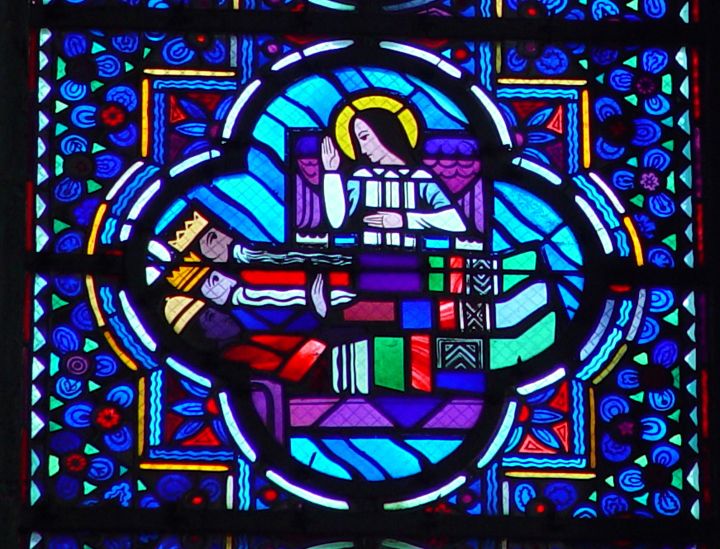
Source: Art in the Christian Tradition , a project of the Vanderbilt University Divinity Library, Nashville, TN. Original source: image donated by Jim Womack and Anne Richardson
Stained glass is not just highly decorative, it’s a medium which has been used to express important religious messages for centuries. Literacy was not widespread in the medieval and Renaissance periods and the Church used stained glass and other artworks to teach the central beliefs of Christianity. In Gothic churches, the windows were filled with extensive narrative scenes in stained glass — like huge and colorful picture storybooks — in which worshipers could ‘read’ the stories of Christ and the saints and learn what was required for their religious salvation. (Source: Victoria and Albert Museum )
complete verse (Matthew 2:12)
Following are a number of back-translations of Matthew 2:12:
- Uma: “After that, God spoke to them in their dreams, he told them: ‘Don’t return to Herodes!’ So, on their return, they no longer went through Yerusalem, they avoided it going on another road.” (Source: Uma Back Translation)
- Yakan: “After this they were told by God in their dream, not to go back to Herod. So-then they returned home, following a different road.” (Source: Yakan Back Translation)
- Western Bukidnon Manobo: “God caused them to understand by means of a dream that they should not return to Herod. And because of this they did not retrace the way they came as they went home.” (Source: Western Bukidnon Manobo Back Translation)
- Kankanaey: “So then, God caused-them -to-dream, and he instructed them that they not return to Herod, so they walked-by-a-different -route to go-home to their country.” (Source: Kankanaey Back Translation)
- Tagbanwa: “When they were to go home now, that night they were caused to dream by God who said that they weren’t to stop-by Herodes. That’s why they went on a different trail when they went home.” (Source: Tagbanwa Back Translation)
- Tenango Otomi: “After this, while these men were sleeping, God showed them that when they returned home, they must not go to where Herod was. Rather they returned by another road.” (Source: Tenango Otomi Back Translation)
Scriptures Plain & Simple (Matthew 2:1-12)
Barclay Newman, a translator on the teams for both the Good News Bible and the Contemporary English Version, translated passages of the New Testament into English and published them in 2014, “in a publication brief enough to be non-threatening, yet long enough to be taken seriously, and interesting enough to appeal to believers and un-believers alike.” The following is the translation of Matthew 2:1-12:
They came from the east when Herod was king in Judea.
They were authorities themselves, authorities about stars, and they asked in Jerusalem,
“Where is the child born to be king of your nation?
In the east we saw the star that signaled his birth,
and we have come to worship him.”
This news worried King Herod and everyone else in town.
So Herod called together the religious authorities and asked,
“Where is this new king supposed to be born?”
They replied, “In Bethlehem, just as the prophet wrote:
‘Bethlehem — so important in Judea—from you will come
One with absolute authority over God’s flock.’”
Herod was sly, and after he had sent for the star-authorities,
he said, “Go to Bethlehem and return with all the details,
so I can worship this new king.”
The eastern authorities followed the star
until it had settled over the child’s home —
they were overwhelmed with joy…
When they entered the house,
they saw him with Mary his mother.
So they knelt down and worshiped the child,
placing at his feet the treasures they had brought.
Later — after being warned in a dream –
they returned home by a different route.
donkey
The Hebrew, Ge’ez, and Greek that is translated as “donkey” in English was translated in the 1900 Kalaallisut (Greenlandic) translation (a newer version was published in 2000) as siutitôĸ or “‘something with big ears.” “[This] is based on the word siut ‘ear’ combined with the same suffix –tôĸ (-tooq).” (Source: Lily Kahn & Riitta-Liisa Valijärvi in The Bible Translator 2019, p. 125ff.)
These Hebrew and Greek words (with the exception of pōlos and hupozugion — see discussion below) all definitely refer to the Domestic Donkey equus asinus. However the different words do have slight semantic differences among them.
Chamor and onos are the generic words for donkey while ’athon (feminine gender) refers specifically to a saddle donkey or a donkey used for riding. A saddle donkey is usually a large strong female donkey the males are too difficult to control when they are near a female in heat. The Hebrew word is derived from a root that means “strong”.
‘Ayir refers to the young male or jack donkey (probably with an emphasis on its liveliness and the difficulty in controlling it since the Hebrew root means something like “frisky”).
Onarion means a young donkey of either sex. Some languages will have a special word for a young donkey. This will be appropriate for translating onarion.
The word hupozugion often translated “donkey,” actually indicates any beast of burden. Walter Bauer, the famous German New Testament scholar, has argued very convincingly that the animal referred to in Matthew 21:5 in the expression epi pōlon huion hupozugiou is the foal of a horse not a donkey (1953:220-229). In some languages it will be possible to express this in a way that does not designate a specific species of animal`, as in “beast of burden.”
Pōlos usually refers to a foal, that is a young horse, unless a word for donkey follows.
Donkeys are domestic animals belonging to the same family as the horse, but they are smaller and have longer ears. The donkey bred and used in the Middle East is the domesticated Nubian or Somali Wild Ass Equus Asinus africanus. In its original wild state this was a gray ass with pale, whitish belly and dark rings on the lower part of the legs. It was domesticated in Egypt as early as 2500 B.C. In its domesticated version, as a result of interbreeding with donkeys from Europe and Persia, the donkey came to be a variety of colors from dark brown, through light brown to the original gray and occasionally white. The Hebrew chamor comes from a root meaning “reddish brown.”
Donkeys are good pack animals being able to carry as much as the larger mule without the latter’s unpredictable moods. They also have great stamina and are easy to feed since they eat almost any available vegetation. Larger individual animals (usually females) are also often used for riding.
Donkeys were highly prized in biblical times especially females since they were suitable for packing and riding and had the potential for producing offspring. Donkeys were seen as man’s best friend in the animal kingdom. They were the common man’s means of transport and many ordinary families owned a donkey. They were used for plowing and for turning large millstones as well as a means of transport.
Today domestic donkeys are found all over savannah Africa the Middle East South and Central Asia Europe Latin America and Australia. They do not seem to be reared in rain forest or monsoon areas but they are nevertheless often known in these areas.
A donkey was considered to be a basic domestic requirement and thus the number of donkeys available was a means of measuring the relative prosperity of a society at any given time. While only powerful political or military people rode horses (which were usually owned by the state) the common people rode donkeys. This is the significance of the passage in Zechariah 9:9: the victorious king would return to the city riding a donkey thus identifying himself as a common Israelite rather than a victorious warlord.
In the majority of languages there is a local or a borrowed word for donkey. This is the obvious choice. In areas of Southeast Asia, Papua New Guinea, West Africa, and other places, where donkeys are rare or unknown, the word from the dominant major language or trade language (for example, English, Spanish, French, Chinese, or Arabic) is often transliterated.
In most contexts ’athon should be translated by the equivalent of “female” donkey, but in some contexts riding donkey is better.
‘Ayir should be translated according to the specific context. In Genesis 32:15 the translation should definitely be the equivalent of “male donkey”, and probably also in Judges 10:4 and Judges 12:14. The significance of these latter passages is that female donkeys were the more normal choice of mount.
In Job 11:12 the emphasis is probably on the friskiness of the donkey, and the translation should be the equivalent of “He ties his young donkey to a grapevine, his frisky young ass to the best of the vines” (indicating a certain amount of irresponsibility, and perhaps extravagance).
In Job 11:12 and Zechariah 9:9 the obvious emphasis is on the youth of the donkey, so the equivalent of “colt”, “foal”, “young donkey”, and so on should be used.


Source: All Creatures Great and Small: Living things in the Bible (UBS Helps for Translators)
See also young donkey and wild ass.
Translation commentary on Matthew 2:12
Good News Bible reverses the order of the two clauses as they appear in the Greek text (compare Revised Standard Version and Good News Translation), thereby destroying the chronological sequence. For most languages the Greek order, retained by Revised Standard Version, will be more natural.
Being warned translates one word in Greek; Good News Translation restructures as an active, indicating subject and indirect object: “since God had warned them.” This is legitimate, since the Greek verb refers specifically to a revelation which originates from God, and several other translations also make this information explicit (Moffatt “they had been divinely warned”; Barclay “because a message from God came to them … warning them”; Die Bibel im heutigen Deutsch “God commanded them”). This verb is used once again in verse 22, but nowhere else in the Gospel.
Being warned will be expressed in some languages with indirect speech, as in “God told them in a dream they should not go back to Herod.” But others will use direct speech: “God spoke to them while they dreamed, and said, ‘You should not go back to Herod.’ ”
In a dream is the same expression used in 1.20. Here some possibilities are “God appeared to them in a dream,” “God gave them a dream and said to them…,” or “God showed himself to them while they slept and warned them….” Others will have “God warned them … Therefore (or, As a result) they departed.”
The verb translated return is rare in the New Testament; other than here it occurs only in Luke 10.6; Acts 18.21; and Hebrews 11.15; it is also found in some manuscripts in 2 Peter 2.21. It can be translated “go back to” or perhaps “go back to see.”
For departed to their own country, translators can say “they went back,” or “they went to their own country,” or “they left there to go to their own country.”
Their own country can be “the region where they lived.”
Another way means a route or road different from the one by which they had come from their country: “They took a different road” or “They followed a road they had not taken when they came.”
Quoted with permission from Newman, Barclay M. and Stine, Philip C. A Handbook on the Gospel of Matthew. (UBS Handbook Series). New York: UBS, 1988. For this and other handbooks for translators see here .
SIL Translator’s Notes on Matthew 2:12
Paragraph 2:12
2:12a
And: In some languages, it may be natural to begin 2:12 with a word or phrase that shows that the wise men’s dream occurred some time after they gave gifts. For example:
Later (Contemporary English Version)
-or-
Then (Good News Translation)
having been warned in a dream: The Greek verb that the Berean Standard Bible translates as having been warned is passive.
Here are some ways to translate this verb:
• Use a passive verb. For example:
Later they were warned in a dream (Contemporary English Version)
-or-
And having been warned by God in a dream (New American Standard Bible)
• Use an active verb. For example:
God had warned them in a dream (Good News Translation)
-or-
God instructed/told them in a dream
warned: Here are some other ways to translate this word:
advised
-or-
told/instructed
-or-
informed
not to return to Herod: The phrase not to return to Herod was God’s warning in the dream. It is implied that they should not return to Herod and tell him where Jesus was.
Also, it may be more natural in some languages to make this direct speech. For example:
“Do not go back to Herod.”
-or-
“You (plur.) must not return to Herod.”
2:12b
they withdrew to their country: The wise men went back to their own country where they lived. They returned to their homeland. For example:
they went back home (Contemporary English Version)
by another route: They returned a different way. They did not go back the same way they had come. They did this to avoid seeing Herod again.
Here are some other ways to translate this phrase:
by another road (Good News Translation)
-or-
a different way
© 2023 by SIL International®
Made available under the terms of a Creative Commons Attribution-ShareAlike 4.0 License (CC BY-SA) creativecommons.org/licenses/by-sa/4.0.
All Scripture quotations in this publication, unless otherwise indicated, are from The Holy Bible, Berean Standard Bible.
BSB is produced in cooperation with Bible Hub, Discovery Bible, OpenBible.com, and the Berean Bible Translation Committee.
Leave a Reply
You must be logged in to post a comment.