mustard seed

The Greek that is translated in English as “mustard seed” is translated in Muna as “wonolita seed.” René van den Berg explains: “The mustard plant rarely exceeds 50 cm in height. A wonolita is a big forest tree growing from a tiny seed.”

In the Bislama and Uripiv translations it is translated as “banyan.” “The banyan tree is one of the biggest in the islands, and it grows from a tiny seed. We (Uripiv) added a footnote to explain to more advanced readers what we had done: ‘Here Matthew compares the kingdom of God to a mustard seed, but since mustard doesn’t grow here, we put banyan, so that Matthew’s meaning will be clear.’” (Source: Ross McKerras)

In Elhomwe it is translated as “tree seed” (source: project-specific translation notes in Paratext) and in Yakut as “larch seed,” a small seed which does indeed grow into a large tree” (source: David Clark in The Bible Translator 2015, p. 117ff. ),

In Gbaya is is translated with the ideophone kɛ̧́ɛ̧́ which “denotes a very tiny and barely visible object. (…) The Gbaya team applied it to faith instead of referring to a mustard seed which is unknown to Gbaya readers.” Ideophones are a class of sound symbolic words expressing human sensation that are used as literary devices in many African languages. (Source: Philip Noss)

See also mustard.

small quantities

In Gbaya, the notion of small quantities (often in relation to divisions) or something very small (such as a mustard seed) is emphasized in the referenced verses with the ideophone kɛ̧́ɛ̧́.

Ideophones are a class of sound symbolic words expressing human sensation that are used as literary devices in many African languages. (Source: Philip Noss)

formal pronoun: Jesus addressing his disciples and common people

Like many languages (but unlike Greek or Hebrew or English), Tuvan uses a formal vs. informal 2nd person pronoun (a familiar vs. a respectful “you”). Unlike other languages that have this feature, however, the translators of the Tuvan Bible have attempted to be very consistent in using the different forms of address in every case a 2nd person pronoun has to be used in the translation of the biblical text.

As Voinov shows in Pronominal Theology in Translating the Gospels (in: The Bible Translator 2002, p. 210ff. ), the choice to use either of the pronouns many times involved theological judgment. While the formal pronoun can signal personal distance or a social/power distance between the speaker and addressee, the informal pronoun can indicate familiarity or social/power equality between speaker and addressee.

Here, Jesus is addressing his disciples, individuals and/or crowds with the formal pronoun, showing respect.

In Nepali translations, Jesus addresses his disciples and other people with the medium honorific pronoun timīlē (तिमीले) or timīlēharū (तिमीलेहरू). This disciples respond with a high honorific pronoun. (Source: Chitra Chhetri in The Bible Translator 2009, p. 73ff. )

In most Dutch translations, Jesus addresses his disciples and common people with the informal pronoun, whereas they address him with the formal form.

See also formal 2nd person plural pronoun (Japanese).

truly truly - I tell you

The Greek that is often translated in English as “truly, truly, I tell you” or similar is translated in the Russian BTI translation (publ. 2015) as Поверьте Мне (Pover’te Mne) or “trust me.” (Source: Andy Warren-Rothlin)

See also Amen.

mustard

There is by no means full agreement about the precise identity of the plant in Jesus’ famous references to the mustard seed. Two types of mustard grow in the Holy Land and probably grew there in Bible times: Black Mustard Brassica nigra and White Mustard Sinapis alba. Both species were either cultivated or gathered in Bible times, probably more for the oil, which was used in medicine and cooking, than as a spice. Both types are cultivated today.

Mustard plants are related to some other well-known food plants, such as collards, broccoli, cauliflower, Brussels sprouts, rutabaga, and Chinese cabbage. They are planted and harvested each year. They grow to 2 meters (7 feet) in height and have branches like a tree. At the ends of the branches there are bright yellow flowers with four petals, like nearly all the members of the Brassicaceae family. The seeds are small among the seeds of garden plants, being about 2 millimeters (1/12 inch) in diameter, but they are not by any means the smallest of all seeds.

The point of the mustard seed parable of Jesus is that something small can produce something very large and complex, like the kingdom of God, or like the amazing deeds of a person with faith.

At least thirty kinds of mustard are known in the world, twenty-one of them in Europe. Others are found in Northeast Africa, India, Japan, and China. The quality in focus in all of the Gospel references is the smallness of the mustard seed compared to the large size of the resulting plant. The translator must keep that in mind, even if a relative of the mustard is found. If no effective equivalent is available, it will be necessary to transliterate “mustard” from a major language.

White mustard plants, photo by Nigel Hepper
Mustard seeds with pin, photo by Ray Pritz

Source: Each According to its Kind: Plants and Trees in the Bible (UBS Helps for Translators)

See also mustard seed.

complete verse (Matthew 17:20)

Following are a number of back-translations of Matthew 17:20:

  • Uma: “Yesus said: ‘[Of course] it was like that, because your faith is so little. I say to you: if we (incl.) have faith, even just a chigger’s-worth, there would not be anything that would not happen. We (incl.) could say to that mountain over there: ‘Move from there,’, and it would certainly move.” (Source: Uma Back Translation)
  • Yakan: “Isa said, ‘The reason that you could not drive him out is, because your trust in God is very little. I tell you truly, if you trust in God only just a little bit, figuratively just like the size of a mustard seed, and you tell the mountain to transfer/move, it will really transfer/move. Nothing is difficult for you if you trust. (” (Source: Yakan Back Translation)
  • Western Bukidnon Manobo: “‘You couldn’t heal him,’ answered Jesus, ‘because your faith is so small. Remember that if you have faith, even just a little bit like a mustard seed, you can say to this hill that it be transferred, and it will obey you. You can do anything.” (Source: Western Bukidnon Manobo Back Translation)
  • Kankanaey: “‘Because your faith is lacking,’ said Jesus answering. ‘This that I say to you is true that even if your faith is small like the smallest seed, it is possible for you to say to this mountain, ‘Move-over there,’ and it will truly move-over. There is absolutely nothing that you can’t do!” (Source: Kankanaey Back Translation)
  • Tagbanwa: “Jesus replied saying, ‘Because your belief-in/obeying-of me is still lacking. Hopefully your belief can be like a small seed of mustasa’ which keeps on growing till it is a big plant. For this it true which I will say to you, if your belief in me is like this, really even supposing you say to that hill to move, it’s certain that it will obey you. There’s nothing you won’t have ability for as long as your trust and belief are firmly-founded in me.” (Source: Tagbanwa Back Translation)
  • Tenango Otomi: “Jesus said to his learners: ‘You couldn’t because you were not sure in your hearts that he would be healed. Truly I tell you that if you have just a little faith, even though it is no bigger than the small seed of mustard, then you would be able to say to the mountain there: ‘Leave from where you are, mountain, go to the other side,’ you would say. And the mountain would leave. Nothing is impossible if you have a little faith.” (Source: Tenango Otomi Back Translation)

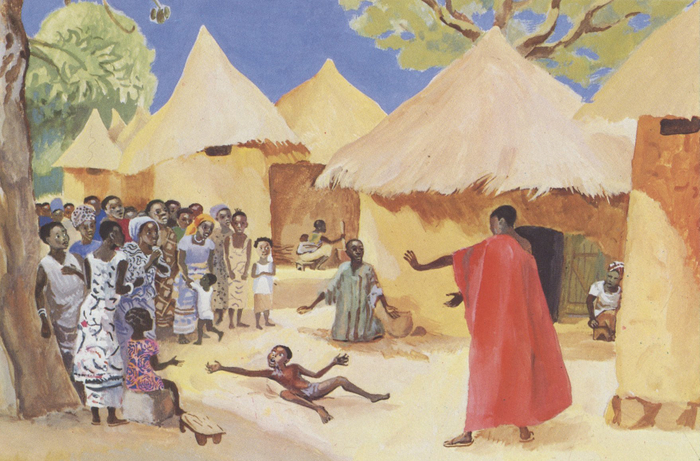
Jesus heals a boy

Image taken from the Wiedmann Bible. For more information about the images and ways to adopt them, see here .

For other images of Willy Wiedmann paintings in TIPs, see here.

Following is the 1973 painting “The Possessed” of the JESUS MAFA project, a response to New Testament readings from the Lectionary by a Christian community in Cameroon, Africa. Each of the readings was selected and adapted to dramatic interpretation by the community members. Photographs of their interpretations were made, and these were then transcribed to paintings:

From Art in the Christian Tradition , a project of the Vanderbilt Divinity Library, Nashville, TN. Image retrieved March 23, 2026. Original source: librairie-emmanuel.fr.

formal 2nd person plural pronoun (Japanese)

Click or tap here to see the rest of this insight.

Like a number of other East Asian languages, Japanese uses a complex system of honorifics, i.e. a system where a number of different levels of politeness are expressed in language via words, word forms or grammatical constructs. These can range from addressing someone or referring to someone with contempt (very informal) to expressing the highest level of reference (as used in addressing or referring to God) or any number of levels in-between.

One way Japanese shows different degree of politeness is through the choice of a formal plural suffix to the second person pronoun (“you” and its various forms) as shown here in the widely-used Japanese Shinkaiyaku (新改訳) Bible of 2017. In these verses, anata-gata (あなたがた) is used, combining the second person pronoun anata and the plural suffix -gata to create a formal plural pronoun (“you” [plural] in English).

(Source: S. E. Doi, see also S. E. Doi in Journal of Translation, 18/2022, p. 37ff. )