The Greek that is transliterated as “Nicodemus” in English is translated in Mandarin Chinese as Nígēdémù (尼哥德慕) in the Protestant tradition. This is an unremarkable transliteration if it were not for the transliteration that was used until a revision of the Union Version in 1988: Nígēdǐmǔ (尼哥底母) which could also be read as “mother of Ni’s older brother,” and which had become one of the most often-cited examples in calls for a revision. (Source: Zetzsche)
In Spanish Sign Language it is translated with with the signs for “thinking” and “bearded one” (the latter is used for “Pharisees”). (Source: Steve Parkhurst)
In the EnglishGood News Bible (2nd edition of 1992), this occurrence of the Greek hoi Ioudaioi, traditionally “the Jews” in English, is translated with a term that refers to the Jewish people or is not translated at all if it implicitly refers to the Jewish people (for example “Passover” instead of “Passover of the Jews”). For an explanation of the differentiated translation in English as well as translation choices in a number of languages, see the Jews.
“It is unusual for anyone to seek out another at night unless it is desired to be kept secret. Betel nut and condiments are laid out to welcome the guest even at the late hour. Nicodemus’s robe and bared shoulder show he is a religious devotee.”
For more images by Sawai Chinnawong in TIPs see here.
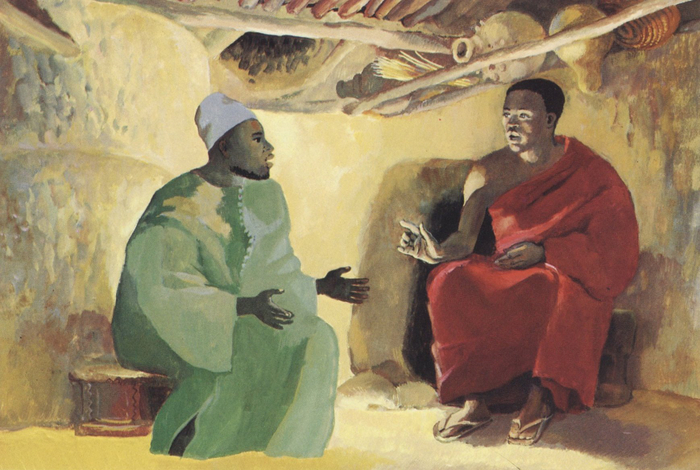
The following 1973 painting “Nicodemus” of the JESUS MAFA project is a response to New Testament readings from the Lectionary by a Christian community in Cameroon, Africa. Each of the readings was selected and adapted to dramatic interpretation by the community members. Photographs of their interpretations were made, and these were then transcribed to paintings:
Here we see Jesus patiently teaching about the kingdom of God to a perplexed Nicodemus, whose hands are in a gesture of questioning. Nicodemus has, like so many before and since, gotten caught up in the literal and limited understanding of the scriptures. Jesus attempted to explain the nature of reality in different terms that thereby he (and we) might be transformed. The boundaries we place on ourselves can be escaped if only we are brave enough to venture beyond them. Shall we remain in the cover of night with Nicodemus or step into the light that Jesus offers?
From Art in the Christian Tradition, a project of the Vanderbilt Divinity Library, Nashville, TN. Image retrieved March 23, 2026. Original source: librairie-emmanuel.fr.
Following are a number of back-translations of John 3:1:
Uma: “There was a man named Nikodemus. Nikodemus was a Parisi person and a leader of the Yahudi religion.” (Source: Uma Back Translation)
Yakan: “So-then there was a certain leader of the Yahudi called Nikodemus. He was a Pariseo.” (Source: Yakan Back Translation)
Western Bukidnon Manobo: “There was a person named Nicodemus. He was one of the group called Pharisees. As for this Nicodemus, he was one of the head men of the Jews.” (Source: Western Bukidnon Manobo Back Translation)
Kankanaey: “There was a leader of the Jews named Nicodemus who belonged to the party/group of the Pharisees.” (Source: Kankanaey Back Translation)
Tagbanwa: “There was a leader of the Judio whose name was Nicodemo. He was one of those called Pariseo.” (Source: Tagbanwa Back Translation)
Tenango Otomi: “There was a man who was a Pharisee named Nicodemus. This man was a boss of the Jews.” (Source: Tenango Otomi Back Translation)
The Greek that is a transliteration of the Hebrew Pərūšīm and is typically transliterated into English as “Pharisee” is transliterated in Mandarin Chinese as Fǎlìsài (法利賽 / 法利赛) (Protestant) or Fǎlìsāi (法利塞) (Catholic). In Chinese, transliterations can typically be done with a great number of different and identical-sounding characters. Often the meaning of the characters are not relevant, unless they are chosen carefully as in these cases. The Protestant Fǎlìsài can mean something like “Competition for the profit of the law” and the Catholic Fǎlìsāi “Stuffed by/with the profit of the law.” (Source: Zetzsche 1996, p. 51)
In Finnish Sign Language it is translated with the sign signifying “prayer shawl”. (Source: Tarja Sandholm)
Scot McKnight (in The Second Testament, publ. 2023) translates it into English as Observant. He explains (p. 302): “Pharisee has become a public, universal pejorative term for a hypocrite. Pharisees were observant of the interpretation of the Covenant Code called the ‘tradition of the elders.’ They conformed their behaviors to the interpretation. Among the various groups of Jews at the time of Jesus, they were perhaps closest to Jesus in their overall concern to make a radical commitment to the will of God (as they understood it).”
Illustration by Horst Lemke (1922-1985) for the GermanGute Nachricht für Sie – NT68, one of the first editions of the Good News Bible in German of 1968. Lemke was a well-known illustrator who illustrated books by Erich Kästner , Astrid Lindgren and many others.
This verse serves to introduce a new participant into the Gospel of John. Nicodemus is identified by name, by his relationship to his nation, and by his affiliations within the religious structure of his nation. In Greek, the introduction of these last two elements is in reverse order from the order in English, but in English it is easier to go from the more general (Jewish leader) to the particular (who belonged to the party of the Pharisees). The fact that Nicodemus was a Jewish leader probably means that he was a member of the Sanhedrin, the highest governing body of the Jewish people. This body was presided over by the High Priest, and most of its 70 members were Sadducees, but there were some Pharisees among its members.
In this context, a Jewish leader would not refer to a government official; it is best translated “an important man among the Jews.” The local equivalent in some receptor languages is “an elder among the Jews” or “a Jewish counselor,” referring to the position of the leading men in a society, who give their advice to a chief or king. Nicodemus is mentioned only in the Gospel of John; he appears again in 7.50 and in 19.39. Nicodemus is actually a Greek name, but it was not an unusual name among Jews.
In some languages it may be important to identify the nature of the party of the Pharisees by calling it “a religious group called Pharisees.” In any publication of a Gospel or New Testament, it is essential that such a term as Pharisees be properly identified in a glossary, so that some of the distinctive views and types of behavior characteristic of the Pharisees of biblical times may be understood.
Quoted with permission from Newman, Barclay M. and Nida, Eugene A. A Handbook on the Gospel of John. (UBS Handbook Series). New York: UBS, 1980. For this and other handbooks for translators see here .
This section tells about how a Pharisee called Nicodemus went to visit Jesus. Jesus told Nicodemus that all people need God to change them. Nicodemus could be sure that Jesus was speaking the truth because Jesus came from God.
Here are some other possible section headings:
Jesus told a Pharisee that he needed to change -or-
Everyone must be born again -or-
All people need God to give them a new birth/life
Paragraph 3:1–2
Jesus’ miracles impressed one of the Pharisees very much. His name was Nicodemus. He went to see Jesus at night, possibly so that other Jewish leaders would not know that he saw Jesus. He might have feared what they would think about him if they knew.
3:1a
Now there was a man of the Pharisees named Nicodemus: This is the beginning of the story. It tells who Nicodemus was. Introduce him in a way that is natural in your language.
Now: The common Greek conjunction de that the Berean Standard Bible translates as Now here introduces a new person in the story. It is not a time word. Introduce this new person in a way that is natural in your language. For example:
There was a man named Nicodemus who was one of the Pharisees (Contemporary English Version) -or-
One of the Pharisees, called Nicodemus (Revised English Bible)
a man of the Pharisees named Nicodemus: This phrase means that Nicodemus belonged to the Pharisee group or party. Here are other ways to translate this phrase:
a man named Nicodemus who was a Pharisee (Contemporary English Version) -or-
who belonged to the party of the Pharisees (Good News Translation)
Pharisees: The Pharisees were a Jewish religious group or party. It was very important to them to obey all of the Jewish religious laws carefully and exactly. See the note at 1:24 for examples of how to translate the word. Also see how you translated the word there.
See Pharisee in Key Biblical Terms.
3:1b
a leader of the Jews: The Greek phrase that the Berean Standard Bible translates literally as a leader of the Jews probably indicates that Nicodemus was a member of the Sanhedrin. The Sanhedrin was the highest governing body among the Jewish people. Here are other ways to translate this phrase:
an important Jewish leader (New Century Version) -or-
a member of the Jewish council (God’s Word) -or-
a Jewish religious leader (New Living Translation (2004))



Leave a Reply
You must be logged in to post a comment.