Like many languages (but unlike Greek or Hebrew or English), Tuvan uses a formal vs. informal 2nd person pronoun (a familiar vs. a respectful “you”). Unlike other languages that have this feature, however, the translators of the Tuvan Bible have attempted to be very consistent in using the different forms of address in every case a 2nd person pronoun has to be used in the translation of the biblical text.
As Voinov shows in Pronominal Theology in Translating the Gospels (in: The Bible Translator2002, p. 210ff. ), the choice to use either of the pronouns many times involved theological judgment. While the formal pronoun can signal personal distance or a social/power distance between the speaker and addressee, the informal pronoun can indicate familiarity or social/power equality between speaker and addressee.
Here, Jesus is addressing his disciples, individuals and/or crowds with the formal pronoun, showing respect.
In Nepali translations, Jesus addresses his disciples and other people with the medium honorific pronoun timīlē (तिमीले) or timīlēharū (तिमीलेहरू). His disciples respond with a high honorific pronoun. (Source: Chitra Chhetri in The Bible Translator 2009, p. 73ff. )
In most Dutch translations, Jesus addresses his disciples and common people with the informal pronoun, whereas they address him with the formal form.
Following are a number of back-translations of John 14:20:
Uma: “When that time comes, you will know that I am the one who is in-harmony [lit., mutual-life] with my Father, and you in-harmony with me, and I in-harmony with you.” (Source: Uma Back Translation)
Yakan: “When that day comes, you will know that my Father and I are one. And you will also know that you and I are one.” (Source: Yakan Back Translation)
Western Bukidnon Manobo: “And on the day when I return for you, you will know that we are only one, I and my Father. And as for you, you are here to me, and I am there to you.” (Source: Western Bukidnon Manobo Back Translation)
Kankanaey: “At that time, you will know that I am in my Father while also you are in me and I in you.” (Source: Kankanaey Back Translation)
Tagbanwa: “You will know on that day that I and my Father, we (excl.) are one living-entity, and I and you, there’s no longer any separating us.” (Source: Tagbanwa Back Translation)
Tenango Otomi: “On that day you will realize that I am in fellowship with my Father. And I am in fellowship with you.” (Source: Tenango Otomi Back Translation)
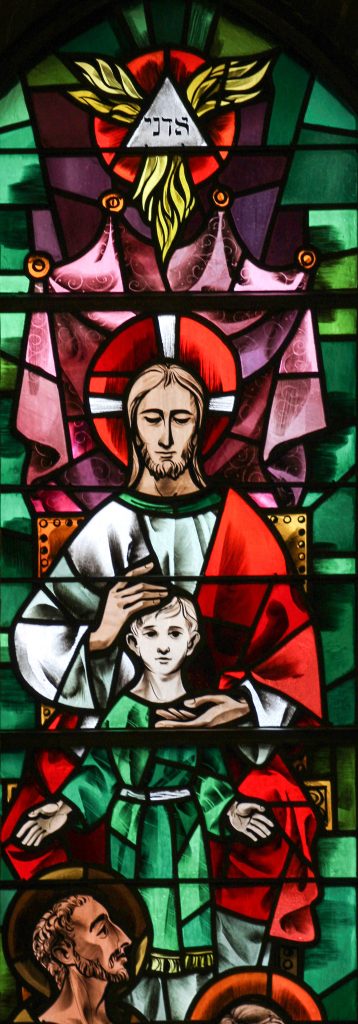
Stained glass is not just highly decorative, it’s a medium which has been used to express important religious messages for centuries. Literacy was not widespread in the medieval and Renaissance periods and the Church used stained glass and other artworks to teach the central beliefs of Christianity. In Gothic churches, the windows were filled with extensive narrative scenes in stained glass — like huge and colorful picture storybooks — in which worshipers could ‘read’ the stories of Christ and the saints and learn what was required for their religious salvation. (Source: Victoria and Albert Museum )
The Greek that is translated with the capitalized “Father” in English when referring to God is translated in Highland Totonac with the regular word for (biological) father to which a suffix is added to indicate respect. The same also is used for “Lord” when referring to Jesus. (Source: Hermann Aschmann in The Bible Translator 1950, p. 171ff. )
Like a number of other East Asian languages, Japanese uses a complex system of honorifics, i.e. a system where a number of different levels of politeness are expressed in language via words, word forms or grammatical constructs. These can range from addressing someone or referring to someone with contempt (very informal) to expressing the highest level of reference (as used in addressing or referring to God) or any number of levels in-between. In the widely-used Japanese Shinkaiyaku (新改訳) Bible of 2017, God the Father is addressed with mi-chichi (御父). This form has the “divine” honorific prefix mi– preceding the archaic honorific form chichi for “father.”
If, however, Jesus addresses his Father, he is using chichi-o (父を) which is also highly respectful but does not have the “divine” honorific. (Source: S. E. Doi, see also S. E. Doi in Journal of Translation, 18/2022, p. 37ff. )
Click or tap here to see the rest of this insight.
Like a number of other East Asian languages, Japanese uses a complex system of honorifics, i.e. a system where a number of different levels of politeness are expressed in language via words, word forms or grammatical constructs. These can range from addressing someone or referring to someone with contempt (very informal) to expressing the highest level of reference (as used in addressing or referring to God) or any number of levels in-between.
One way Japanese shows different degree of politeness is through the choice of a first person singular and plural pronoun (“I” and “we” and its various forms) as shown here in the widely-used Japanese Shinkaiyaku (新改訳) Bible of 2017. The most commonly used watashi/watakushi (私) is typically used when the speaker is humble and asking for help. In these verses, where God / Jesus is referring to himself, watashi is also used but instead of the kanji writing system (私) the syllabary hiragana (わたし) is used to distinguish God from others.
Click or tap here to see the rest of this insight.
Like a number of other East Asian languages, Japanese uses a complex system of honorifics, i.e. a system where a number of different levels of politeness are expressed in language via words, word forms or grammatical constructs. These can range from addressing someone or referring to someone with contempt (very informal) to expressing the highest level of reference (as used in addressing or referring to God) or any number of levels in-between.
One way Japanese shows different degree of politeness is through the choice of a formal plural suffix to the second person pronoun (“you” and its various forms) as shown here in the widely-used Japanese Shinkaiyaku (新改訳) Bible of 2017. In these verses, anata-gata (あなたがた) is used, combining the second person pronoun anata and the plural suffix -gata to create a formal plural pronoun (“you” [plural] in English).
Living Water is produced for the Bible translation movement in association with Lutheran Bible Translators. Lyrics derived from the ESV® Bible (The Holy Bible, English Standard Version®).
When that day comes (literally “on that day”) is used three times in John’s Gospel (here and in 16.23,26). Although in traditional biblical language the term refers to “the last day,” the day of God’s final intervention, in the present verse it refers to verse 18. Verses 18 and 20 both refer primarily to the time of Jesus’ resurrection, but the thought is obviously extended to the permanent presence of the risen Lord with his people everywhere.
It is essential that the time referred to by that day be understood as the time when the disciples would see Jesus again (verse 19) or when Jesus would live again (implied in verse 19). In some languages an equivalent of When that day comes may be “When that happens.” It may be made even more specific in some languages as “when I come back to life.”
Once again the pronouns you and I are emphatic.
I am in my Father is almost identical with I am in the Father (10.38). Note also 14.10-11 and 17.21-23. Die Bibel im heutigen Deutsch expresses this idea of oneness as “I am inseparably one with the Father. Even so shall you be one with me and I with you.” Here, as in the other passages listed, it may be difficult to express the idea of one person being in another person. It may be best expressed as “lives in” or “is united with” or even “is one with.” As in many similar contexts, expressions involving one person being in another may be expressed as “just like one”; for example, “I and my Father are just like one person, and you and I are just like one person.”
Quoted with permission from Newman, Barclay M. and Nida, Eugene A. A Handbook on the Gospel of John. (UBS Handbook Series). New York: UBS, 1980. For this and other handbooks for translators see here .

Leave a Reply
You must be logged in to post a comment.