38When Jesus turned and saw them following, he said to them, “What are you looking for?” They said to him, “Rabbi” (which translated means Teacher), “where are you staying?”
Like many languages (but unlike Greek or Hebrew or English), Tuvan uses a formal vs. informal 2nd person pronoun (a familiar vs. a respectful “you”). Unlike other languages that have this feature, however, the translators of the Tuvan Bible have attempted to be very consistent in using the different forms of address in every case a 2nd person pronoun has to be used in the translation of the biblical text.
As Voinov shows in Pronominal Theology in Translating the Gospels (in: The Bible Translator2002, p. 210ff. ), the choice to use either of the pronouns many times involved theological judgment. While the formal pronoun can signal personal distance or a social/power distance between the speaker and addressee, the informal pronoun can indicate familiarity or social/power equality between speaker and addressee.
Here, Jesus is addressing his disciples, individuals and/or crowds with the formal pronoun, showing respect.
In Nepali translations, Jesus addresses his disciples and other people with the medium honorific pronoun timīlē (तिमीले) or timīlēharū (तिमीलेहरू). His disciples respond with a high honorific pronoun. (Source: Chitra Chhetri in The Bible Translator 2009, p. 73ff. )
In most Dutch translations, Jesus addresses his disciples and common people with the informal pronoun, whereas they address him with the formal form.
Like many languages (but unlike Greek or Hebrew or English), Tuvan uses a formal vs. informal 2nd person pronoun (a familiar vs. a respectful “you”). Unlike other languages that have this feature, however, the translators of the Tuvan Bible have attempted to be very consistent in using the different forms of address in every case a 2nd person pronoun has to be used in the translation of the biblical text.
As Voinov shows in Pronominal Theology in Translating the Gospels (in: The Bible Translator2002, p. 210ff. ), the choice to use either of the pronouns many times involved theological judgment. While the formal pronoun can signal personal distance or a social/power distance between the speaker and addressee, the informal pronoun can indicate familiarity or social/power equality between speaker and addressee.
John addresses Jesus with the formal pronoun
Voinov explains: “This relationship is somewhat complicated. John and Jesus are relatives, John being the older. However, John recognizes Jesus as more important than himself, as the Messiah whose sandal straps he is not worthy to untie (Mark 1:7). At the same time, Jesus highly respects John, submitting to the inferior position by receiving John’s baptism, and later calling him the greatest among the prophets (Matt 11:7-15). In the Tuvan translation, we finally decided that the overall circumstances indicate that John addresses Jesus with the formal pronoun as a sign of respect.”
The Greek in John 1:38 that is translated in English as “What are you looking for?” or similar is translated in Huehuetla Tepehua as “What are you hunting for?” (Source: Larson 1998, p. 221)
The Hebrew word that is transliterated in Greek and typically in English as “rabbi” is translated in Indonesian and Malay as guru — “teacher” — or bapak guru — “father teacher” in recent translations. (The only exception that is the Alkitab Versi Borneo of 2015 that transliterates as rabi.) (Source: Daud Soesilo in The Bible Translator 1996, p. 335ff. )
In the Yatzachi Zapotec translation of the Gospel of John, any reference to the evangelist and presumed narrator is done in the first person.
The translator Inez Butler explains (in: Notes on Translation, September 1967, pp. 10ff.):
“In revising the Gospel of John in Yatzachi Zapotec we realized from the start that the third person references of Jesus to himself as Son of Man had to be converted into first person references, but only more recently have we decided that similar change is necessary in John’s references to himself as ‘the disciple whom Jesus loved.’ As I worked on those changes and questioned the informant about his understanding of other passages in the Gospel, I discovered that the reader misses the whole focus of the book as an eyewitness account unless every reference to the disciples indicates the writer’s membership in the group. In view of that we went back through the entire book looking for ways to cue in the reader to the fact that John was an eyewitness and a participant in a many of the events, as well as the historian.
“When the disciples were participants in events along with Jesus, it was necessary to make explicit the fact that they accompanied him, although in the source language that is left implicit, since otherwise our rendering would imply that they were not present.”
In this verse, the Yatzachi Zapotec says: “Jesus turned and saw that we were following him. And he said to us, “What do you want?” And we said to him, “Teacher, where do you live?””
Following are a number of back-translations of John 1:38:
Uma: “Yesus turned around, he saw them following him. He asked him: ‘What are you looking for?’ They said to him: ‘Where are you (sing.) staying, Teacher?'” (Source: Uma Back Translation)
Yakan: “When Isa turned around, he saw the two following him. He asked them, he said, ‘What do you want (lit. what is your business)?’ They answered, they said, ‘Rabbi, (that means Teacher) where are you staying?'” (Source: Yakan Back Translation)
Western Bukidnon Manobo: “Jesus stopped and turned around, and he saw that they were coming with him, and he said, ‘Why are you following me?’ And they said, ‘Rabbi, (which is to say, Teacher) where do you live?'” (Source: Western Bukidnon Manobo Back Translation)
Kankanaey: “Jesus looking-back then, he saw the ones following him and he said to them, ‘Do you have something to ask?’ ‘Where are you (sing.) staying Rabbi?’ they said in reply. (The meaning of Rabbi, it is teacher.)” (Source: Kankanaey Back Translation)
Tagbanwa: “Jesus turned-his-head and saw those two who were following after him. He asked them, ‘Where are you going? Seems like there’s something/someone you are looking for.’ They answered, ‘Excuse (us), Teacher, where are you staying?'” (Source: Tagbanwa Back Translation)
Tenango Otomi: “Jesus turned and saw that they were following. He said, ‘What do you want?’ They said, ‘Teacher, where are you staying?'” (Source: Tenango Otomi Back Translation)
Like many languages (but unlike Greek or Hebrew or English), Tuvan uses a formal vs. informal 2nd person pronoun (a familiar vs. a respectful “you”). Unlike other languages that have this feature, however, the translators of the Tuvan Bible have attempted to be very consistent in using the different forms of address in every case a 2nd person pronoun has to be used in the translation of the biblical text.
As Voinov shows in Pronominal Theology in Translating the Gospels (in: The Bible Translator2002, p. 210ff. ), the choice to use either of the pronouns many times involved theological judgment. While the formal pronoun can signal personal distance or a social/power distance between the speaker and addressee, the informal pronoun can indicate familiarity or social/power equality between speaker and addressee.
Here, individual or several disciples address Jesus with the formal pronoun, expressing respect. Compare this to how that address changes after the resurrection.
In most Dutch as well as in Western Frisian, Gronings, and Afrikaans translations, the disciples address Jesus before and after the resurrection with the formal pronoun.
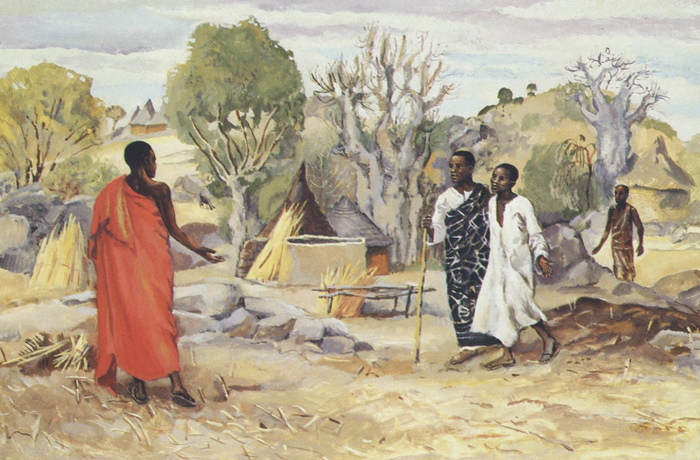
Following is a 1973 painting of the JESUS MAFA project, a response to New Testament readings from the Lectionary by a Christian community in Cameroon, Africa. Each of the readings was selected and adapted to dramatic interpretation by the community members. Photographs of their interpretations were made, and these were then transcribed to paintings:
From Art in the Christian Tradition, a project of the Vanderbilt Divinity Library, Nashville, TN. Image retrieved March 23, 2026. Original source: librairie-emmanuel.fr.

Leave a Reply
You must be logged in to post a comment.