
Illustration by Annie Vallotton, copyright by Donald and Patricia Griggs of Griggs Educational Service. More images can be viewed at rotation.org .
For other images by Annie Vallotton on Translation Insights & Perspectives, see here.

λέγει αὐτοῖς, Ἔρχεσθε καὶ ὄψεσθε. ἦλθαν οὖν καὶ εἶδαν ποῦ μένει καὶ παρ᾽ αὐτῷ ἔμειναν τὴν ἡμέραν ἐκείνην· ὥρα ἦν ὡς δεκάτη.
39He said to them, “Come and see.” They came and saw where he was staying, and they remained with him that day. It was about four o’clock in the afternoon.
Illustration by Annie Vallotton, copyright by Donald and Patricia Griggs of Griggs Educational Service. More images can be viewed at rotation.org .
For other images by Annie Vallotton on Translation Insights & Perspectives, see here.
Like many languages (but unlike Greek or Hebrew or English), Tuvan uses a formal vs. informal 2nd person pronoun (a familiar vs. a respectful “you”). Unlike other languages that have this feature, however, the translators of the Tuvan Bible have attempted to be very consistent in using the different forms of address in every case a 2nd person pronoun has to be used in the translation of the biblical text.
As Voinov shows in Pronominal Theology in Translating the Gospels (in: The Bible Translator 2002, p. 210ff. ), the choice to use either of the pronouns many times involved theological judgment. While the formal pronoun can signal personal distance or a social/power distance between the speaker and addressee, the informal pronoun can indicate familiarity or social/power equality between speaker and addressee.
Here, Jesus is addressing his disciples, individuals and/or crowds with the formal pronoun, showing respect.
In Nepali translations, Jesus addresses his disciples and other people with the medium honorific pronoun timīlē (तिमीले) or timīlēharū (तिमीलेहरू). His disciples respond with a high honorific pronoun. (Source: Chitra Chhetri in The Bible Translator 2009, p. 73ff. )
In most Dutch translations, Jesus addresses his disciples and common people with the informal pronoun, whereas they address him with the formal form.
The name that is transliterated as “Simon (Peter)” in English is translated in Libras (Brazilian Sign Language) with a sign that combines a reference to “Peter” (see here for the Libras translation of “Peter”) and “son” (of Jonah / John). (Source: Missão Kophós )
“Simon” in Libras (source )
See also Peter.
For more information on translations of proper names with sign language see Sign Language Bible Translations Have Something to Say to Hearing Christians .
Following is a 1973 painting of the JESUS MAFA project, a response to New Testament readings from the Lectionary by a Christian community in Cameroon, Africa. Each of the readings was selected and adapted to dramatic interpretation by the community members. Photographs of their interpretations were made, and these were then transcribed to paintings:
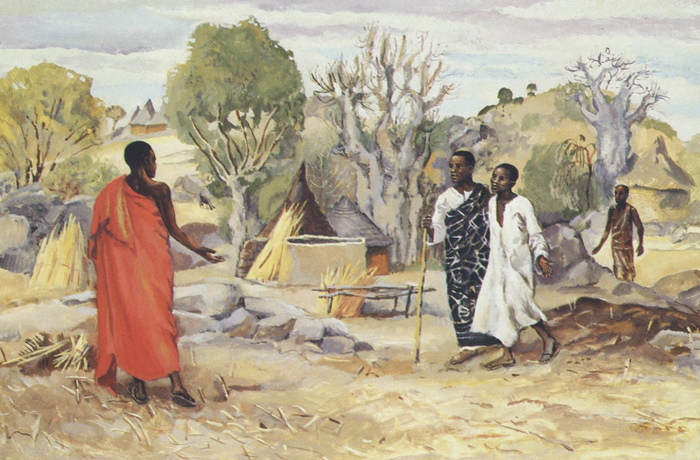
From Art in the Christian Tradition , a project of the Vanderbilt Divinity Library, Nashville, TN. Image retrieved March 23, 2026. Original source: librairie-emmanuel.fr.
In the Yatzachi Zapotec translation of the Gospel of John, any reference to the evangelist and presumed narrator is done in the first person.
The translator Inez Butler explains (in: Notes on Translation, September 1967, pp. 10ff.):
“In revising the Gospel of John in Yatzachi Zapotec we realized from the start that the third person references of Jesus to himself as Son of Man had to be converted into first person references, but only more recently have we decided that similar change is necessary in John’s references to himself as ‘the disciple whom Jesus loved.’ As I worked on those changes and questioned the informant about his understanding of other passages in the Gospel, I discovered that the reader misses the whole focus of the book as an eyewitness account unless every reference to the disciples indicates the writer’s membership in the group. In view of that we went back through the entire book looking for ways to cue in the reader to the fact that John was an eyewitness and a participant in a many of the events, as well as the historian.
“When the disciples were participants in events along with Jesus, it was necessary to make explicit the fact that they accompanied him, although in the source language that is left implicit, since otherwise our rendering would imply that they were not present.”
In this verse, the Yatzachi Zapotec says: “Then he said to us, “Come and see.” And we went with him and saw where he lived and we stayed with him a few hours, because at that time it was already about four o’clock.”
Following are a number of back-translations of John 1:39:
The following is a contemporary stained glass window by Cláudio Pastro from the Mosteiro Beneditino do Encontro in Parana, Brazil:

Source: Art in the Christian Tradition , a project of the Vanderbilt University Divinity Library, Nashville, TN. Original source: Wikimedia
Stained glass is not just highly decorative, it’s a medium which has been used to express important religious messages for centuries. Literacy was not widespread in the medieval and Renaissance periods and the Church used stained glass and other artworks to teach the central beliefs of Christianity. In Gothic churches, the windows were filled with extensive narrative scenes in stained glass — like huge and colorful picture storybooks — in which worshipers could ‘read’ the stories of Christ and the saints and learn what was required for their religious salvation. (Source: Victoria and Albert Museum )
Like a number of other East Asian languages, Japanese uses a complex system of honorifics, i.e. a system where a number of different levels of politeness are expressed in language via words, word forms or grammatical constructs. These can range from addressing someone or referring to someone with contempt (very informal) to expressing the highest level of reference (as used in addressing or referring to God) or any number of levels in-between.
One way Japanese shows different degree of politeness is through the usage of an honorific construction where the morphemes rare (られ) or are (され) are affixed on the verb as shown here in the widely-used Japanese Shinkaiyaku (新改訳) Bible of 2017. This is particularly done with verbs that have God as the agent to show a deep sense of reverence. Here, tomatteo-rare-ru (泊まっておられる) or “staying” and iw-are-ru (言われる) or “say” are used.
Also, a benefactive construction is used. Here, aratte (洗って) or “wash” is used in combination with kudasaru (くださる), a respectful form of the benefactive kureru (くれる). A benefactive reflects the good will of the giver or the gratitude of a recipient of the favor. To convey this connotation, English translation needs to employ a phrase such as “for me (my sake)” or “for you (your sake).”
(Source: S. E. Doi, see also S. E. Doi in Journal of Translation, 18/2022, p. 37ff. )
No comments yet.

Leave a Reply
You must be logged in to post a comment.