The name that is transliterated as “Elisha” in English means “God the Savior,” “to whom God is salvation,” “God of salvation,” “God is Savior.” (Source: Cornwall / Smith 1997 )
In Finnish Sign Language it is translated with the sign signifying “help + prophet.” (Source: Tarja Sandholm)
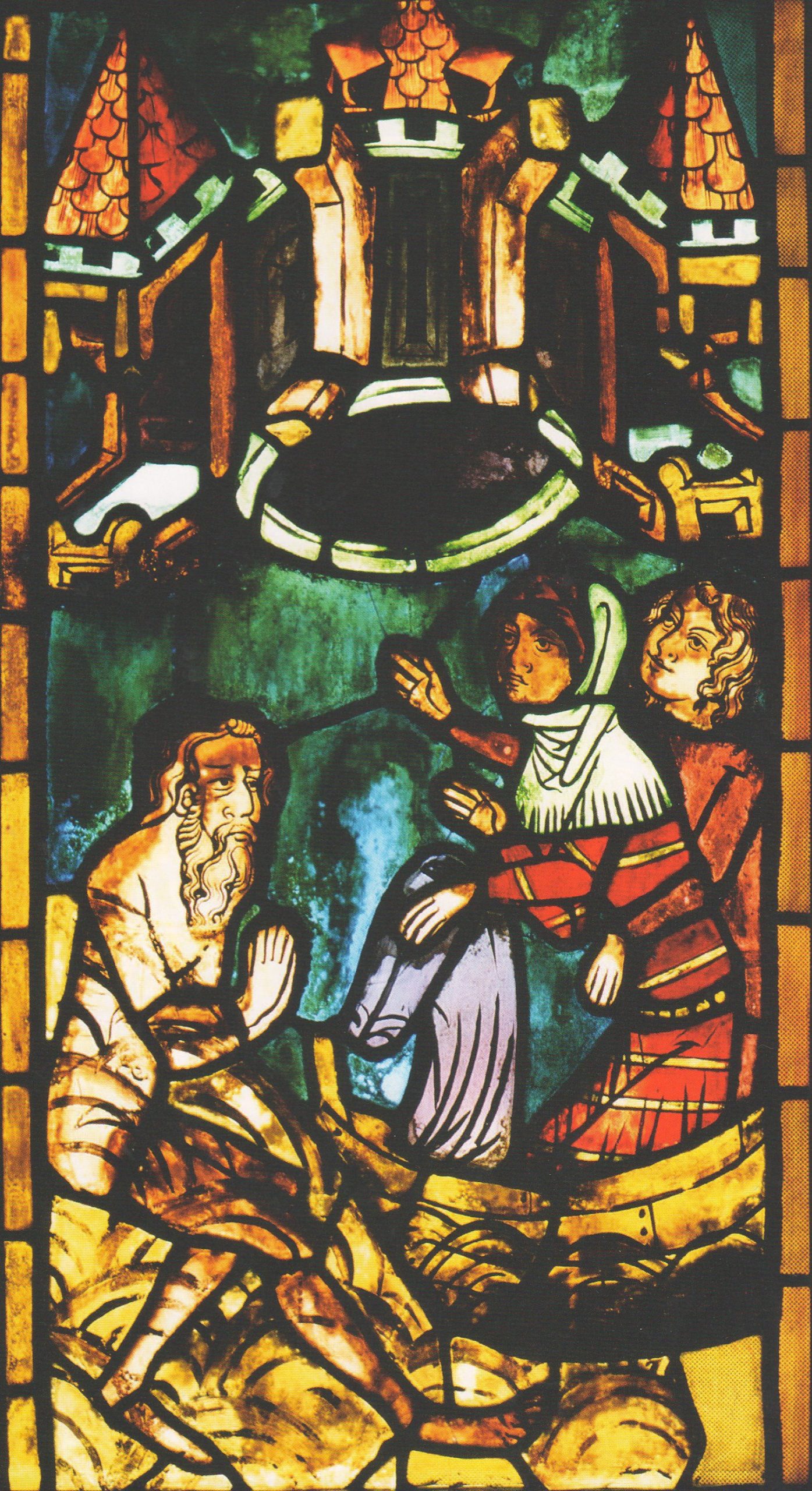
The following is a stained glass window from the Three choir windows in the Marienkirche, Frankfurt (Oder), Germany, of the 14th century, depicting the healing of Naaman:
Source: Der gläserne Schatz: Die Bilderbibel der St. Marienkirche in Frankfurt (Oder), Neuer Berlin Verlag, 2005, copyright for this image: Brandenburgisches Landesamt für Denkmalpflege und Archäologisches Landesmuseum
Stained glass is not just highly decorative, it’s a medium which has been used to express important religious messages for centuries. Literacy was not widespread in the medieval and Renaissance periods and the Church used stained glass and other artworks to teach the central beliefs of Christianity. In Gothic churches, the windows were filled with extensive narrative scenes in stained glass — like huge and colorful picture storybooks — in which worshipers could ‘read’ the stories of Christ and the saints and learn what was required for their religious salvation. (Source: Victoria and Albert Museum )
The Hebrew, Latin, Ge’ez, and Greek that is translated into English as “chariot” is translated into Anuak as “canoe pulled by horse.” “Canoe” is the general term for “vehicle” (source: Loren Bliese). Similarly it is translated in Lokạạ as ukwaa wạ nyanyang ntuuli or “canoe that is driven by horses.” (Source: J.A. Naudé, C.L. Miller Naudé, J.O. Obono in Acta Theologica 43/2, 2023, p. 129ff. )
Other translations include:
Chichicapan Zapotec: “ox cart” (in Acts 8) (ox carts are common vehicles for travel) (source: Loren Bliese)
Chichimeca-Jonaz, it is translated as “little house with two feet pulled by two horses” (source: Viola Waterhouse in Notes on Translation August 1966, p. 86ff.)
HausaCommon Language Bible as keken-doki or “cart of donkey” (source: Andy Warren-Rothlin)
Following are a number of back-translations as well as a sample translation for translators of 2 Kings 5:9:
Kupsabiny: “(Then) Naaman went with his horses and chariots/carts and came to a stop at the entrance of the home of Elisha.” (Source: Kupsabiny Back Translation)
Newari: “So Naaman, taking his horse and chariot, came to Elisha’s house, and stood at the gate.” (Source: Newari Back Translation)
Hiligaynon: “So Naaman went with his horses and chariot and stopped at the door of the house of Elisha.” (Source: Hiligaynon Back Translation)
English: “So Naaman went with his horses and chariots to Elisha’s house and waited outside the door.” (Source: Translation for Translators)
So: The common Hebrew conjunction here is usually expressed by a logical connector in English versions (Revised Standard Version, Good News Translation, New International Version, New Jewish Publication Society’s Tanakh, New Jerusalem Bible, New Revised Standard Version), but in others it is omitted altogether (New American Bible).
Naaman came: The perspective of the writer seems to be with Elisha, but in many languages it will be more natural to use the verb “went” as in Good News Translation.
Horses and chariots: In Hebrew both nouns here are singular (so Hobbs), although some Hebrew manuscripts have “horses and chariot” (so Good News Translation, New Jerusalem Bible, Nouvelle Bible Segond, Traduction œcuménique de la Bible, La Bible Pléiade). Some manuscripts of the Septuagint read both nouns as plural. It is also possible to take the noun “chariot” as a collective noun, that is, plural in meaning. The majority of modern translations have both nouns in plural form and this is recommended to translators.
Halted: The Hebrew verb here is translated “waited” by Cogan and Tadmor (also New Living Translation), who maintain that “the present verse is misconstrued by all modern versions” (page 64). However, any significant difference in meaning between halted and “waited” is slight and not important.
Quoted with permission from Omanson, Roger L. and Ellington, John E. A Handbook on 1-2 Kings, Volume 2. (UBS Helps for Translators). New York: UBS, 2008. For this and other handbooks for translators see here .



Leave a Reply
You must be logged in to post a comment.